
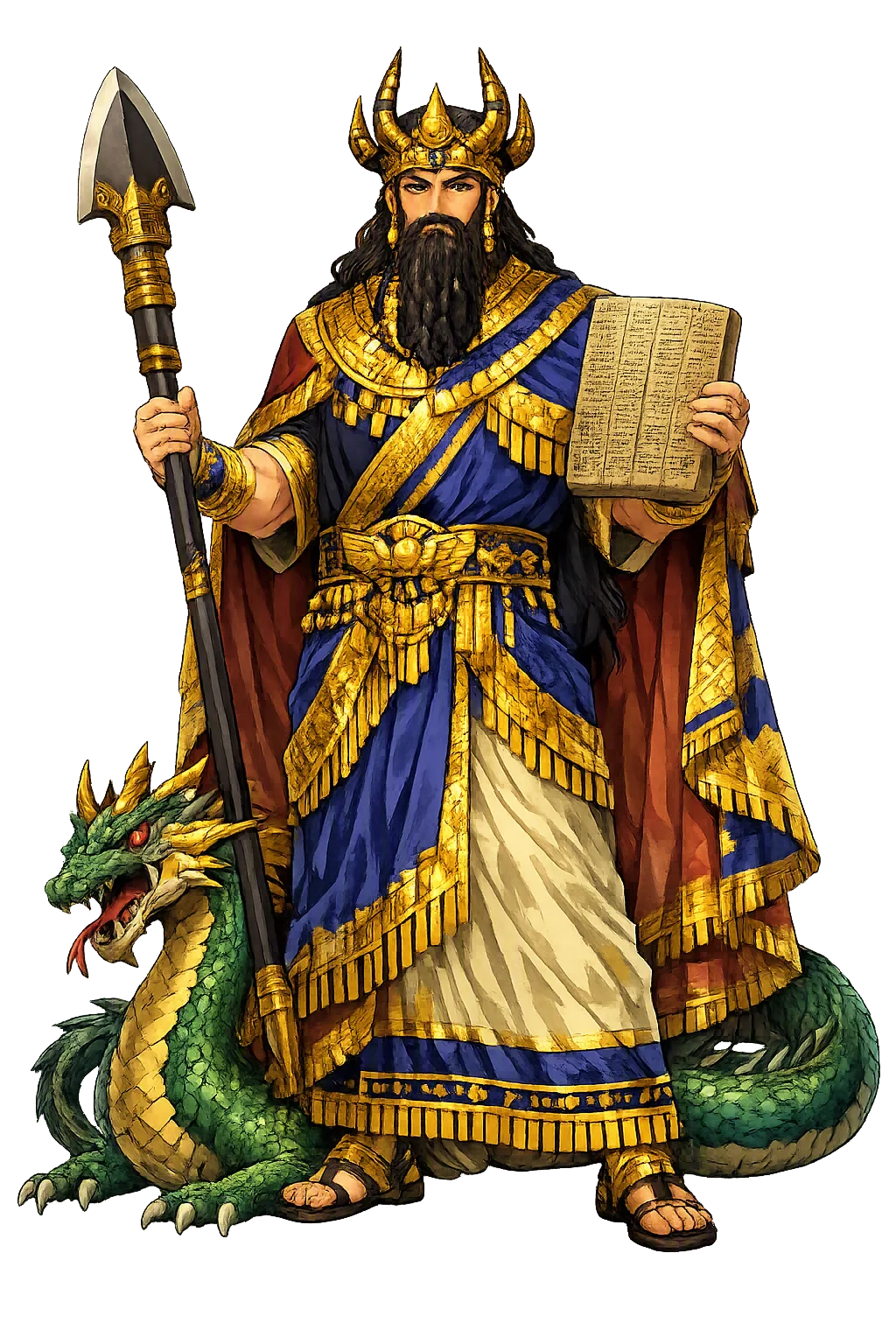
Marduk walks into a leadership, governance & public administration firm
Somewhere right now, in a leadership, governance & public administration office, someone is doing exactly what the myths describe — and has never heard of Marduk. This file is the introduction.
Before the Office, the Story
Marduk Slays Tiāmat and Builds the World. In the Babylonian Enuma Elish ('When on High', tablets I–VII), the younger gods disturb the primordial pair Apsu and Tiāmat. After Apsu is killed, Tiāmat raises an army of monsters under the rebel god Kingu to avenge him. Marduk alone accepts the challenge, on condition that the gods grant him supreme kingship.
Marduk Receives His Names. The seventh and final tablet of the Enuma Elish lists Marduk's fifty names, each explained as a function or title he has absorbed from older gods. Anu, Enlil, and Ea yield aspects of their sovereignty to him; his names declare him creator, provider, judge, and shepherd. This is not mere praise but theological consolidation: by naming, the older pantheon legally transfers cosmic authority to Babylon's patron deity.
At a Glance
- Temple: Marduk
- Pantheon: Mesopotamian
- Domain of influence: Creation, Babylon, Storms
- Pattern seats: 4
- Sectors touched: Commerce & Governance · Home & Lifestyle
- Strongest seat: Leadership, Governance & Public Administration
- Series: The Resonance Files, No. 301 of 548
The Reveal, Seat by Seat
Leadership, Governance & Public Administration
Marduk is the paradigmatic sovereign of the Mesopotamian pantheon: the deity who receives kingship from the gods, exercises it through decree and combat, and serves as the divine model for Babylonian rulership. The match is not poetic license. Strip the trade to its function and the function is the myth.
Legal, Justice & Compliance
Now read the why-line with the office in mind: The Enuma Elish makes Marduk the one who 'decrees destinies' (parāsu), and Hammurabi's law code presents him as the source of the king's mandate to 'cause justice to prevail in the land.' The people doing this work did not borrow the archetype. They re-derived it — the way Marduk was always going to be re-derived wherever creation, babylon, storms matters.
Architecture & Spatial Design
Now read the why-line with the office in mind: Marduk divides Tiamat's corpse to form heaven and earth, establishes the cosmic axes, and is worshipped at Esagila and Etemenanki — the architectural expressions of an ordered cosmos. The people doing this work did not borrow the archetype. They re-derived it — the way Marduk was always going to be re-derived wherever creation, babylon, storms matters.
Defense, Military & Security
He leads the divine army against Tiamat's host, wields bow, mace, and the four winds as weapons, and is invoked as the divine protector of Babylon. Nobody in that trade worships at this temple. They just keep its hours.
Not the First Rebrand
Marduk absorbed functions from Enlil (kingship and the decree of destinies), Ea/Enki (wisdom and water), and Šamaš (justice and solar radiance). His rise parallels the political rise of Babylon: when Babylon was small, he was a local storm-god; when Babylon became an imperial capital, he became king of the gods. The office is only the latest translation.
The Method, Stated Plainly
Skeptical? Good — the system is built for you. Every seat in this file carries its why-line and its weight, the full derivation is public at the methodology page, and the challenge process is part of the design. Falsifiable is not a posture here; it is the mechanism.
For the Ones Who Work There
For a sponsor in leadership, governance & public administration, the fit here is not adjacency — it is inheritance. Your trade already tells this story every working day; the temple simply holds the original. The patron tier and the advertising terms carry the mechanics; the myths above carry the reason.
The File Continues
This is one of 548 Resonance Files — the third dispatch from every flagship temple, where the myths meet the markets. The temple's founding dispatch tells the name's story; its Restoration File tells the spelling's; the blog index holds the whole archive.
Continue the series — previous: Māra (read it) · next: Marishiten (read it).
The Resonance Files are argued from the same canonical record as the pattern atlas itself: the lexicon, the lore catalog, and the cited sources. Every seat can be challenged at the methodology page — and the challenge is the point.