PuniCodex

Extended Lore

𒀭𒀫𒌅 Marduk

Etymology · Phonology · Orthography · Cultural Legacy · Primary Sources

Tier 2 Marduk
Marduk — Creation, Babylon, Storms
01

Quick Facts

Essential information about Marduk, Creation, Babylon, Storms

Original Script𒀭𒀫𒌅
Unicode RestorationMarduk
Reconstructed Pronunciation/marˈduk/
PantheonMesopotamian
DomainCreation, Babylon, Storms
MeaningSolar calf (Akkadian Marduk)
ClassificationTier 2
Primary DomainMarduk
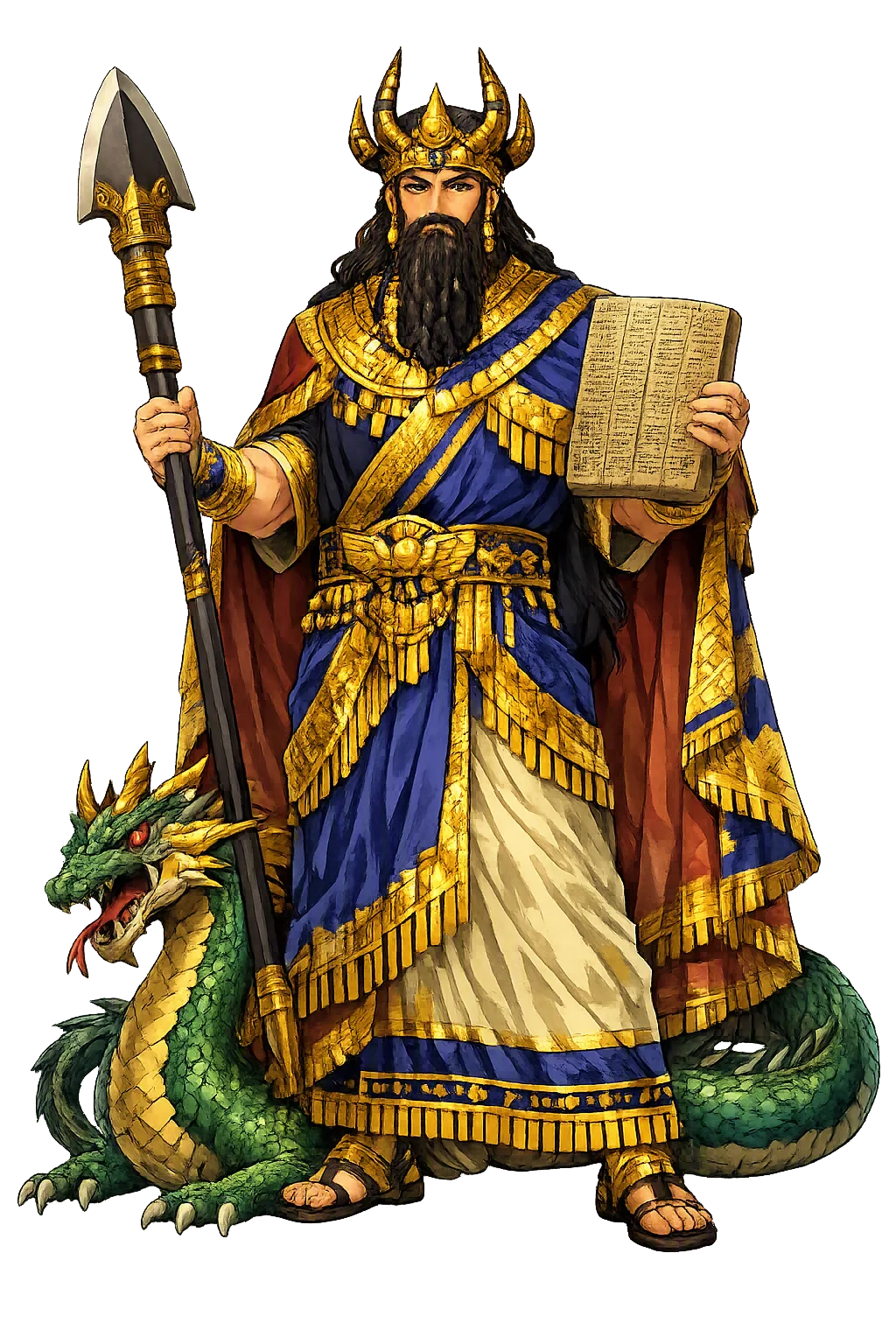
Sacred SymbolsWinged sun-disc, Spade or triangular hoe (šaruḫu), Mušḫuššu dragon, Four winds, Ziggurat / cosmic mountain
02

Etymology & Word Family

From original script to Unicode restoration

Original Script 𒀭𒀫𒌅 Marduk — "Solar calf (Akkadian Marduk)"
Unicode Restoration Marduk Restored stress, length, and script
Modern ASCII marduk Plain-ASCII fallback

Marduk is Tier 2: the canonical Unicode restoration is the plain Latin form Marduk, which preserves no diacritic, long-vowel mark, or distinctive non-ASCII letter. A scholarly variant Mardūk with a final macron is sometimes used to mark a posited long vowel, but PuniCodex follows the lexicon's attested conventional form. The tier classification therefore reflects the name's ASCII-canonicality, not its religious or mythological importance.

03

Unicode Character Breakdown

Character-by-character philological analysis

CharacterUnicodeNameBlockPhonetic Role
MU+004DLatin Capital Letter MBasic LatinSame
aU+0061Latin Small Letter ABasic LatinSame
rU+0072Latin Small Letter RBasic LatinSame
dU+0064Latin Small Letter DBasic LatinSame
uU+0075Latin Small Letter UBasic LatinSame
kU+006BLatin Small Letter KBasic LatinSame

The Tier 2 classification reflects how much of the original phonology this restoration preserves — stress and vowel length for Greek names, distinctive letters and diacritics for every other tradition.

04

Cultural Significance

From ancient cult to modern Unicode

Ancient Domain

Marduk began as a local storm-god of Babylon and rose, by the first millennium BCE, to become the supreme head of the Mesopotamian pantheon. His name, written 𒀭𒀫𒌓 (dAMAR.UTU), means 'calf of the sun' — a theophoric compound that binds the young animal to the solar god Šamaš. In the Babylonian Enuma Elish, Marduk defeats the primordial sea Tiamat, splits her body to fashion heaven and earth, and receives from the assembled gods the kingship of the cosmos. This temple treats him as the paradigm of legitimate sovereignty: the deity who turns chaos into order by decree, combat, and architecture.

His city, Babylon, was both a political capital and a theological statement. Its ziggurat Etemenanki ('Temple of the Foundation of Heaven and Earth') and its temple complex Esagila were understood as the axis where Marduk's cosmic order touched the ground. Kings from Hammurabi to Nebuchadnezzar II ruled by his mandate, and the king's first duty was to maintain Marduk's cult. Justice, law, and the measured world were therefore extensions of his domain.

Marduk in Later Traditions

Marduk absorbed functions from Enlil (kingship and the decree of destinies), Ea/Enki (wisdom and water), and Šamaš (justice and solar radiance). His rise parallels the political rise of Babylon: when Babylon was small, he was a local storm-god; when Babylon became an imperial capital, he became king of the gods. The Greeks identified him with Zeus Belos (Bel = Baal = 'Lord'), and Berossus transmitted Marduk-Bel to the Hellenistic world as the civic god of Babylon. In Jewish and early Christian exegesis, the figure of Bel and the dragon (Daniel 14) preserves a polemical memory of Marduk's cult statue and animal. No later deity exactly reproduces Marduk's combination of storm-combat, cosmic architecture, and urban kingship.

Modern Legacy

Marduk's most visible survival is architectural: the Ishtar Gate of Babylon, now in the Pergamon Museum, is glazed in the deep lapis-blue and gold associated with his city, and its processional way is lined with mušḫuššu dragons and aurochs. The tower of Babel narrative in Genesis 11 almost certainly reflects the memory of Etemenanki. In modern fantasy and games, Marduk appears as a dragon-slaying storm-god and as the namesake of Babylonian magic. The name still means: the sovereign who turns chaos into a city.

Unicode Restoration as Cultural Act

Restoring Marduk in a domain name is more than orthographic accuracy. It is a statement that the internet should recognize the full range of human writing — not only the ASCII keyboard.

05

Frequently Asked Questions

Common questions about Marduk, Creation, Babylon, Storms, and Unicode restoration

01How do you pronounce Marduk?

In reconstructed pronunciation, Marduk is /marˈduk/ — approximately 'mar-DOOK' — stress the second syllable; the final vowel is short in the everyday transliteration, though some scholars posit an original long /uː/..

02What does Marduk mean?

Marduk means Solar calf (Akkadian Marduk) in the mesopotamian tradition.

03What are the symbols of Marduk?

Marduk is associated with Winged sun-disc (The emblem of solar kingship and Marduk's link to the sun-god Šamaš), Spade or triangular hoe (šaruḫu) (Marduk's primary attribute, the tool with which he shapes land and clears the primordial waters), Mušḫuššu dragon (The snake-dragon hybrid that serves as Marduk's sacred animal, seen on the Ishtar Gate), Four winds (The winds Marduk deploys as weapons and messengers in the chaos-battle), Ziggurat / cosmic mountain (Etemenanki as the axis between heaven and earth, the material form of Marduk's ordered cosmos).

04Why restore Marduk in Unicode?

Plain ASCII marduk strips the stress, length, and script that make the name specific. Unicode restoration returns the name to its original written dignity.

05What is the most important myth about Marduk?

In the Babylonian Enuma Elish ('When on High'), the younger gods disturb the primordial Apsu and Tiamat. After Apsu is killed, Tiamat raises an army of monsters to avenge him. Marduk alone accepts the challenge, on condition that the gods grant him supreme kingship. He rides into battle in a storm-chariot drawn by four fearful creatures, surrounds Tiamat with the four winds, and splits her body with his bow and mace. From one half he makes the sky; from the other, the earth. He fixes the stars, the moon, and the calendar, then creates humankind from the blood of the slain god Kingu to serve the gods. The poem is both creation myth and charter for Marduk's cult in Babylon.

06

Scholarly Sources

The philological foundations of this restoration

Every claim on this page is grounded in established scholarship. The orthographic restorations follow disciplinary convention. The etymological chain follows the best available reference works. This is not invention — it is resurrection through scholarship.

Lexicography & Philology

  • CAD
  • AHw

Primary Texts

  • The Epic of Gilgamesh; Sumerian temple hymns and Akkadian ritual texts.

Archaeology & Art History

  • Material evidence — iconography, inscriptions, and temple archaeology — for Marduk and related cults.

Religious Studies

  • ETCSL
  • CAD
  • AHw
  • Foster, Before the Muses
  • George, House Most High
  • Black & Green, Gods, Demons and Symbols of Ancient Mesopotamia
Return

The Surface Awaits

You have traced the name from its earliest attestation to its Unicode restoration. Now return to the myth. The story is where the name lives.

Back to Lore
Marduk mascot