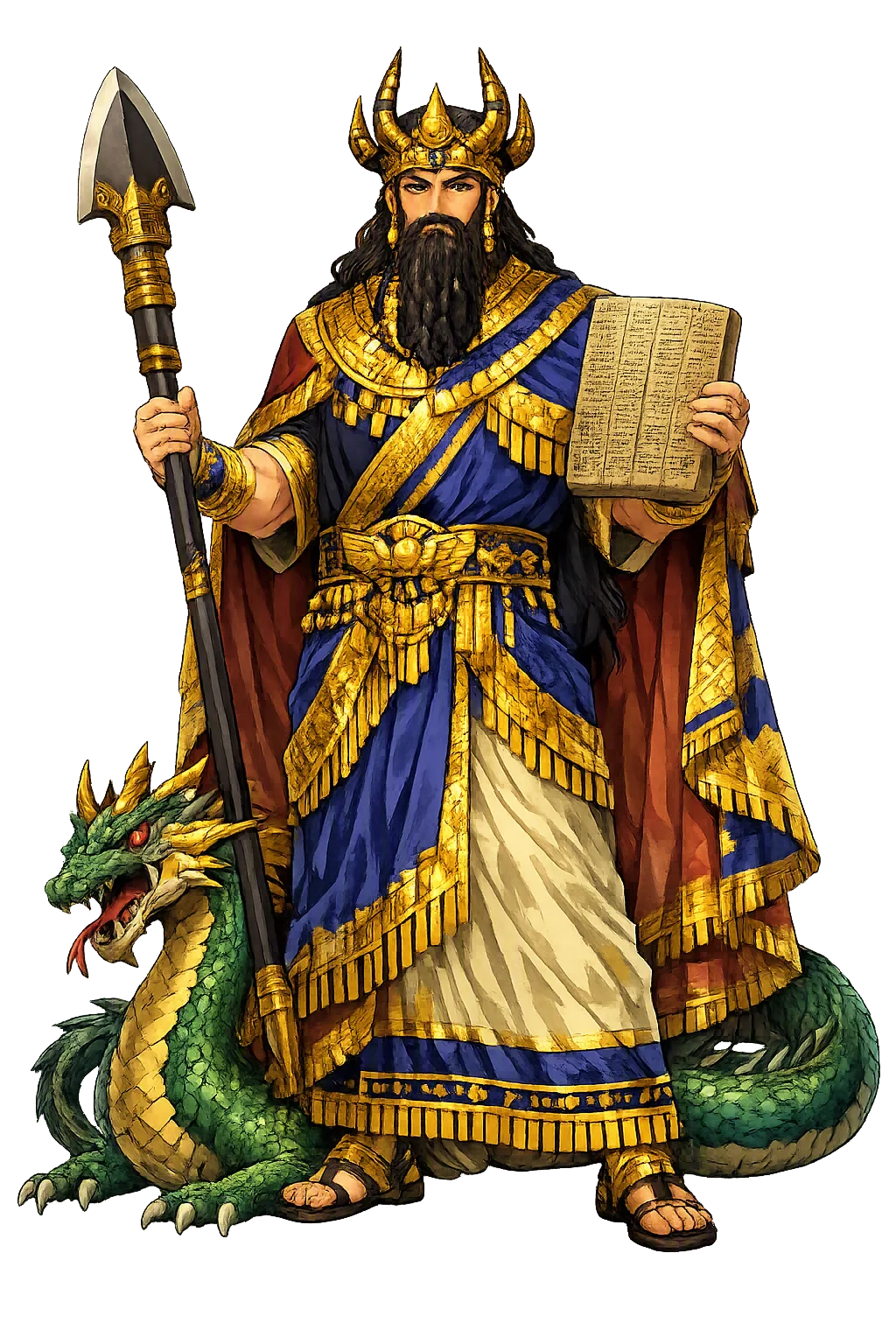
Stories of Marduk
Marduk's mythology is the mythology of cosmic sovereignty. It is not enough for him to be powerful; he must be chosen by the gods, prove himself in combat, build the world, and then receive the legal instrument of kingship. His stories are therefore political theology in narrative form: they explain why Babylon, and by extension its god, stands at the center of the world.
In the Babylonian Enuma Elish ('When on High', tablets I–VII), the younger gods disturb the primordial pair Apsu and Tiāmat. After Apsu is killed, Tiāmat raises an army of monsters under the rebel god Kingu to avenge him. Marduk alone accepts the challenge, on condition that the gods grant him supreme kingship. He rides into battle in a storm-chariot drawn by four fearsome creatures, traps Tiāmat in the net of the four winds, and splits her body with bow and mace: from one half he makes the sky, from the other the earth. He fixes the stars, the moon, and the calendar, founds Babylon and builds Esagila, and creates humankind from Kingu's blood 'to bear the gods' yoke' — 'the service of the gods be imposed upon him, that they may rest.' The poem is simultaneously creation myth, city charter, and cult text. It means that order is not found but built: the habitable world is the debris of a victory, arranged by a sovereign architect.
The seventh and final tablet of the Enuma Elish lists Marduk's fifty names, each explained as a function or title he has absorbed from older gods. Anu, Enlil, and Ea yield aspects of their sovereignty to him; his names declare him creator, provider, judge, and shepherd. This is not mere praise but theological consolidation: by naming, the older pantheon legally transfers cosmic authority to Babylon's patron deity. The list preserves the names of deities who might otherwise have been forgotten, making the tablet a kind of annotated divine genealogy, read aloud before the assembly at the New Year festival while Marduk's statue received the renewed homage of Babylon. The fifty names mean that Marduk's kingship is a totalization — every older power survives, but only as an aspect of the new sovereign.
The prologue to the Code of Hammurabi (c. 1754 BCE) names Marduk as the god who called Hammurabi 'to bring about the welfare of the people' and 'to cause justice to prevail in the land.' Kingship is thus a delegated office: the king rules because Marduk has chosen him, and his laws are legitimate because they extend Marduk's own ordering power. The stele's imagery makes the theology visible: Hammurabi stands before a seated god — conventionally read as Marduk or Šamaš — receiving the rod and ring of authority. Nebuchadnezzar II, a thousand years later, still frames his reign in the same terms, boasting of rebuilding Esagila and Etemenanki as acts of cultic service. The myth means that in Babylon, law is not the king's will but the god's maintenance order, administered.
The Erra Epic (c. eighth century BCE) tells how Marduk abandons his shrine and his divine statue is carried off into desecration, allowing the war-god Erra to devastate Babylon. When Marduk returns and his statue is refurbished, order is restored. The myth dramatizes a Mesopotamian theological anxiety: even the king of the gods can be absent, and the stability of the cosmos depends on the proper maintenance of his cult. It also reflects historical catastrophe — the sack of Babylon by Sennacherib in 689 BCE and its restoration under Esarhaddon, who ceremonially reinstalled Marduk's statue in 668. The epic means that divine kingship, like human kingship, has a physical address: unmake the cult, and you unmake the cosmos it anchors — the same anxiety that would shadow every Babylonian restoration for the next thousand years.
Creation, Divine Kingship, Storms, Justice
Marduk began as a local storm-god of Babylon and rose, by the first millennium BCE, to become the supreme head of the Mesopotamian pantheon. His name, written 𒀭𒀫𒌓 (dAMAR.UTU), means 'calf of the sun' — a theophoric compound that binds the young animal to the solar god Šamaš. In the Babylonian Enuma Elish, Marduk defeats the primordial sea Tiāmat, splits her body to fashion heaven and earth, and receives from the assembled gods the kingship of the cosmos. This temple treats him as the paradigm of legitimate sovereignty: the deity who turns chaos into order by decree, combat, and architecture.
His city, Babylon, was both a political capital and a theological statement. Its ziggurat Etemenanki ('Temple of the Foundation of Heaven and Earth') and its temple complex Esagila were understood as the axis where Marduk's cosmic order touched the ground. Kings from Hammurabi to Nebuchadnezzar II ruled by his mandate, and the king's first duty was to maintain Marduk's cult. Justice, law, and the measured world were therefore extensions of his domain.
The solar emblem of divine kingship; Marduk's name binds him to the sun-god Šamaš, and the winged disc proclaims celestial authority.
The 'House of the Raised Head' and the ziggurat 'Foundation of Heaven and Earth' — the architectural center of Marduk's cosmic rule.
Marduk holds the four winds as weapons and messengers; in the Enuma Elish they are the first instruments he fashions for the storm-battle.
After defeating Tiāmat, Marduk divides her corpse into halves, sets up constellations as heavenly regulators, and establishes the calendar.
From the original script to the living URL
𒀭𒀫𒌅
The name in its original Mesopotamian form. Marduk (𒀭𒀫𒌅) is attested in the source tradition — “Solar calf (Akkadian Marduk)”. Its original diacritics and script distinctions carry the full phonetic and orthographic weight of the source tradition.
marduk
The plain marduk form is identical to the Unicode restoration. Because this name is already written in Latin letters, no diacritics, stress, or script information were lost — only capitalization differs.
Marduk
The Unicode restoration does not need to recover lost marks for Marduk. Its value is canonical spelling and consistent cataloguing, not the reconstruction of erased orthography. The domain is readable as-is to both DNS and humanity.
Marduk.com
This restoration is written entirely in ASCII letters — no Punycode encoding stands between Marduk and the DNS. The domain reads identically to machines and to human eyes.
Owned, ideal, and ASCII forms of Marduk
Marduk
Restores 𒀭𒀫𒌅. The full Unicode restoration. marduk.com is not in the PuniCodex collection — it is watched for release; if it drops, this temple upgrades to an owned flagship.
How Marduk was spoken
How Marduk travels from ancient script to the modern URL
Akkadian Marduk is the chief god of Babylon; his Sumerian logogram AMAR.UTU means “calf of the sun", but the name Marduk itself is probably of foreign or archaic origin.
The lore you have read is the living myth. Extended Lore opens the scholarly vault beneath it: the cult and its material remains, a history of the image, the name after antiquity, a meditation on what the name still means, and the full scholarly apparatus — etymology, orthography, sources.
Enter Extended Lore