
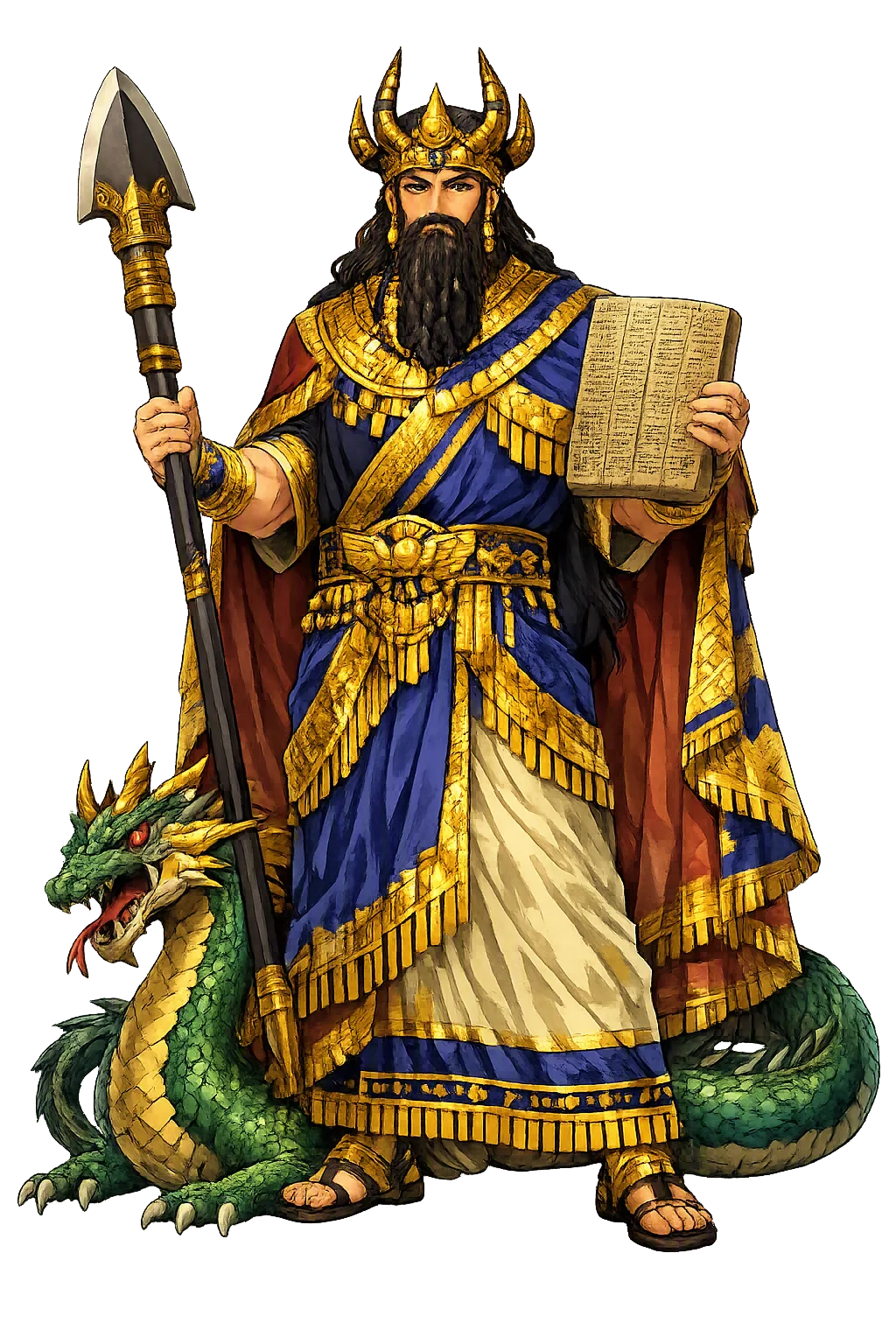
Marduk: the stories first, then the spelling
Before the spelling, the story. Marduk earns its restoration the old way — through what was actually told.
The Stories That Carry the Name
Marduk Slays Tiāmat and Builds the World. In the Babylonian Enuma Elish ('When on High', tablets I–VII), the younger gods disturb the primordial pair Apsu and Tiāmat. After Apsu is killed, Tiāmat raises an army of monsters under the rebel god Kingu to avenge him. Marduk alone accepts the challenge, on condition that the gods grant him supreme kingship.
Marduk Receives His Names. The seventh and final tablet of the Enuma Elish lists Marduk's fifty names, each explained as a function or title he has absorbed from older gods. Anu, Enlil, and Ea yield aspects of their sovereignty to him; his names declare him creator, provider, judge, and shepherd. This is not mere praise but theological consolidation: by naming, the older pantheon legally transfers cosmic authority to Babylon's patron deity.
Marduk and the Gift of Kingship. The prologue to the Code of Hammurabi (c. 1754 BCE) names Marduk as the god who called Hammurabi 'to bring about the welfare of the people' and 'to cause justice to prevail in the land. ' Kingship is thus a delegated office: the king rules because Marduk has chosen him, and his laws are legitimate because they extend Marduk's own ordering power.
And Here Is What the Spelling Preserves
At a Glance
- Restored name: Marduk
- ASCII form: marduk
- Meaning: "Solar calf (Akkadian Marduk)"
- Domain of influence: Creation, Babylon, Storms
- Pantheon: Mesopotamian
- Classification: Tier 2
- Original script: 𒀭𒀫𒌅
- Series: The Restoration Files, No. 301 of 548
The Name Travels
Marduk absorbed functions from Enlil (kingship and the decree of destinies), Ea/Enki (wisdom and water), and Šamaš (justice and solar radiance). His rise parallels the political rise of Babylon: when Babylon was small, he was a local storm-god; when Babylon became an imperial capital, he became king of the gods.
The Address It Earned
The temple of Marduk stands at /marduk/ — lore, scholars, patterns — because a name carrying this much story deserves more than a parking page. One decisive feature survives — a single, honest mark — which places the restoration in Tier-2: exact, and exactly labeled.
The Sources Are Open
The myths above are retold from the temple's record; the primary voices are in the Sacred Texts: Enūma Eliš and The Epic of Gilgamesh. Nothing in this file outranks them.
The File Continues
Read the founding dispatch for the name's full story, the Resonance File for the archetype at work — or the whole archive in one sitting.
Continue the series — previous file: Māra (read it here) · next file: Marishiten (read it here).
The Restoration Files are written from the same canonical record as the temples themselves: the lexicon, the lore catalog, the pattern atlas, and the cited scholarly sources. If a file ever disagrees with its temple, the temple is right — tell us, and the file will be corrected.