
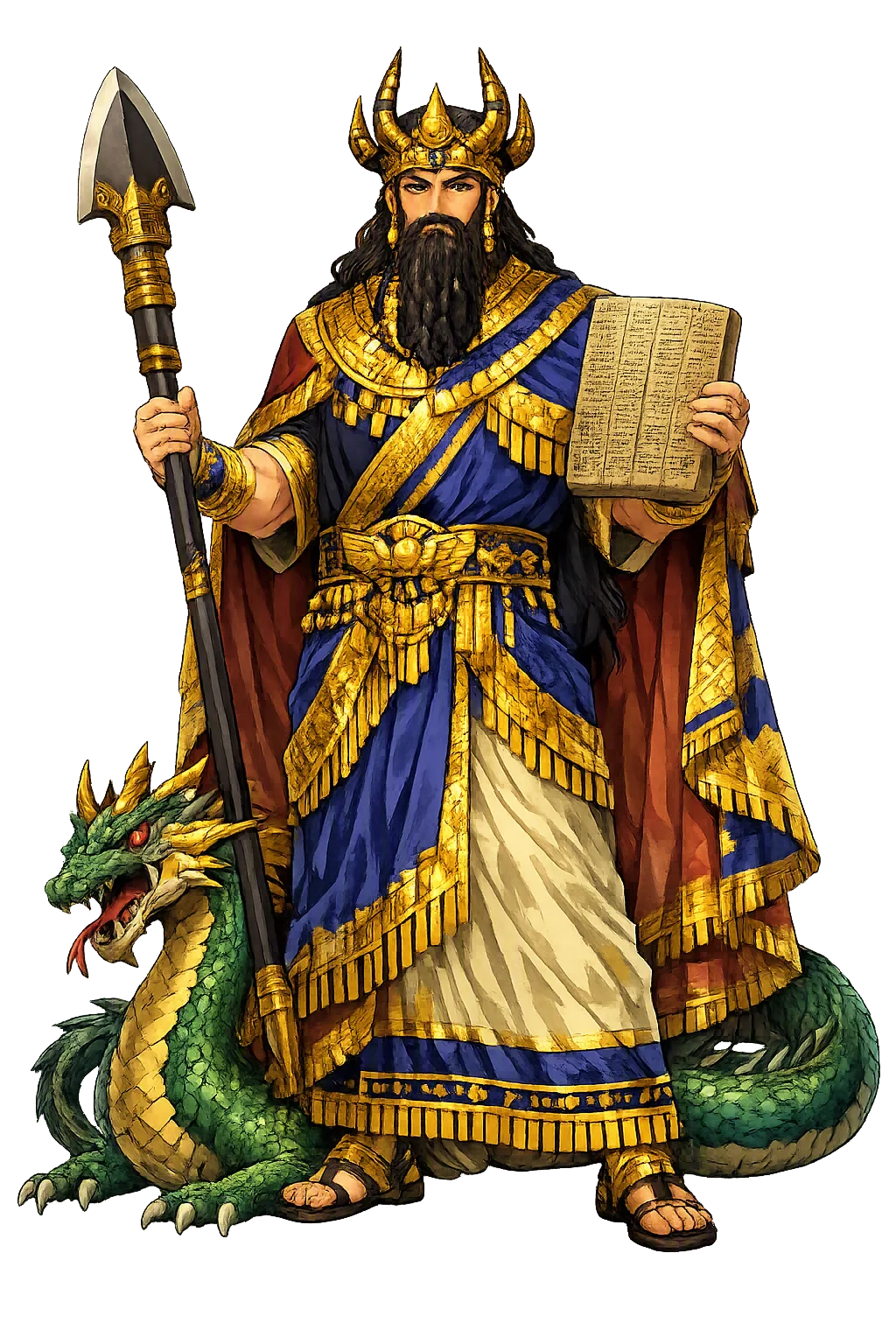
Marduk: canonical, contested, and the false forms on record
Evidence dossier 301 — Marduk. Every exhibit catalogued, every ruling stated with its grounds.
At a Glance
- Canonical form: Marduk
- Original script: 𒀭𒀫𒌅
- Pantheon: Mesopotamian
- Convention: Assyriological transliteration — š, ṣ, ṭ, ḫ as the sign lists require
- False forms on record: 0
- Contested forms: none attested
- Series: The Canonical Register, No. 301 of 548
The Evidence
Exhibit 1 — the attestation. The attested form is 𒀭𒀫𒌅, from the tradition's own record. The canonical transliteration is Marduk.
Exhibit 2 — the flattened form. The plain form marduk differs from the canonical Marduk only by convention of display — case, not content. It is acceptable everywhere: in legacy systems, in plain-text citation, in the DNS itself. What is not acceptable is what follows in the register: respellings that change the letters, not just their case.
Exhibit 3 — the physical record. Babylon's Esagila and Etemenanki, excavated by Robert Koldewey's German expedition (1899–1917), anchor Marduk's cult topographically: the ziggurat's baked-brick core still rises above the mound of Tell Amran ibn Ali near Hillah, and the Processional Way's glazed lions and mušḫuššu-dragons — Marduk's own animal — are divided between Berlin's Pergamon Museum and the reconstructed gate at the site. The barrel-cylinder inscriptions of Nebuchadnezzar II describing the rebuilding of both sanctuaries — the London and Philadelphia cylinders — are among the largest royal inscriptions ever found. Copies of the Enuma Elish from Ashurbanipal's library at Nineveh (c. 650 BCE) and from Seleucid-era Babylon preserve his theology a thousand years after Hammurabi, and New Year festival texts from Uruk and Babylon record the ritual recitation of his epic before the assembled gods.
Exhibit 4 — the continuing record. Marduk's most visible survival is architectural: the Ishtar Gate of Babylon, now in the Pergamon Museum, is glazed in the deep lapis-blue and gold associated with his city, and its processional way is lined with mušḫuššu dragons and aurochs. The tower of Babel narrative in Genesis 11 almost certainly reflects the memory of Etemenanki.
The Convention's Own History
Cuneiform writes a consonant inventory English does not have: š, ṣ, ṭ, ḫ mark sibilants and stops that Akkadian and Sumerian distinguished and meaning depends on — the difference between 'sun' and 'son' is exactly one ṣ. Assyriological transliteration (the sign lists of Borger and the Chicago Assyrian Dictionary) settled those marks over the last century and a half, and the register keeps them because dropping them merges gods, cities, and concepts that the tablets keep apart.
The Protocol's Position
Can the canonical form live in the address bar? Almost always, yes. IDNA 2008 admits every mark this register defends — the DNS stores them as `xn--` punycode and modern browsers render them natively. The real frictions are practical, not legal: some registrars stock only part of the IDN space, so a theoretically valid name can be temporarily unbuyable; and stacked combinations (an acute riding a macron) remain awkward to type on mobile keyboards even where the protocol accepts them.
The project's answer is a ranked ladder, not a compromise: the full restoration first, then attested fallbacks in descending order of completeness. The ladder's lowest rung, plain ASCII, is a vehicle for legacy systems — sanctioned, but never presented as the scholarly form.
The Verdict
Case closed on Marduk: canonical, cited, and defended. The keyboard form marduk is the same name in another register of display — always acceptable. The register's files remain open: if a source surfaces that changes any line of this entry, the entry changes. Until then, the temple at /marduk/ holds the canonical form.
The docket for this ruling: no false forms on the docket; no contested forms attested; the attestation rests on 6 cited sources — ETCSL, CAD, AHw.
The Register Continues
This is one of 548 entries in the Canonical Register — the authoritative reference for every flagship temple. The temple's founding dispatch tells the name's story; its Restoration File details the marks; its Resonance File reads the archetype into the industries. The blog index holds the whole archive, and the Rulebook states the convention this register enforces.
Continue the register — previous entry: Māra (read it) · next entry: Marishiten (read it).
The Canonical Register is written from the same canonical record as the lexicon itself. If a false form is missing from this page, it is because the evidence does not support calling it false — or because we have not seen it yet. Show us, with a citation, and the register will answer.