
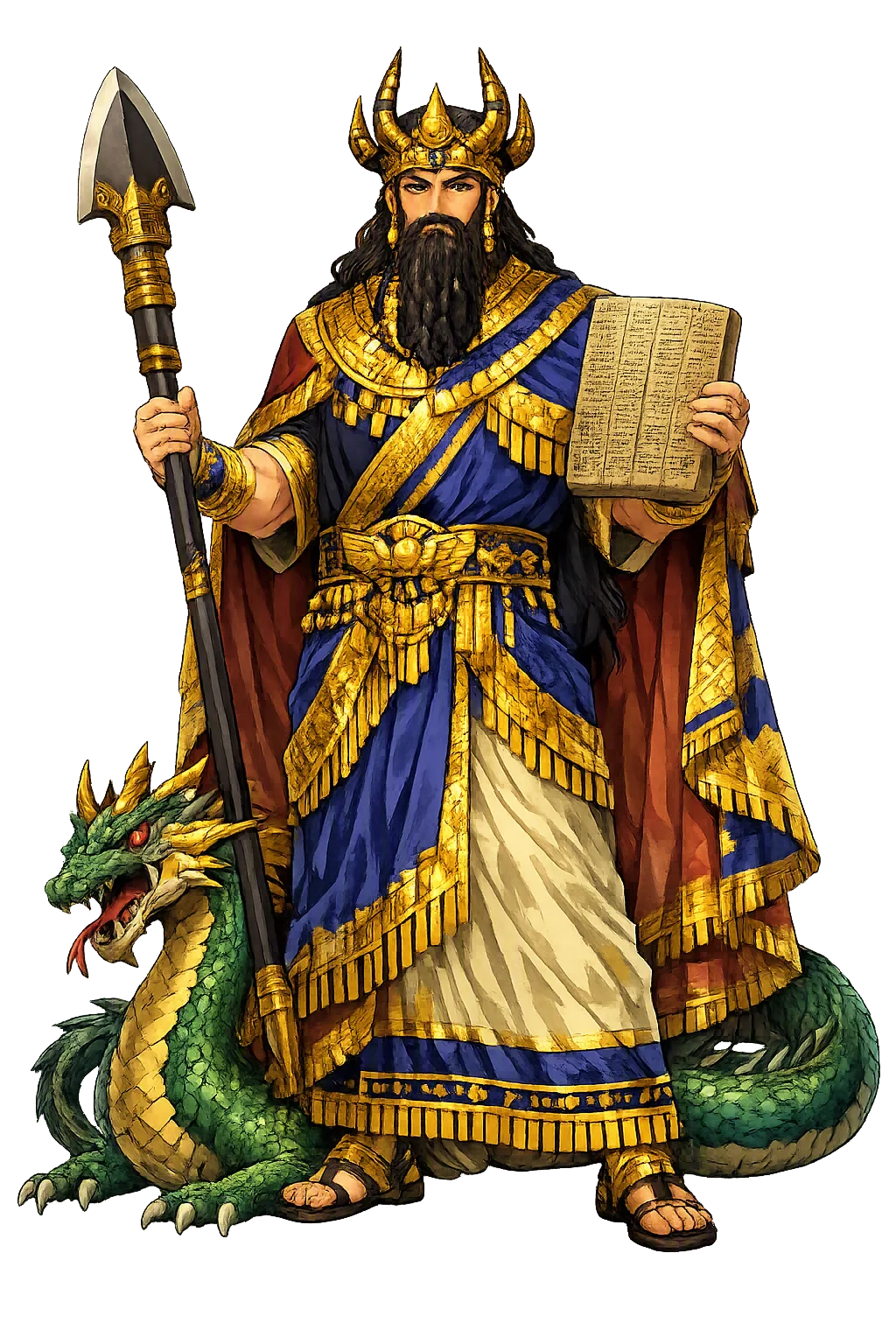
The hidden history behind Marduk
Behind the modern ASCII form marduk hides a much longer story. Marduk reaches back through manuscripts, inscriptions, and oral tradition long before it ever touched a keyboard, and every mark in the restored spelling is a receipt from that journey. In what follows we trace the name from its Cuneiform attestations through its mythology, its cult, its symbols, and its afterlife in other cultures — and we show how the PuniCodex project turned that philological record into a Unicode domain that resolves today. The history was never lost. It was only waiting for the infrastructure to catch up.
At a Glance
- Restored name: Marduk
- ASCII form: marduk
- Meaning: "Solar calf (Akkadian Marduk)"
- Domain of influence: Creation, Babylon, Storms
- Pantheon: Mesopotamian
- Classification: Tier 2
- Original script: 𒀭𒀫𒌅 (Cuneiform)
Overview
Marduk (marduk) — Creation, Babylon, Storms · Solar calf (Akkadian Marduk) — belongs to the Mesopotamian tradition, where it is catalogued under the domain "Creation, Babylon, Storms". The name means "Solar calf (Akkadian Marduk)".
Marduk began as a local storm-god of Babylon and rose, by the first millennium BCE, to become the supreme head of the Mesopotamian pantheon. His name, written 𒀭𒀫𒌓 (dAMAR.UTU), means 'calf of the sun' — a theophoric compound that binds the young animal to the solar god Šamaš. In the Babylonian Enuma Elish, Marduk defeats the primordial sea Tiamat, splits her body to fashion heaven and earth, and receives from the assembled gods the kingship of the cosmos. This temple treats him as the paradigm of legitimate sovereignty: the deity who turns chaos into order by decree, combat, and architecture.
His city, Babylon, was both a political capital and a theological statement. Its ziggurat Etemenanki ('Temple of the Foundation of Heaven and Earth') and its temple complex Esagila were understood as the axis where Marduk's cosmic order touched the ground. Kings from Hammurabi to Nebuchadnezzar II ruled by his mandate, and the king's first duty was to maintain Marduk's cult. Justice, law, and the measured world were therefore extensions of his domain.
PuniCodex restores the name as Marduk and serves its temple at its temple. The restoration needs no distinctive letters or diacritics its ASCII form would lose, which places the name in Tier 2. The plain ASCII form marduk survives as a modern convenience imposed by the early domain-name system; the restoration, not the fallback, is the form the project defends as philologically complete.
The Name
The name is attested in Cuneiform as 𒀭𒀫𒌅. Etymologically it means "Solar calf (Akkadian Marduk)".
The ASCII form marduk survives only because the early domain-name system could not carry diacritics; it is a technological compromise, not an ancient spelling. The Unicode restoration Marduk recovers the full diacritic detail of the scholarly transliteration directly in the address bar. The restoration needs no distinctive letters or diacritics its ASCII form would lose, which places the name in Tier 2.
The letter-by-letter transformation runs:
- m → M — Same
- a → a — Same
- r → r — Same
- d → d — Same
- u → u — Same
- k → k — Same
The Original Script
The name is preserved in Cuneiform as 𒀭𒀫𒌅 — Sumero-Akkadian cuneiform, attested Sumerian / Old Babylonian – Neo-Assyrian, c. 2600–600 BCE, in Mesopotamia. The script is written left-to-right / top-to-bottom.
The scholarly transliteration is Marduk (Sumerian logogram + Akkadian scholarly), giving the normalized reading /ˈmar.duk/.
The rendering proceeds step by step:
- Sumerogram AMAR.UTU (𒀫𒌅), 'calf of the sun'
- Prefixed with divine determinative 𒀭
- Later Babylonian orthography uses syllabic Mar-duk
Pronunciation
The reconstructed pronunciation of the name is /marˈduk/ — Akkadian Conventional Reading.
Phoneme by phoneme:
- Mar- — Akkadian /mar/ — the first syllable of the conventional reading, identical to the Sumerogram AMAR ('calf, young animal').
- -duk — Akkadian /duk/ — the second element, from the sun-god name UTU/Šamaš; the whole name means 'calf of the sun'.
For the modern speaker, the closest approximation is: 'mar-DOOK' — stress the second syllable; the final vowel is short in the everyday transliteration, though some scholars posit an original long /uː/.
Kindred and historical forms of the name:
- Akkadian — 𒀭𒀫𒌓 (dAMAR.UTU), 'calf of the sun' — the logographic spelling used in Babylonian texts
- Sumerogram — AMAR.UTU — AMAR = calf, UTU = the sun god Šamaš; the name is a theophoric compound
- Conventional — Marduk — the standard Assyriological transliteration adopted into English and most modern languages
Marduk is Tier 2: the canonical Unicode restoration is the plain Latin form Marduk, which preserves no diacritic, long-vowel mark, or distinctive non-ASCII letter. A scholarly variant Mardūk with a final macron is sometimes used to mark a posited long vowel, but PuniCodex follows the lexicon's attested conventional form. The tier classification therefore reflects the name's ASCII-canonicality, not its religious or mythological importance.
Mythology
Marduk's mythology is the mythology of cosmic sovereignty. It is not enough for him to be powerful; he must be chosen by the gods, prove himself in combat, build the world, and then receive the legal instrument of kingship. His stories are therefore political theology in narrative form: they explain why Babylon, and by extension its god, stands at the center of the world.
Marduk Slays Tiamat and Builds the World (Enuma Elish)
In the Babylonian Enuma Elish ('When on High'), the younger gods disturb the primordial Apsu and Tiamat. After Apsu is killed, Tiamat raises an army of monsters to avenge him. Marduk alone accepts the challenge, on condition that the gods grant him supreme kingship. He rides into battle in a storm-chariot drawn by four fearful creatures, surrounds Tiamat with the four winds, and splits her body with his bow and mace. From one half he makes the sky; from the other, the earth. He fixes the stars, the moon, and the calendar, then creates humankind from the blood of the slain god Kingu to serve the gods. The poem is both creation myth and charter for Marduk's cult in Babylon.
Marduk Receives His Names (The Fifty Names)
The seventh and final tablet of the Enuma Elish lists Marduk's fifty names, each explained as a function or title he has absorbed from older gods. Anu, Enlil, and Ea yield aspects of their sovereignty to him; his names declare him creator, provider, judge, and shepherd. This is not mere praise but theological consolidation: by naming, the older pantheon legally transfers cosmic authority to Babylon's patron deity. The list preserves the names of deities who might otherwise have been forgotten, making the tablet a kind of annotated divine genealogy.
Marduk and the Gift of Kingship (Hammurabi)
The prologue to the Code of Hammurabi names Marduk as the god who called Hammurabi 'to bring about the welfare of the people' and 'to cause justice to prevail in the land.' Kingship is thus a delegated office: the king rules because Marduk has chosen him, and his laws are legitimate because they extend Marduk's own ordering power. Nebuchadnezzar II later boasted of rebuilding Esagila and Etemenanki, framing his reign as an act of cultic service to Marduk.
Marduk's Absence and the Fall of Babylon (Erra Epic)
The Erra Epic tells how Marduk abandons his shrine and the divine statue is desecrated, allowing the war-god Erra to devastate Babylon. When Marduk returns and his statue is refurbished, order is restored. The myth dramatizes a Mesopotamian theological anxiety: even the king of the gods can be absent, and the stability of the cosmos depends on the proper maintenance of his cult. It also reflects historical catastrophes such as the sack of Babylon by Sennacherib in 689 BCE and its later restoration under Esarhaddon.
Symbols & Iconography
The iconography associated with Marduk concentrates in a small set of recurring attributes, each a compressed statement about the name:
- Winged sun-disc — The emblem of solar kingship and Marduk's link to the sun-god Šamaš
- Spade or triangular hoe (šaruḫu) — Marduk's primary attribute, the tool with which he shapes land and clears the primordial waters
- Mušḫuššu dragon — The snake-dragon hybrid that serves as Marduk's sacred animal, seen on the Ishtar Gate
- Four winds — The winds Marduk deploys as weapons and messengers in the chaos-battle
- Ziggurat / cosmic mountain — Etemenanki as the axis between heaven and earth, the material form of Marduk's ordered cosmos
Archaeology & Evidence
No monument, inscription, or artifact in the current PuniCodex corpus is yet assigned to Marduk with certainty. That absence should be read honestly: for a Mesopotamian name of this type the material record is expected to be thin, and the primary evidence remains the textual testimony gathered in the Scholarly Sources section.
Were such evidence to surface, it would take recognizable forms: votive or dedicatory inscriptions naming 𒀭𒀫𒌅, sanctuary or cult remains tied to creation and iconography matching its traditional attributes (winged sun-disc and spade or triangular hoe (šaruḫu)). Each candidate would be weighed against the reconstructed form of the name before entering the scholarly record.
Realm & Domain
Marduk began as a local storm-god of Babylon and rose, by the first millennium BCE, to become the supreme head of the Mesopotamian pantheon. His name, written 𒀭𒀫𒌓 (dAMAR.UTU), means 'calf of the sun' — a theophoric compound that binds the young animal to the solar god Šamaš. In the Babylonian Enuma Elish, Marduk defeats the primordial sea Tiamat, splits her body to fashion heaven and earth, and receives from the assembled gods the kingship of the cosmos. This temple treats him as the paradigm of legitimate sovereignty: the deity who turns chaos into order by decree, combat, and architecture.
His city, Babylon, was both a political capital and a theological statement. Its ziggurat Etemenanki ('Temple of the Foundation of Heaven and Earth') and its temple complex Esagila were understood as the axis where Marduk's cosmic order touched the ground. Kings from Hammurabi to Nebuchadnezzar II ruled by his mandate, and the king's first duty was to maintain Marduk's cult. Justice, law, and the measured world were therefore extensions of his domain.
The Winged Sun-Disc
The solar emblem of divine kingship; Marduk's name binds him to the sun-god Šamaš, and the winged disc proclaims celestial authority.
Esagila & Etemenanki
The 'House of the Raised Head' and the ziggurat 'Foundation of Heaven and Earth' — the architectural center of Marduk's cosmic rule.
The Four Winds
Marduk holds the four winds as weapons and messengers; in the Enuma Elish they are the first instruments he fashions for the storm-battle.
The Measured Cosmos
After defeating Tiamat, Marduk divides her corpse into halves, sets up constellations as heavenly regulators, and establishes the calendar.
Across Cultures
Marduk absorbed functions from Enlil (kingship and the decree of destinies), Ea/Enki (wisdom and water), and Šamaš (justice and solar radiance). His rise parallels the political rise of Babylon: when Babylon was small, he was a local storm-god; when Babylon became an imperial capital, he became king of the gods. The Greeks identified him with Zeus Belos (Bel = Baal = 'Lord'), and Berossus transmitted Marduk-Bel to the Hellenistic world as the civic god of Babylon. In Jewish and early Christian exegesis, the figure of Bel and the dragon (Daniel 14) preserves a polemical memory of Marduk's cult statue and animal. No later deity exactly reproduces Marduk's combination of storm-combat, cosmic architecture, and urban kingship.
Kindred figures in the PuniCodex cross-tradition index include Adad, Baꜥal, Enlīl, Keraunós, Ninurta, and Ọya, each linked through thunder / storm sovereignty.
Cultural Legacy
Marduk's most visible survival is architectural: the Ishtar Gate of Babylon, now in the Pergamon Museum, is glazed in the deep lapis-blue and gold associated with his city, and its processional way is lined with mušḫuššu dragons and aurochs. The tower of Babel narrative in Genesis 11 almost certainly reflects the memory of Etemenanki. In modern fantasy and games, Marduk appears as a dragon-slaying storm-god and as the namesake of Babylonian magic. The name still means: the sovereign who turns chaos into a city.
The Scholarly Record
The account of Marduk given in this edition rests on the witnesses and reference works listed below. Lexica and etymological dictionaries secure the form and meaning of the name; the literary and religious texts supply the narrative evidence.
- Electronic Text Corpus of Sumerian Literature, Oxford Oriental Institute, 1998. Full text
- The Assyrian Dictionary of the Oriental Institute of the University of Chicago, 21 vols., Oriental Institute, Chicago (completed 2010), 1956. Full text
- Akkadisches Handwörterbuch, 3 vols., Harrassowitz, Wiesbaden (completed 1981), 1965.
- Foster, Before the Muses.
- George, House Most High.
- Black & Green, Gods, Demons and Symbols of Ancient Mesopotamia.
A Meditation
Marduk is the god of the city as cosmos. Where Enlil rules the wind and Ea rules the sweetwater deep, Marduk rules the assembly that decides what order is. His power is not merely physical; it is constitutional. The gods vote him kingship, name him into authority, and then witness his exercise of it. This is Mesopotamian political theory rendered as myth: legitimacy comes not from strength alone but from a recognized procedure, a public mandate, and the capacity to deliver the goods — in this case, a habitable world.
To name Marduk is to remember that creation is not a single event but an ongoing administrative project. The cosmos must be maintained: the calendar kept, the temple repaired, the king watchful, the law enforced. The Enuma Elish does not end with the making of the world; it ends with the establishment of the cult that sustains it. Every ziggurat is a promise that chaos has been defeated once and can be defeated again, provided the proper rites continue. The plain Latin spelling of his name — Marduk, Tier 2 — is itself a kind of stability: no diacritic to argue over, no reconstruction to dispute, just the conventional form by which two and a half millennia of readers have known the king of Babylon.
The Unicode Restoration
Marduk is classified as Tier 2: the restoration needs no distinctive letters or diacritics its ASCII form would lose. The ASCII fallback marduk still resolves everywhere, but it is the restored form that carries the name's full information. That is the whole thesis of this temple: the marks are the message.
Character by Character
The journey from marduk to Marduk, one character at a time:
- m → M — Same
- a → a — Same
- r → r — Same
- d → d — Same
- u → u — Same
- k → k — Same
The Mesopotamian Pantheon
Marduk is one of 30 entries the PuniCodex lexicon catalogues under the Mesopotamian pantheon. The Pantheon page gathers the tradition's major figures in one place, and the Lexicon lets you filter all 980 restorations by tradition, tier, or script — the fastest way to see where this name sits among its kin.
Frequently Asked Questions
What does Marduk mean? The traditional gloss is "Solar calf (Akkadian Marduk)."
Which tradition does Marduk belong to? Marduk is catalogued in the Mesopotamian pantheon of the PuniCodex lexicon.
Why is Marduk classified as Tier 2? Because the restoration needs no distinctive letters or diacritics its ASCII form would lose — and the marks in the restored spelling preserve exactly that evidence.
Can I use Marduk in a normal browser? Yes. The DNS resolves the punycode form automatically, and the type tool on this site converts marduk to Marduk for copying and pasting.
Where does the scholarly information come from? The entry is built from lexica, inscriptional evidence, and reviewed scholarly sources listed in the Scholarly Edition. Every claim is traceable to a canonical source.
Why This Restoration Matters
The story of Marduk did not end in antiquity; it changed medium. Names that survive for millennia do so because each generation finds a new carrier for them — clay, papyrus, print, and now DNS. The PuniCodex restoration simply makes the carrier honest: the spelling that resolves is the spelling the evidence supports. If this post showed anything, it is that marduk and Marduk are not the same name with different styling. They are a summary and the text it summarizes. The web can now serve the text.
Explore Further
This post is one doorway into the temple. The home page carries the full character breakdown and the ambient canvas; the lore page tells the myths in long form; the Scholarly Edition preserves the sources, pronunciation data, and revision history; and the patron wall supports the restoration directly. For the wider map, browse the Lexicon, explore the Pantheon, or return to the PuniCodex blog.
Related Names
Sources
The full scholarly apparatus — every citation, revision, and review — lives in the Scholarly Edition. Key references for this post:
- Electronic Text Corpus of Sumerian Literature, Oxford Oriental Institute, 1998.
- The Assyrian Dictionary of the Oriental Institute of the University of Chicago, 21 vols., Oriental Institute, Chicago (completed 2010), 1956.
- Akkadisches Handwörterbuch, 3 vols., Harrassowitz, Wiesbaden (completed 1981), 1965.
- Black & Green, Gods, Demons and Symbols of Ancient Mesopotamia.
- CAD, Marduk.
- Chicago Assyrian Dictionary (CAD).
- Lexicon authorities for this entry: CAD, AHw.