
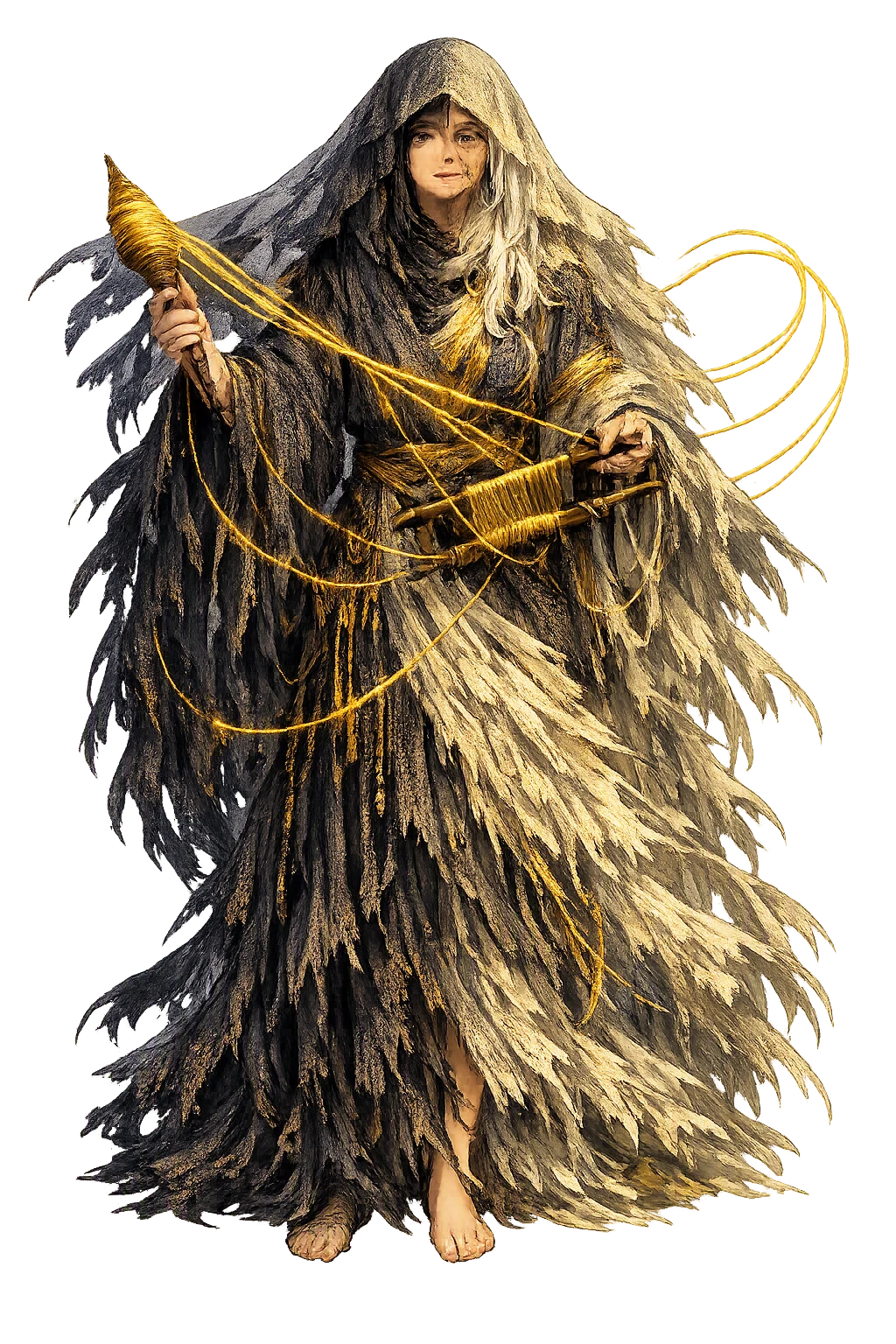
Wyrd in 2026: why scholars still care
In 2026, names are treated as data points. Wyrd is a reminder that they are also cultural artifacts — and that the difference matters for search engines, AI training corpora, and anyone who types the name of a Norse figure into a browser. Scholars never stopped caring about the difference between wyrd and Wyrd; the web simply made that care actionable. What follows is the full scholarly picture — name, script, sound, myth, cult, and legacy — followed by the engineering compromise that lets a restored spelling live at a real address. The question is not whether the name is old. It is whether the digital world is old enough to hold it.
At a Glance
- Restored name: Wyrd
- ASCII form: wyrd
- Meaning: "Fate (cognate with Urðr)"
- Domain of influence: Fate, Destiny
- Pantheon: Norse
- Classification: Tier 2
- Original script: ᚹᚣᚱᛞ (Anglo-Saxon Futhorc)
Overview
Wyrd (wyrd) — Fate, Destiny · Fate (cognate with Urðr) — is the Old English word for what happens: fate, destiny, the shape of events, built on the verb weorðan 'to become'. It is not a goddess but a noun, and its dossier is a set of sentences: 'Wyrd bið ful ārǣd', says the Wanderer — fate is wholly fixed; 'Gǣð ā wyrd swā hīo sceal', says Beowulf on the threshold of every fight — fate goes always as she must; and the same poet grants the exception that governs his hero's career, 'Wyrd oft nereð unfǣgne eorl, þonne his ellen dēah' — fate often spares the undoomed man when his courage avails.
Bosworth–Toller record the full semantic range — event, fate, destiny, and a half-personified power glossing Latin fatum, fortuna, even the Parcae — and Timmer's classic study shows how the word hovers between process and person without ever becoming a culted goddess. Its exact Old Norse cognate is not a noun but a name: Urðr, eldest of the three Norns who lay down laws beside Verðandi and Skuld at the well beneath Yggdrasill.
PuniCodex restores the name as Wyrd — identical to the ASCII input, because normalized Old English writes no diacritic in this word. The mechanical rule therefore places it in Tier 2: nothing distinctive is lost in transit, a statement about orthography and never about the concept. The temple is domain-less: the plain-ASCII wyrd.com lies outside the collection and is watched for release.
The Name
The word is attested in Old English as wyrd, a feminine noun whose first sense is simply 'what happens, event', and whose developed senses are 'fate, destiny, fortune' — with a personified stratum the dictionaries mark with capitals: Wyrd, the power that determines events. Its etymology is transparent: it is the verbal abstract of weorðan 'to become, to happen' (Gothic waírþan, Old Norse verða, Old High German werdan), from Proto-Germanic *werþaną — 'becoming' nominalized. Fate, in this word, is the past tense of the world.
The manuscript spelling deserves note: Anglo-Saxon bookhand writes the word ƿyrd with wynn, the runic letter borrowed into the Latin alphabet for the /w/ sound; normalized editions print w. The Unicode restoration Wyrd therefore preserves everything the manuscripts' normalized form contains, and the mechanical rule classifies the name Tier 2 — an orthographic fact, not a judgment on the concept.
The letter-by-letter transformation runs:
- w → W — Same, capitalized
- y → y — Same
- r → r — Same
- d → d — Same
The project holds no domain for this name. The plain-ASCII wyrd.com lies outside the collection and is watched for release; this temple claims nothing it does not hold.
Etymology & Roots
The recorded derivation reads: Fate (cognate with Urðr)
The root gloss is "Fate."
The reconstruction is classed as attested.
Kindred forms recorded in the lexicon:
- Urðr) (related) — cognate
The Original Script
The word is preserved in Anglo-Saxon manuscripts in the Latin alphabet with the runic letter wynn: ƿyrd — Old English (West Germanic), attested in codices of the tenth and eleventh centuries recording verse and prose centuries older in composition. The indigenous writing system of pre-Viking England was the Anglo-Saxon futhorc; in that row the word would run ᚹᚣᚱᛞ (w-ȳ-r-d) — a normalized reconstruction, since no runic inscription of the word survives, and the manuscript form remains the primary witness.
The scholarly rendering proceeds step by step:
- The word is a simplex, not a compound: four letters, one syllable, the verbal abstract of weorðan 'to become'.
- Old English orthography needs no diacritic here: the vowel y is a plain letter of the Anglo-Saxon alphabet, not a marked u.
- The manuscripts write wynn (ƿ), borrowed from the runes; normalized editions print w — the only regular substitution between bookhand and modern type.
- The Unicode restoration Wyrd is therefore identical to the ASCII form plus its capital — the restoration is a matter of canonical reference, not rescued orthography.
Pronunciation
The reconstructed pronunciation of the word is /ˈwyrd/ — Old English Reconstruction.
Phoneme by phoneme:
- W- — Labial-velar approximant [w], written wynn (ƿ) in the manuscripts, voiced and plain as in modern 'water'
- -y- — Short close front rounded [y], the vowel English later unrounded: shape the lips for 'oo' while saying 'ee', as in German ü
- -rd — Alveolar trill or tap [r], fully sounded even before the consonant, closing on a released [d]
For the modern speaker, the closest approximation is: 'WÜRD' — one syllable, the ü rounded as in German 'Würde', the r rolled, the d stopped hard.
Kindred and historical forms of the word:
- Old English — wyrd, feminine noun, 'that which happens, fate, destiny'
- Anglo-Saxon Futhorc — ᚹᚣᚱᛞ (w-ȳ-r-d), the runic rendering; unattested in surviving inscriptions
- Old Norse — Urðr, the exact cognate, eldest of the three Norns
- Modern English — weird, the fate-noun worn down to an adjective of strangeness
Wyrd is Tier 2 because the restoration preserves nothing the ASCII form loses: no diacritic, no distinctive letter, no vowel length. English before and after writes the word identically.
Mythology
Wyrd has no mythology in the narrative sense — no birth, no hall, no kin — because it is not a figure but the Old English word for fate itself. What it has is a dossier of sentences, the moments where the poets reach for the word and the whole Anglo-Saxon theory of destiny shows through.
The Wanderer: Fate Is Wholly Fixed (Wanderer 5, 106–107)
The Exeter Book's exile opens his elegy with the coldest sentence in Old English: 'Wyrd bið ful ārǣd' — fate is wholly fixed, fully resolved, past appeal. He has buried his lord, crossed the winter seas, and found no hall to take him in; wyrd is the name he gives the weight of it. Near the poem's end the word returns in its grandest frame: 'onwendeð wyrda gesceaft weoruld under heofonum' — the decree of fates turns the world under heaven. The poem gives Wyrd no face and no spindle; its consolation is not that fate can be moved but that God alone is the fastness when her turning is done.
Beowulf: Fate Goes as She Must (Beowulf 455, 572–573)
Beowulf speaks the word at every threshold. Before Grendel: 'Gǣð ā wyrd swā hīo sceal' — fate goes always as she must. After the mere: 'Wyrd oft nereð unfǣgne eorl, þonne his ellen dēah' — fate often spares the undoomed man when his courage avails. The two sentences are the poem's whole theology: doom is real for the doomed (fǣge), but for the undoomed, courage and fate divide the work. When the dragon comes, the old king feels himself fǣge, and wyrd no longer negotiates.
The Proverb Poems: Fate Is Strongest (Maxims II 5; Solomon and Saturn)
The gnomic tradition keeps the word's power in its bluntest form. Maxims II ranks her first among forces — 'Wyrd byð swīðost', fate is strongest, ahead of winter's cold. Solomon and Saturn gives Saturn the matching proverb: fate is hard to turn, and neither wealth nor kin will turn her. This is the word's working sense outside the heroic hall: the unalterable course of what happens.
Alfred's Boethius: The Christian Taming (Consolation, OE version)
When Alfred's circle translated Boethius, Fortuna had to be rendered — and the native word took her place. Wyrd translates Fortuna throughout the Old English Consolation, but the translation is a conquest: wyrd is declared God's work and instrument, providence as experienced from below, the wheel's rim turning while the nave — God — stands still. The pagan noun of unalterable event is retained, baptized, and set to work inside Christian providence; every later English use of wyrd and weird lives downstream of this choice.
The Northern Sister: Urðr (Völuspá 19–20; Gylfaginning 15–16)
The Old Norse cognate is not a common noun but a name: Urðr, 'what has become', eldest of the three Norns. Völuspá sets the well beneath Yggdrasill, and from it come three maidens, deep in wisdom: Urðr one is called, Verðandi the second, Skuld the third; they laid down laws and allotted life to the children of men. Snorri adds the daily rite: the Norns draw water from Urðr's well and pour it with the well's clay over the tree's roots so its branches do not wither. England kept the word a noun; Iceland made it a person — one inheritance in two grammars.
Symbols & Iconography
The iconography of Wyrd is lexical rather than cultic — no temple regalia exists for a common noun, but the poems fixed around the word a small set of figures no discussion can omit:
- The decree (wyrda gesceaft) — the Wanderer's 'shaping of fates' that turns the world under heaven: fate as ordinance written into things, not accident
- The fixed resolve (ful ārǣd) — 'fate is wholly determined', the exile's five-word verdict: the hardest consolation Old English knows
- The spared undoomed man (unfǣgne eorl) — Beowulf's exception, 'fate often spares the undoomed man when his courage avails': the loophole that makes heroism rational
- The wheel declined — Alfred's Boethius keeps the word but strips Fortune's wheel of its independence: fate re-founded as God's instrument, the nave still while the rim turns
- The well of Urðr — the northern mirror: the norn at the spring beneath Yggdrasill where the Æsir hold their judgements, the word's exact cognate given a face
Archaeology & Evidence
Wyrd is a word of manuscripts, not monuments: no runic inscription carves it, no amulet invokes it, and no material image can be identified with a personified Wyrd. Its witnesses are codices. The Exeter Book (Exeter Cathedral Library MS 3501, written c. 975) preserves The Wanderer and Maxims II; the Nowell Codex (British Library, Cotton Vitellius A.xv, c. 1000), scorched in the Ashburnham House fire of 1731, alone preserves Beowulf; the homiletic prose where wyrd is debated survives in the Vercelli Book and the great Corpus and CCCC collections.
The Anglo-Saxon futhorc is itself materially attested — the ninth-century Thames scramasax bears the full inscribed row — and in that row the word would run ᚹᚣᚱᛞ (w-ȳ-r-d), though no surviving carving spells it. The bookhand's wynn (ƿ), borrowed from the runes into the Latin alphabet for the /w/ sound, is the last material trace of the runic world inside the word's own spelling.
Realm & Domain
Wyrd is catalogued under Fate, Destiny — and the pairing is exact: the word is not a being with a sphere of influence but the English language's own name for the sphere itself.
Fate
The developed sense, 'that which is fated to happen': the unalterable course the Wanderer calls wholly fixed and Maxims II ranks strongest of all forces. This is wyrd as decree — impersonal, grammatical, absolute.
Destiny
The personified half of the word: the manuscripts capitalize Wyrd where the glosses render Latin fatum and fortuna, and the pronoun 'she' (hīo) of the feminine noun lets the poets half-stage a goddess who is never named, never housed, never worshipped.
Becoming
The root sense: from weorðan, 'to become'. Before wyrd is a power it is a process — the shape events take as they come about — and that verbal past is what distinguishes the English word from the spindle-goddesses of the Mediterranean.
Providence
The Christian re-reading: Alfred's Boethius keeps the word and subordinates it, making wyrd God's instrument — providence as felt from below — so that the pagan noun of unalterable event survives inside a theology of divine forethought.
Across Cultures
Wyrd's learned afterlife begins as translation. The glosses recorded by Bosworth–Toller put the word in place of Latin fatum, fortuna, and even the Parcae — the three spinning Fates — and Alfred's Boethius makes the equation systematic, substituting wyrd for Fortuna while denying Fortune her independence. The comparison with the Greek Moirai — Klotho spinning, Lachesis measuring, Atropos cutting — is therefore as old as the word's manuscript life.
But Timmer's classic study sounds the necessary caution: Old English wyrd is fundamentally the event-word, 'what happens', and its personification is grammatical and poetic, never cultic — no spindle, no altar, no priesthood is attested anywhere in the English record. The honest alignment is structural and linguistic: with the Norns of Völuspá, who lay down laws and allot life, and above all with Urðr herself — the exact cognate, the past tense of becoming enthroned beside Verðandi and Skuld beneath Yggdrasill.
Cultural Legacy
The word's modern career is the strangest semantic journey in English. In medieval Scots and northern usage 'weird' stayed a noun of fate — to 'dree one's weird' is to endure one's destiny — and the prophetic women of Holinshed's chronicle were 'the weird sisters, that is (as ye would say) the goddesses of destinie'. Shakespeare took the phrase into Macbeth; the sisters' supernatural strangeness rubbed off on the word, and by the nineteenth century 'weird' meant the uncanny, then merely the odd: the noun of absolute fate worn down to an adjective of mild strangeness.
Modern fantasy literature and gaming revived 'wyrd' as a deliberate archaism for deep, woven fate; runic revivalism added the so-called 'wyrd rune', a blank stone invented in the 1980s with no medieval attestation — a modern ornament the inscriptions do not know. Through all of it the old word keeps its dignity in the Exeter Book and Beowulf, where it still means what it meant: what happens, wholly fixed, and faced with courage.
The Scholarly Record
The account of Wyrd given in this edition rests on the witnesses and reference works listed below. Beowulf and the Exeter Book supply the poetic dossier; the proverb poems the gnomic stratum; Bosworth–Toller and Timmer the semantics; Alfred's Boethius the Christian re-founding; Völuspá and Gylfaginning the Norse cognate; Page the runic frame; the OED the word's afterlife.
- Beowulf, ll. 455 ('Gǣð ā wyrd swā hīo sceal') and 572–573 ('Wyrd oft nereð unfǣgne eorl, þonne his ellen dēah'), ed. R. D. Fulk, Robert E. Bjork, and John D. Niles, Klaeber's Beowulf, 4th ed. (Toronto: University of Toronto Press, 2008).
- The Wanderer 5 ('Wyrd bið ful ārǣd') and 106–107 (wyrda gesceaft), ed. G. P. Krapp and E. Van Kirk Dobbie, The Exeter Book, ASPR III (New York: Columbia University Press, 1936).
- Maxims II 5 ('Wyrd byð swīðost') and Solomon and Saturn, ed. Krapp, Dobbie, and Dobbie, ASPR III and VI (New York: Columbia University Press, 1936, 1942).
- Bosworth, Joseph, and T. Northcote Toller, An Anglo-Saxon Dictionary (Oxford: Clarendon Press, 1898), s.v. wyrd, weorðan.
- Timmer, B. J., 'Wyrd in Anglo-Saxon Prose and Poetry', Neophilologus 26 (1941).
- King Alfred's Old English Version of Boethius, De consolatione philosophiae, ed. Malcolm Godden and Susan Irvine (Oxford: Oxford University Press, 2009).
- Völuspá 19–20 (the Norns at the well), trans. Carolyne Larrington, The Poetic Edda, 2nd ed. (Oxford: Oxford University Press, 2014).
- Snorri Sturluson, Edda, Gylfaginning 15–16 (Urðr's well and the Norns' rite), trans. Anthony Faulkes (London: Everyman, 1987).
- Page, R. I., An Introduction to English Runes, 2nd ed. (Woodbridge: Boydell, 1999).
- Oxford English Dictionary, s.v. weird, n. and adj.
A Meditation
Wyrd is the rare fate-word that never pretends to be a person. The Greeks spun fate into three women with shears; the Icelanders gave her a name and a well; the English kept her a common noun — the shape of what happens, grammatically feminine by accident of declension, addressed by no prayer and moved by no sacrifice.
And yet the Beowulf poet finds the loophole that keeps the word honest: fate often spares the undoomed man when his courage avails. Doom is real, but it is not everything; between the fixed decree and the falling sword there is a space the size of a man's ellen, his courage, and in that space the whole heroic ethic of the poem lives. The Wanderer ends where Alfred ends: the decree turns the world under heaven, and the one fastness is not in the turning but above it. A word for fate that leaves room for courage and for God — no tradition stated that settlement more economically.
The Unicode Restoration
Wyrd is classified as Tier 2: the restoration needs no distinctive letters or diacritics its ASCII form would lose. The ASCII fallback wyrd still resolves everywhere, but it is the restored form that carries the name's full information. That is the whole thesis of this temple: the marks are the message.
Why This Restoration Matters
In 2026 the stakes are practical. Search indexes, language models, and localization pipelines all inherit whatever spelling the web normalizes — which means every Unicode domain is also a training signal. Wyrd teaches the machinery that the restored form exists, that it is used, and that it points to a real place. That is why a project built on philology ends up caring about DNS: the infrastructure decides which names the future sees. This restoration makes sure the future sees the whole name.
Explore Further
This post is one doorway into the temple. The home page carries the full character breakdown and the ambient canvas; the lore page tells the myths in long form; the Scholarly Edition preserves the sources, pronunciation data, and revision history; and the patron wall supports the restoration directly. For the wider map, browse the Lexicon, explore the Pantheon, or return to the PuniCodex blog.
Related Names
Sources
The full scholarly apparatus — every citation, revision, and review — lives in the Scholarly Edition. Key references for this post:
- Beowulf, ll. 455 and 572–573, ed. R. D. Fulk, Robert E. Bjork, and John D. Niles, Klaeber's Beowulf, 4th ed. (Toronto: University of Toronto Press, 2008); The Wanderer 5, ed. Krapp and Dobbie, The Exeter Book, ASPR III (New York: Columbia University Press, 1936).
- Bosworth, Joseph, and T. Northcote Toller, An Anglo-Saxon Dictionary (Oxford: Clarendon Press, 1898), s.v. wyrd; Timmer, B. J., 'Wyrd in Anglo-Saxon Prose and Poetry', Neophilologus 26 (1941).
- Völuspá 19–20 (Poetic Edda), trans. Carolyne Larrington, The Poetic Edda, 2nd ed. (Oxford: Oxford University Press, 2014); Snorri Sturluson, Edda, Gylfaginning 15–16, trans. Anthony Faulkes (London: Everyman, 1987).
- Bosworth, Joseph, and T. Northcote Toller, An Anglo-Saxon Dictionary (Oxford: Clarendon Press, 1898), s.v. wyrd, weorðan.
- Lexicon authorities for this entry: Beowulf, Bosworth-Toller.