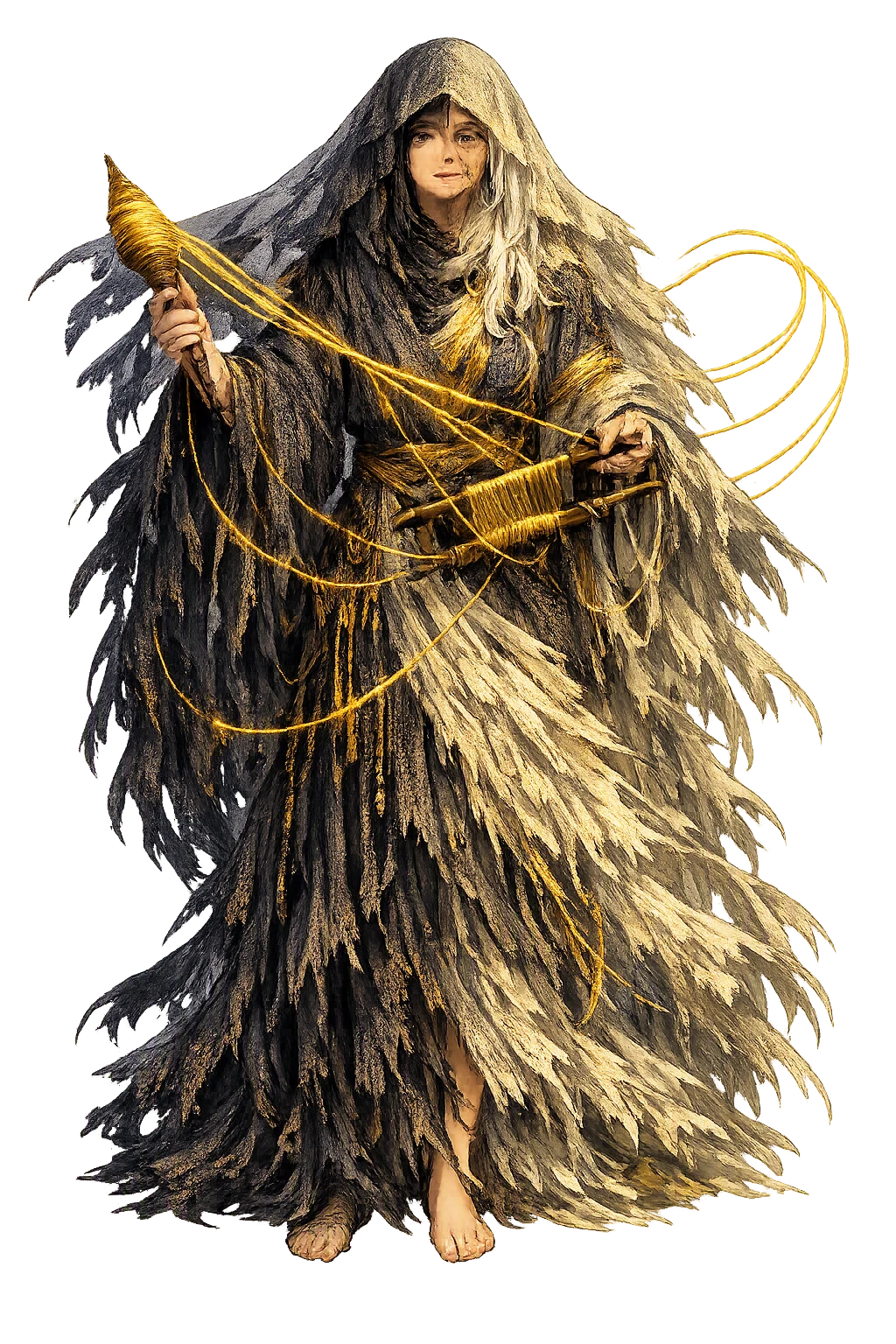
Stories of Wyrd
Wyrd has no mythology in the usual sense — no birth, no hall, no marriage — because Wyrd is not a figure but the Old English word for fate itself. What it has instead is a dossier of sentences: the moments where the poets reach for the word and the whole Anglo-Saxon theory of destiny shows through. Four witnesses matter most — the Wanderer, Beowulf, the proverb poems, and Alfred's Boethius — and one northern mirror, the norn Urðr.
The Exeter Book's exile opens his elegy with the coldest sentence in Old English: 'Wyrd bið ful ārǣd' — fate is wholly fixed, fully resolved, past all appeal. He has buried his lord, crossed the winter seas, and found no hall that will take him in; the word wyrd is the name he gives the weight of all of it. Near the poem's end the word returns in its grandest frame: 'eall is earfoðlīc eorþan rīce, onwendeð wyrda gesceaft weoruld under heofonum' — all is full of hardship in the earthly kingdom; the decree of fates turns the world under heaven.
Note what the poem does not do: it gives Wyrd no face, no spindle, no shrine. The word stays a noun of process — the way things go — and the poem's consolation is not that Wyrd can be moved but that God alone is the fastness that stands when her turning is done.
Beowulf speaks the word at every threshold. Before Grendel he commits the night to it: 'Gǣð ā wyrd swā hīo sceal' — fate goes always as she must. Surfacing from the mere's edge of disaster he states the exception that governs his whole career: 'Wyrd oft nereð unfǣgne eorl, þonne his ellen dēah' — fate often spares the undoomed man, when his courage avails. The two sentences together are the poem's whole theology: doom is real for the doomed (fǣge), but for the undoomed, courage and fate divide the work.
When the dragon comes, the old king feels the balance tip: he knows himself fǣge, and wyrd no longer negotiates. The poet's grammar is exact — fate is spoken of as 'she' (hīo), grammatically feminine, half-personified by the pronoun alone, yet never once given a name, a household, or a cult.
The proverb tradition keeps the word's power in its bluntest form. Maxims II, the catalogue of how things are, ranks her first among forces: 'Wyrd byð swīðost' — fate is strongest — ahead of winter's cold and spring's frost. The dialogue of Solomon and Saturn gives Saturn the matching proverb: fate is hard to turn, and neither wealth nor kinship can turn her.
These are the word's working senses — what the farmers and homilists meant when the poets were not listening: the unalterable course of what happens, stronger than every other thing the maxims catalogue. The homilies sharpen the point: in the Vercelli and Corpus tradition wyrd names the world's turning that must not be trusted, set against the God who stands unmoved above it — the same noun, but already half-tamed toward Alfred's settlement.
When King Alfred's circle translated Boethius's Consolation of Philosophy into Old English, they had to decide what to do with Fortuna and her wheel. They kept the native word: wyrd translates Fortuna throughout — but the translation is a conquest, not a courtesy. Alfred's text subordinates her absolutely: wyrd is God's work and God's instrument, the name for his providence as it is felt from below, turning the world the way a wheelwright turns a wheel — while the nave, God himself, stands still. The Alfredian additions are explicit: Lady Philosophy rebukes the translator's own people for blaming wyrd, and the prose preface promises that Boethius's book will teach them what power she truly has — none, save what God lends her.
It is the great re-founding of the word: the pagan noun of unalterable event is retained, baptized, and set to work inside a Christian providence. Every later English use of wyrd and weird lives downstream of this translation.
The Old Norse cognate is not a common noun but a name: Urðr, 'what has become', eldest of the three Norns. Völuspá sets the scene beneath Yggdrasill, where the well stands under the tree: thence come three maidens, deep in wisdom — Urðr one is called, Verðandi the second, Skuld the third. They laid down laws, they allotted life to the children of men, fates to be told. Snorri adds the daily rite: the Norns draw water from Urðr's well and pour it with the clay over the tree's roots, so its branches do not wither.
England kept the word a noun; Iceland made it a person. The two traditions preserve one inheritance in two grammars — and the PuniCodex lexicon files Wyrd under the Norse pantheon precisely for this kinship, the English word recorded in Beowulf answering its sister at the well.
The Word That Becomes What Happens
Wyrd is the Old English word for what happens — fate, destiny, the shape of events — built on the verb weorðan, 'to become'. It is not a goddess enthroned at a spindle but a noun the poets kept reaching for: 'Wyrd bið ful ārǣd', says the Wanderer — fate is wholly fixed. Beowulf goes to the dragon with 'Gǣð ā wyrd swā hīo sceal' on his lips — fate goes always as she must. Its exact Norse cognate is Urðr, eldest of the three Norns at the well beneath the world-tree; its modern descendant is the word 'weird', the fateful worn smooth into the strange.
From weorðan 'to become': wyrd names the event itself before it names any power behind it — fate as a process, not a person, in the earliest English we have.
Beowulf's maxim on the threshold of every fight — 'Gǣð ā wyrd swā hīo sceal' — the bravest resignation in English verse, spoken by a man who fights anyway.
'Wyrd bið ful ārǣd' — the Wanderer's five-word verdict that fate is wholly resolved: the hardest consolation the Exeter Book offers its exiles.
Urðr at the well with Verðandi and Skuld, laying down laws beneath Yggdrasill — the Old English word's exact Norse twin, personified where England kept her a noun.
From the original script to the living URL
ᚹᚣᚱᛞ
The name in its original Norse form. Wyrd (ᚹᚣᚱᛞ) is attested in the source tradition — “Fate (cognate with Urðr)”. Its original diacritics and script distinctions carry the full phonetic and orthographic weight of the source tradition.
wyrd
The plain wyrd form is identical to the Unicode restoration. Because this name is already written in Latin letters, no diacritics, stress, or script information were lost — only capitalization differs.
Wyrd
The Unicode restoration does not need to recover lost marks for Wyrd. Its value is canonical spelling and consistent cataloguing, not the reconstruction of erased orthography. The domain is readable as-is to both DNS and humanity.
Wyrd.com
This restoration is written entirely in ASCII letters — no Punycode encoding stands between Wyrd and the DNS. The domain reads identically to machines and to human eyes.
Owned, ideal, and ASCII forms of Wyrd
Wyrd
Restores ᚹᚣᚱᛞ. The full Unicode restoration. wyrd.com is not in the PuniCodex collection — it is watched for release; if it drops, this temple upgrades to an owned flagship.
How Wyrd was spoken
How Wyrd travels from ancient script to the modern URL
The lore you have read is the living myth. Extended Lore opens the scholarly vault beneath it: the cult and its material remains, a history of the image, the name after antiquity, a meditation on what the name still means, and the full scholarly apparatus — etymology, orthography, sources.
Enter Extended Lore