
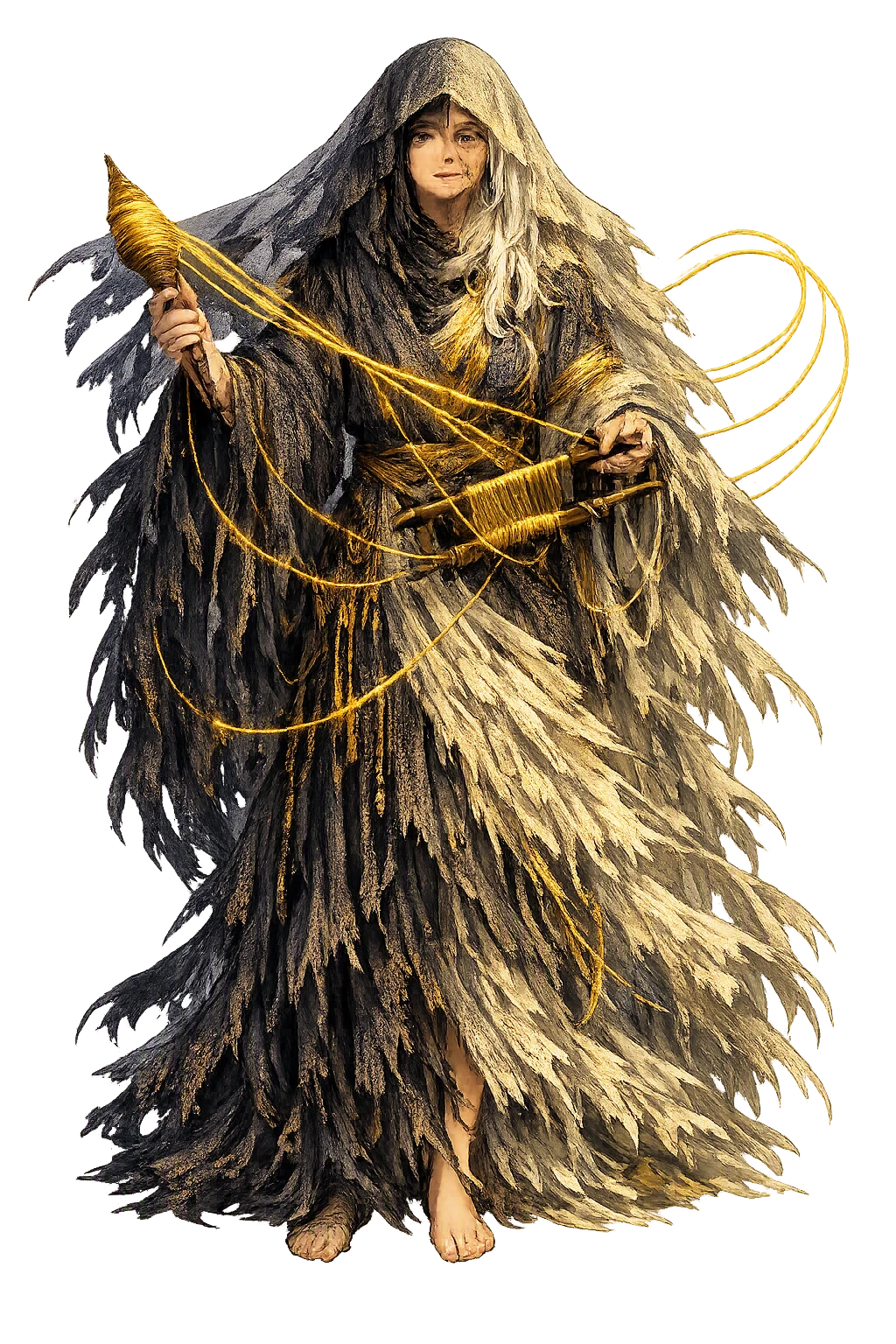
Wyrd in 2026: why scholars still care
Names are not only data points; they are cultural evidence. Wyrd shows why an ASCII spelling can still demand serious scholarship. The sources distinguish this name from every neighboring form, and the temple records that distinction without adding marks the evidence does not contain. What follows is the full picture — name, script, sound, myth, cult, and legacy — ending with the digital home that makes the record easy to reach.
At a Glance
- Canonical name: Wyrd
- ASCII form: wyrd
- Meaning: "Fate (cognate with Urðr)"
- Domain of influence: Fate, Destiny
- Pantheon: Norse
- Restoration: ASCII-equivalent form
- Reconstructed form: ᚹᚣᚱᛞ (Anglo-Saxon Futhorc)
Overview
Wyrd (wyrd) — Fate, Destiny · Fate (cognate with Urðr) — belongs to the Norse tradition, where it is catalogued under the domain "Fate, Destiny". The name means "Fate (cognate with Urðr)".
Wyrd is the Old English word for what happens — fate, destiny, the shape of events — built on the verb weorðan, 'to become'. It is not a goddess enthroned at a spindle but a noun the poets kept reaching for: 'Wyrd bið ful ārǣd', says the Wanderer — fate is wholly fixed. Beowulf goes to the dragon with 'Gǣð ā wyrd swā hīo sceal' on his lips — fate goes always as she must. Its exact Norse cognate is Urðr, eldest of the three Norns at the well beneath the world-tree; its modern descendant is the word 'weird', the fateful worn smooth into the strange.
PuniCodex records the canonical scholarly spelling Wyrd and serves its temple at its temple. The displayed form is ASCII-equivalent — a description computed from the displayed form itself. The plain ASCII form wyrd contains the same letters: no recovered diacritics or special encoding is claimed. The work here is consistent citation, capitalization, provenance, and cultural context.
The Name
The name is attested in Anglo-Saxon Futhorc as ᚹᚣᚱᛞ. Etymologically it means "Fate (cognate with Urðr)".
Fate (cognate with Urðr)
Cognate forms across related languages:
- Urðr) (related)
The canonical spelling Wyrd matches the conventional scholarly romanization. The plain ASCII form wyrd contains the same letters, so no lost diacritics or encoding transition is claimed. The editorial work is to fix one reviewed reference spelling, preserve capitalization and provenance, and keep the original evidence visible. The displayed form is ASCII-equivalent — a description computed from the displayed form itself.
The letter-by-letter transformation runs:
- w → W — Same, capitalized
- y → y — Same
- r → r — Same
- d → d — Same
Etymology & Roots
The recorded derivation reads: Fate (cognate with Urðr)
The root gloss is "Fate."
The reconstruction is classed as attested.
Kindred forms recorded in the lexicon:
- Urðr) (related) — cognate
The Original Script
The name is preserved in Anglo-Saxon Futhorc as ᚹᚣᚱᛞ — Runic (Anglo-Frisian), attested Anglo-Saxon England, c. 700–1000 CE, in England. The script is written left-to-right.
The scholarly transliteration is wyrd (normalized Futhorc), giving the normalized reading /wyrd/.
The rendering proceeds step by step:
- Wyrd is abundantly attested in Old English manuscripts (Beowulf, The Wanderer) — in Latin script with wynn (ƿyrd), not in runes
- No Futhorc inscription of the word is known; this rendering is a normalized phonetic reconstruction, not an attested inscription
The manuscripts write the word in Latin letters with wynn: ƿyrd; normalized Old English orthography prints it wyrd. In the Anglo-Saxon futhorc the word would have been carved ᚹᚣᚱᛞ (w-ȳ-r-d) — a normalized reconstruction, since no runic inscription of the word survives. Because the normalized form is pure ASCII, its domain was registered in the ordinary way long ago: wyrd.com lies outside the PuniCodex collection and is watched for release — no form of the name is currently owned, and this temple claims none.
Pronunciation
The reconstructed pronunciation of the name is /ˈwyrd/ — Old English Reconstruction.
Phoneme by phoneme:
- W- — Labial-velar approximant [w], written wynn (ƿ) in the manuscripts — plain and voiced, as in modern English 'water'.
- -y- — Short close front rounded [y], the vowel English later unrounded and lost: shape the lips for 'oo' while saying 'ee' — German ü in 'über', French u in 'tu'.
- -r- — Alveolar trill or tap [r], fully sounded — Old English r is never silent, and here it closes the syllable hard.
- -d — Voiced alveolar stop [d], final and released — the word ends on a consonant, not a vowel's fading.
For the modern speaker, the closest approximation is: 'WÜRD' — one syllable: begin as in 'we', round the lips tight for ü, roll into a sounded r, and stop on d; a German speaker can say it as the start of 'Würde'.
Kindred and historical forms of the name:
- Old English — wyrd, a feminine noun — 'that which happens, fate, destiny' — personified in verse and prose from the earliest records onward.
- Anglo-Saxon Futhorc — ᚹᚣᚱᛞ (w-ȳ-r-d), the runic row of pre-Viking England; the word itself is unattested in surviving inscriptions.
- Old Norse — Urðr, the exact cognate — eldest of the three Norns who lay down laws beneath Yggdrasill.
- Modern English — weird — the noun of fate worn down to an adjective of strangeness by way of the prophetic 'weird sisters'.
Wyrd is a plain restoration by the mechanical rule: the normalized Old English form is already plain ASCII — no diacritic, no distinctive letter for the ASCII alphabet to lose. The word's thousand-year career vastly outruns its orthography; only the capital distinguishes the restored form from the input.
Mythology
Wyrd has no mythology in the usual sense — no birth, no hall, no marriage — because Wyrd is not a figure but the Old English word for fate itself. What it has instead is a dossier of sentences: the moments where the poets reach for the word and the whole Anglo-Saxon theory of destiny shows through. Four witnesses matter most — the Wanderer, Beowulf, the proverb poems, and Alfred's Boethius — and one northern mirror, the norn Urðr.
Fate Is Wholly Fixed (The Wanderer 5)
The Exeter Book's exile opens his elegy with the coldest sentence in Old English: 'Wyrd bið ful ārǣd' — fate is wholly fixed, fully resolved, past all appeal. He has buried his lord, crossed the winter seas, and found no hall that will take him in; the word wyrd is the name he gives the weight of all of it. Near the poem's end the word returns in its grandest frame: 'eall is earfoðlīc eorþan rīce, onwendeð wyrda gesceaft weoruld under heofonum' — all is full of hardship in the earthly kingdom; the decree of fates turns the world under heaven.
Note what the poem does not do: it gives Wyrd no face, no spindle, no shrine. The word stays a noun of process — the way things go — and the poem's consolation is not that Wyrd can be moved but that God alone is the fastness that stands when her turning is done.
Fate Goes as She Must (Beowulf 455, 572)
Beowulf speaks the word at every threshold. Before Grendel he commits the night to it: 'Gǣð ā wyrd swā hīo sceal' — fate goes always as she must. Surfacing from the mere's edge of disaster he states the exception that governs his whole career: 'Wyrd oft nereð unfǣgne eorl, þonne his ellen dēah' — fate often spares the undoomed man, when his courage avails. The two sentences together are the poem's whole theology: doom is real for the doomed (fǣge), but for the undoomed, courage and fate divide the work.
When the dragon comes, the old king feels the balance tip: he knows himself fǣge, and wyrd no longer negotiates. The poet's grammar is exact — fate is spoken of as 'she' (hīo), grammatically feminine, half-personified by the pronoun alone, yet never once given a name, a household, or a cult.
Fate Is Strongest (Maxims II; Solomon and Saturn)
The proverb tradition keeps the word's power in its bluntest form. Maxims II, the catalogue of how things are, ranks her first among forces: 'Wyrd byð swīðost' — fate is strongest — ahead of winter's cold and spring's frost. The dialogue of Solomon and Saturn gives Saturn the matching proverb: fate is hard to turn, and neither wealth nor kinship can turn her.
These are the word's working senses — what the farmers and homilists meant when the poets were not listening: the unalterable course of what happens, stronger than every other thing the maxims catalogue. The homilies sharpen the point: in the Vercelli and Corpus tradition wyrd names the world's turning that must not be trusted, set against the God who stands unmoved above it — the same noun, but already half-tamed toward Alfred's settlement.
The Christian Taming of Wyrd (Alfred's Boethius)
When King Alfred's circle translated Boethius's Consolation of Philosophy into Old English, they had to decide what to do with Fortuna and her wheel. They kept the native word: wyrd translates Fortuna throughout — but the translation is a conquest, not a courtesy. Alfred's text subordinates her absolutely: wyrd is God's work and God's instrument, the name for his providence as it is felt from below, turning the world the way a wheelwright turns a wheel — while the nave, God himself, stands still. The Alfredian additions are explicit: Lady Philosophy rebukes the translator's own people for blaming wyrd, and the prose preface promises that Boethius's book will teach them what power she truly has — none, save what God lends her.
It is the great re-founding of the word: the pagan noun of unalterable event is retained, baptized, and set to work inside a Christian providence. Every later English use of wyrd and weird lives downstream of this translation.
The Northern Sister (Völuspá 19–20; Gylfaginning 15–16)
The Old Norse cognate is not a common noun but a name: Urðr, 'what has become', eldest of the three Norns. Völuspá sets the scene beneath Yggdrasill, where the well stands under the tree: thence come three maidens, deep in wisdom — Urðr one is called, Verðandi the second, Skuld the third. They laid down laws, they allotted life to the children of men, fates to be told. Snorri adds the daily rite: the Norns draw water from Urðr's well and pour it with the clay over the tree's roots, so its branches do not wither.
England kept the word a noun; Iceland made it a person. The two traditions preserve one inheritance in two grammars — and the PuniCodex lexicon files Wyrd under the Norse pantheon precisely for this kinship, the English word recorded in Beowulf answering its sister at the well.
Symbols & Iconography
The iconography associated with Wyrd concentrates in a small set of recurring attributes, each a compressed statement about the name:
- The decree (wyrda gesceaft) — The Wanderer's 'shaping of fates' that turns the world under heaven — fate as ordinance written into things, not accident
- The fixed resolve (ful ārǣd) — 'Fate is wholly determined' — the exile's hardest consolation, five words that close every appeal
- The spared undoomed man (unfǣgne eorl) — Beowulf's exception — fate often preserves the man not doomed when his courage avails: the loophole that makes heroism rational
- The wheel declined — Alfred's Boethius keeps the word wyrd but strips Fortune's wheel — fate re-founded as God's instrument, not a spinning goddess
- The well of Urðr — The northern mirror — the norn at the spring beneath Yggdrasill where the Æsir hold their judgements
Archaeology & Evidence
Wyrd is a word of manuscripts, not monuments: no runic inscription carves it, no amulet invokes it, and no material image can be identified with a personified Wyrd. Its witnesses are codices. The Exeter Book (Exeter Cathedral Library MS 3501, written c. 975) preserves The Wanderer and Maxims II; the Nowell Codex (British Library, Cotton Vitellius A.xv, c. 1000, scorched in the Ashburnham House fire of 1731) alone preserves Beowulf; the Vercelli Book and the Corpus and CCCC manuscripts carry the homiletic prose where wyrd is debated. The Anglo-Saxon futhorc is itself materially attested — the ninth-century Thames scramasax bears the full inscribed row — and in that row the word would run ᚹᚣᚱᛞ (w-ȳ-r-d), though no surviving carving spells it. The manuscript hand's wynn (ƿ), borrowed from the runes into the book alphabet, is the last material trace of the runic world inside the word's own spelling.
Realm & Domain
Wyrd is the Old English word for what happens — fate, destiny, the shape of events — built on the verb weorðan, 'to become'. It is not a goddess enthroned at a spindle but a noun the poets kept reaching for: 'Wyrd bið ful ārǣd', says the Wanderer — fate is wholly fixed. Beowulf goes to the dragon with 'Gǣð ā wyrd swā hīo sceal' on his lips — fate goes always as she must. Its exact Norse cognate is Urðr, eldest of the three Norns at the well beneath the world-tree; its modern descendant is the word 'weird', the fateful worn smooth into the strange.
The Word for Becoming
From weorðan 'to become': wyrd names the event itself before it names any power behind it — fate as a process, not a person, in the earliest English we have.
Fate Goes as She Must
Beowulf's maxim on the threshold of every fight — 'Gǣð ā wyrd swā hīo sceal' — the bravest resignation in English verse, spoken by a man who fights anyway.
The Fixed Decree
'Wyrd bið ful ārǣd' — the Wanderer's five-word verdict that fate is wholly resolved: the hardest consolation the Exeter Book offers its exiles.
The Northern Sister
Urðr at the well with Verðandi and Skuld, laying down laws beneath Yggdrasill — the Old English word's exact Norse twin, personified where England kept her a noun.
Across Cultures
Wyrd's learned afterlife begins as translation. Bosworth–Toller record the word glossing Latin fatum, fortuna, and even the Parcae — the three spinning Fates — and Alfred's Boethius makes the equation systematic, putting the English word in Fortuna's place while denying her Fortune's independence. The comparison with the Greek Moirai is therefore as old as the word's manuscript life, but Timmer's classic study sounds the necessary caution: Old English wyrd is fundamentally the event-word, 'what happens', and its personification is grammatical and poetic, never cultic — no spindle, no altar, no priesthood is attested. The honest alignment is structural: with the Norns, who in Völuspá 'laid down laws and allotted life', and above all with Urðr herself, the exact cognate, the past tense of becoming enthroned beside Verðandi and Skuld. Within the corpus the related figures are the well's company: Urðr, Verðandi, Skuld, and the tree they tend, Yggdrasill.
Within the Norse tradition, closely related names in the corpus include Álfheimr, Andvari, Angrboða, Auðhumla, Baldr, and Baugi.
Cultural Legacy
The word's modern career is the strangest semantic journey in English. In medieval Scots and northern usage 'weird' stayed a noun of fate — to 'dree one's weird' is to endure one's destiny — and the prophetic women of Holinshed's chronicle were 'the weird sisters, that is (as ye would say) the goddesses of destinie'. Shakespeare took the phrase into Macbeth, the sisters' supernatural strangeness rubbed off on the word, and by the nineteenth century 'weird' meant simply uncanny, then merely odd: the noun of absolute fate worn down to an adjective of mild strangeness. Modern fantasy and gaming revived 'wyrd' as a deliberate archaism for deep fate; runic revivalism added the so-called 'wyrd rune', a blank stone invented in the 1980s with no medieval attestation — a modern ornament the inscriptions do not know. Through all of it the old word keeps its dignity in the Exeter Book and Beowulf, where it still means what it meant: what happens, wholly fixed, and faced with courage.
The Scholarly Record
The account of Wyrd given in this edition rests on the witnesses and reference works listed below. Lexica and etymological dictionaries secure the form and meaning of the name; the literary and religious texts supply the narrative evidence.
- Beowulf, ll. 455 ('Gǣð ā wyrd swā hīo sceal') and 572–573 ('Wyrd oft nereð unfǣgne eorl, þonne his ellen dēah') — Klaeber's Beowulf, 4th ed., ed. Fulk, Bjork & Niles (Toronto, 2008).
- The Exeter Book (ASPR III): The Wanderer 5 ('Wyrd bið ful ārǣd') and 106–107 (wyrda gesceaft); Maxims II 5 ('Wyrd byð swīðost'); Solomon and Saturn (the proverb of fate hard to turn).
- Bosworth–Toller, An Anglo-Saxon Dictionary, s.v. wyrd — the senses 'event, fate, destiny', the personified uses, and the Latin glosses fatum, fortuna, Parcae.
- B. J. Timmer, 'Wyrd in Anglo-Saxon Prose and Poetry', Neophilologus 26 (1941) — the classic semantic study of the word between event, destiny, and half-personified power.
- King Alfred's Old English Version of Boethius, De consolatione philosophiae, ed. Sedgefield (1899); ed. Godden & Irvine (2009) — wyrd translating Fortuna, fate re-founded as God's instrument.
- Völuspá 19–20 (Poetic Edda) and Snorri Sturluson, Gylfaginning 15–16 — Urðr, Verðandi, and Skuld at the well beneath Yggdrasill, the Old Norse cognate personified.
A Meditation
Wyrd is the rare fate-word that never pretends to be a person. The Greeks spun fate into three women with shears; the Icelanders gave her a name and a well; the English kept her a common noun — the shape of what happens, grammatically feminine by accident of declension, addressed by no prayer and moved by no sacrifice. And yet the Beowulf poet finds the loophole that keeps the word honest: fate often spares the undoomed man when his courage avails. Doom is real, but it is not everything; between the fixed decree and the falling sword there is a space the size of a man's ellen, his courage, and in that space the whole heroic ethic of the poem lives. The Wanderer ends where Alfred ends: the decree turns the world under heaven, and the one fastness is not in the turning but above it. A word for fate that leaves room for courage and for God — that is the Anglo-Saxon settlement, and no tradition stated it more economically.
The Canonical Spelling
Wyrd is the canonical spelling used by this temple. The plain ASCII form wyrd contains the same letters, so there are no lost diacritics to recover and no special encoding transition to explain. What the temple preserves is the reviewed reference form: capitalization, conventional romanization, original evidence, and a stable place to inspect them. The value here is not added decoration; it is fidelity to the attested record.
Why This Record Matters
In 2026 the stakes are practical. Search indexes, language models, and localization pipelines inherit whatever spelling the web normalizes. Wyrd teaches the machinery that this reviewed form exists, that it is used, and that it points to a real scholarly record. That is why a project built on philology cares about digital infrastructure: the infrastructure decides which names the future sees, and this temple keeps the whole name visible.
Explore Further
This post is one doorway into the temple. The home page carries the full character breakdown and the ambient canvas; the lore page tells the myths in long form; the Scholarly Edition preserves the sources, pronunciation data, and revision history; and the patron wall supports the restoration directly. For the wider map, browse the Lexicon, explore the Pantheon, or return to the PuniCodex blog.
Related Names
Sources
The full scholarly apparatus — every citation, revision, and review — lives in the Scholarly Edition. Key references for this post:
- Beowulf, ll. 455 ('Gǣð ā wyrd swā hīo sceal') and 572–573 ('Wyrd oft nereð unfǣgne eorl, þonne his ellen dēah') — Klaeber's Beowulf, 4th ed., ed. Fulk, Bjork & Niles (Toronto, 2008).
- The Exeter Book (ASPR III): The Wanderer 5 ('Wyrd bið ful ārǣd') and 106–107 (wyrda gesceaft); Maxims II 5 ('Wyrd byð swīðost'); Solomon and Saturn (the proverb of fate hard to turn).
- Bosworth–Toller, An Anglo-Saxon Dictionary, s.v. wyrd — the senses 'event, fate, destiny', the personified uses, and the Latin glosses fatum, fortuna, Parcae.
- B. J. Timmer, 'Wyrd in Anglo-Saxon Prose and Poetry', Neophilologus 26 (1941) — the classic semantic study of the word between event, destiny, and half-personified power.
- Lexicon authorities for this entry: Beowulf, Bosworth-Toller.