
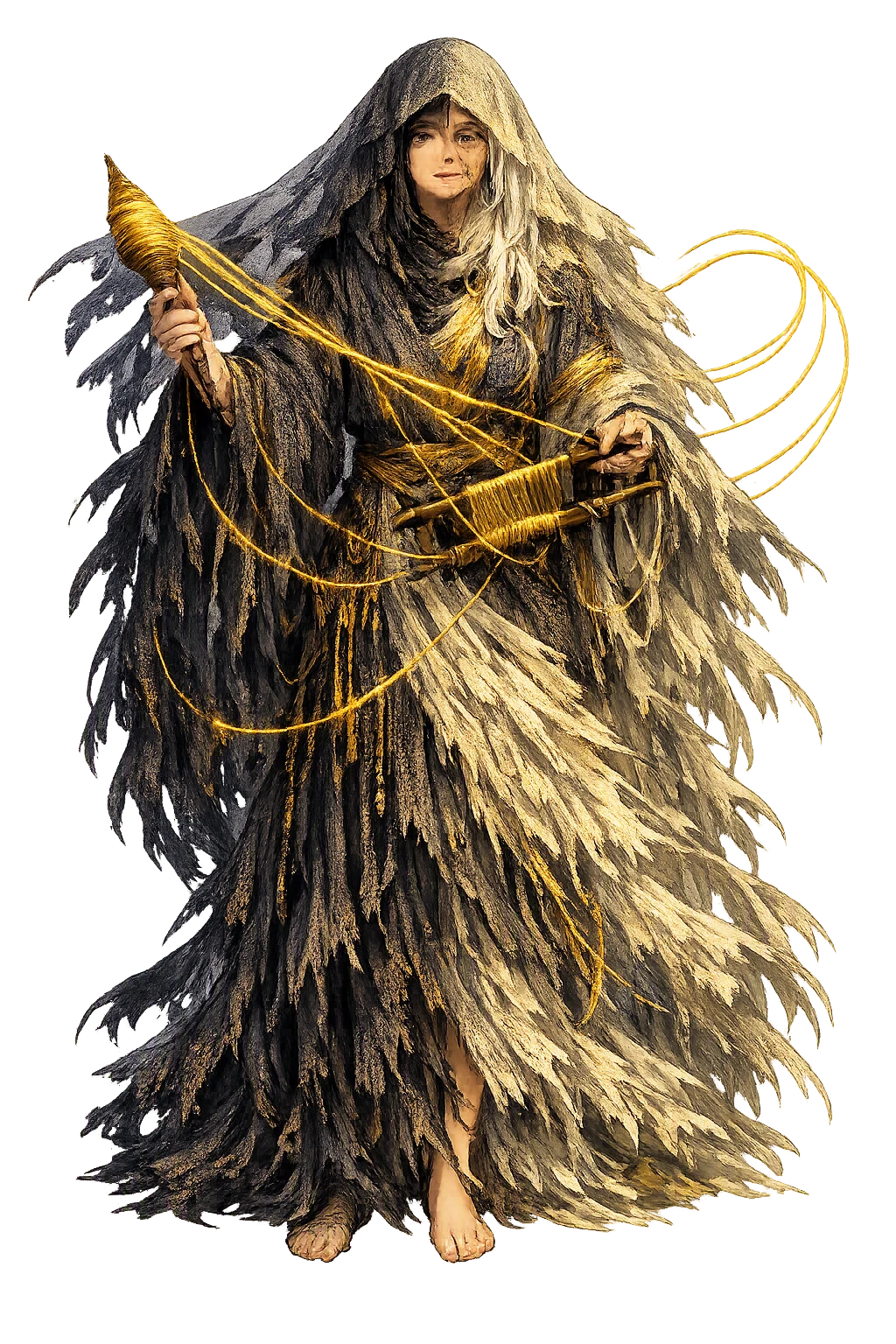
The provenance file on Wyrd
Provenance record 531 · Wyrd · one temple, fully accounted for.
Provenance
1. The attestation. ᚹᚣᚱᛞ, from the tradition's own record. On record: Beowulf, ll. 455 ('Gǣð ā wyrd swā hīo sceal') and 572–573 ('Wyrd oft nereð unfǣgne eorl, þonne his ellen dēah') — Klaeber's Beowulf, 4th ed., ed. Fulk, Bjork & Niles (Toronto, 2008), The Exeter Book (ASPR III): The Wanderer 5 ('Wyrd bið ful ārǣd') and 106–107 (wyrda gesceaft); Maxims II 5 ('Wyrd byð swīðost'); Solomon and Saturn (the proverb of fate hard to turn), Bosworth–Toller, An Anglo-Saxon Dictionary, s.v. wyrd — the senses 'event, fate, destiny', the personified uses, and the Latin glosses fatum, fortuna, Parcae, B. J. Timmer, 'Wyrd in Anglo-Saxon Prose and Poetry', Neophilologus 26 (1941) — the classic semantic study of the word between event, destiny, and half-personified power.
2. The narrative record. Fate Is Wholly Fixed — The Exeter Book's exile opens his elegy with the coldest sentence in Old English: 'Wyrd bið ful ārǣd' — fate is wholly fixed, fully resolved, past all appeal. He has buried his lord, crossed the winter seas, and found no hall that will take him in; the word wyrd is the name he gives the weight of all of it. Fate Goes as She Must — Beowulf speaks the word at every threshold. Before Grendel he commits the night to it: 'Gǣð ā wyrd swā hīo sceal' — fate goes always as she must.
3. The physical record. Wyrd is a word of manuscripts, not monuments: no runic inscription carves it, no amulet invokes it, and no material image can be identified with a personified Wyrd. Its witnesses are codices. The Exeter Book (Exeter Cathedral Library MS 3501, written c. 975) preserves The Wanderer and Maxims II; the Nowell Codex (British Library, Cotton Vitellius A.xv, c. 1000, scorched in the Ashburnham House fire of 1731) alone preserves Beowulf; the Vercelli Book and the Corpus and CCCC manuscripts carry the homiletic prose where wyrd is debated. The Anglo-Saxon futhorc is itself materially attested — the ninth-century Thames scramasax bears the full inscribed row — and in that row the word would run ᚹᚣᚱᛞ (w-ȳ-r-d), though no surviving carving spells it. The manuscript hand's wynn (ƿ), borrowed from the runes into the book alphabet, is the last material trace of the runic world inside the word's own spelling.
4. The current holding. The temple at /wyrd/, classified Tier 2. The restoration keeps one feature the ASCII form drops. One is enough to matter, and the label says so plainly: Tier-2.
5. The documented resonances. Astrology, Tarot & Esoteric Services, AI, Data & Predictive Intelligence, Mental Health & Emotional Wellness — seats argued and weighted in the pattern atlas, read through the myths in this temple's Resonance File.
6. The primary sources. Poetic Edda, Prose Edda — the library this file answers to, open at the Sacred Texts collection.
7. The continuing record. The word's modern career is the strangest semantic journey in English. In medieval Scots and northern usage 'weird' stayed a noun of fate — to 'dree one's weird' is to endure one's destiny — and the prophetic women of Holinshed's chronicle were 'the weird sisters, that is (as ye would say) the goddesses of destinie'.
At a Glance
- Restored name: Wyrd
- ASCII form: wyrd
- Meaning: "Fate (cognate with Urðr)"
- Domain of influence: Fate, Destiny
- Pantheon: Norse
- Classification: Tier 2
- Original script: ᚹᚣᚱᛞ
- Series: The Restoration Files, No. 531 of 548
The File Continues
Read the founding dispatch for the name's full story, the Resonance File for the archetype at work — or the whole archive in one sitting.
Continue the series — previous file: Wǔxíng (read it here) · next file: Xiān (read it here).
The Restoration Files are written from the same canonical record as the temples themselves: the lexicon, the lore catalog, the pattern atlas, and the cited scholarly sources. If a file ever disagrees with its temple, the temple is right — tell us, and the file will be corrected.