
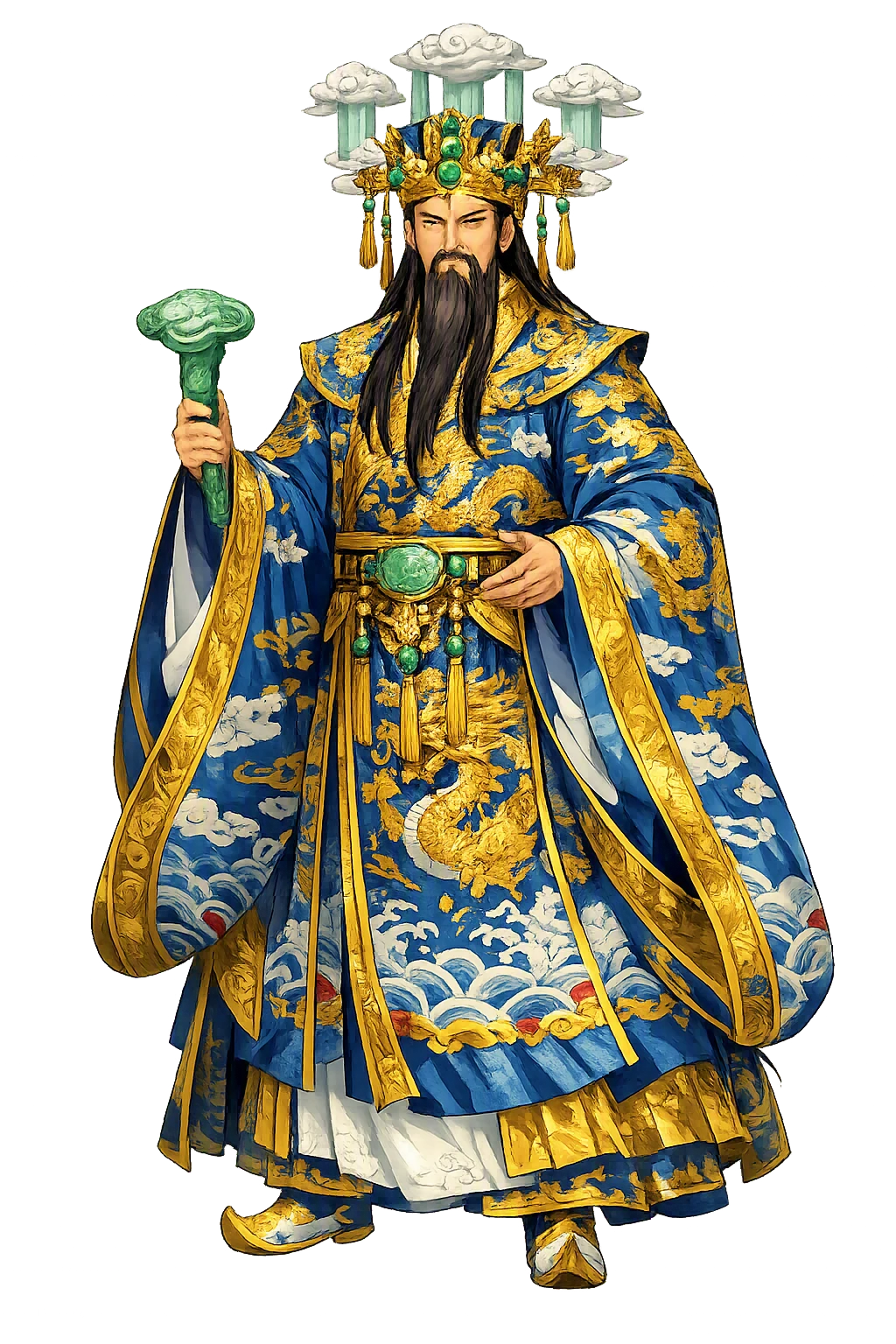
Shàngdì walks into a faith & spiritual organizations firm
Walk into any faith & spiritual organizations outfit and watch for ten minutes. You will see a very old act performed with newer props. The act has a name. It is Shàngdì.
Before the Office, the Story
The King’s Reports. At Yinxu, the last Shang capital (modern Anyang), the kings spoke with Shàngdì through bone and shell. Diviners cracked turtle plastrons and ox scapulae over heat and read the fractures; the questions — Will the harvest be good? Should the king hunt at X?
The Duke of Zhou’s Proclamation. When the Zhōu overthrew the Shang (traditional date 1046 BCE), they faced a theological crisis: how could Heaven’s own dynasty fall? The answer, forged in the Duke of Zhōu’s proclamations, became China’s central political doctrine. The Shang kings had reigned by a charge from on high — the oracle bones already call the god 上帝, and the Zhōu hymns sing ‘Vast is Shàngdì, the ruler of the people below’ (Shijing, Dàyǎ, ‘Dàng’) — but Heaven withdraws its mandate from unvirtuous rulers and bestows it elsewhere: ‘Heaven sees as my people see, Heaven hears as my people hear’ (Shūjīng, ‘Tàishì’).
At a Glance
- Temple: Shàngdì
- Pantheon: Chinese
- Domain of influence: Supreme Deity, Heaven, Sovereign
- Pattern seats: 6
- Sectors touched: Society & Spirit · Culture & Entertainment · Technology & Innovation · Commerce & Governance
- Strongest seat: Faith & Spiritual Organizations
- Series: The Resonance Files, No. 439 of 548
The Reveal, Seat by Seat
Faith & Spiritual Organizations
Now read the why-line with the office in mind: The Highest Emperor of early Chinese religion; the supreme deity to whom the Shang and Zhou kings sacrificed. The people doing this work did not borrow the archetype. They re-derived it — the way Shàngdì was always going to be re-derived wherever supreme deity, heaven, sovereign matters.
Mythic Name Restoration
The High God in classical Chinese, with tones that distinguish meaning. Nobody in that trade worships at this temple. They just keep its hours.
Diacritic-First Domains
Now read the why-line with the office in mind: Toned pinyin distinguishes Shàngdì from its ASCII shadow. The people doing this work did not borrow the archetype. They re-derived it — the way Shàngdì was always going to be re-derived wherever supreme deity, heaven, sovereign matters.
Global Pantheon Brands
Now read the why-line with the office in mind: The High God in classical Chinese, with tones that distinguish meaning. The people doing this work did not borrow the archetype. They re-derived it — the way Shàngdì was always going to be re-derived wherever supreme deity, heaven, sovereign matters.
Leadership, Governance & Public Administration
The Highest Emperor — the apex of sacral kingship in early Chinese religion. Nobody in that trade worships at this temple. They just keep its hours.
Not the First Rebrand
The Han dynasty absorbed Shàngdì into a larger heaven: Tiān became the all-encompassing term while the five directional Thearchs (Wǔdì) shared honours once his alone, a syncretism recorded in the ritual debates of the Shǐjì and the Báihǔtōng. The most consequential identification, however, came from Europe. The office is only the latest translation.
The Method, Stated Plainly
None of this is numerology. A seat exists only where the match can be argued from the deity’s documented domains and deeds — weighted, published, and falsifiable. The derivation, the weights, and the challenge process are public on the methodology page. If a seat in this file reads wrong, the atlas itself tells you how to prove it — and the correction becomes part of the record.
For the Ones Who Work There
For a sponsor in faith & spiritual organizations, the fit here is not adjacency — it is inheritance. Your trade already tells this story every working day; the temple simply holds the original. The patron tier and the advertising terms carry the mechanics; the myths above carry the reason.
The File Continues
This is one of 548 Resonance Files — the third dispatch from every flagship temple, where the myths meet the markets. The temple's founding dispatch tells the name's story; its Restoration File tells the spelling's; the blog index holds the whole archive.
Continue the series — previous: Šamaš (read it) · next: Ṣàngó (read it).
The Resonance Files are argued from the same canonical record as the pattern atlas itself: the lexicon, the lore catalog, and the cited sources. Every seat can be challenged at the methodology page — and the challenge is the point.