
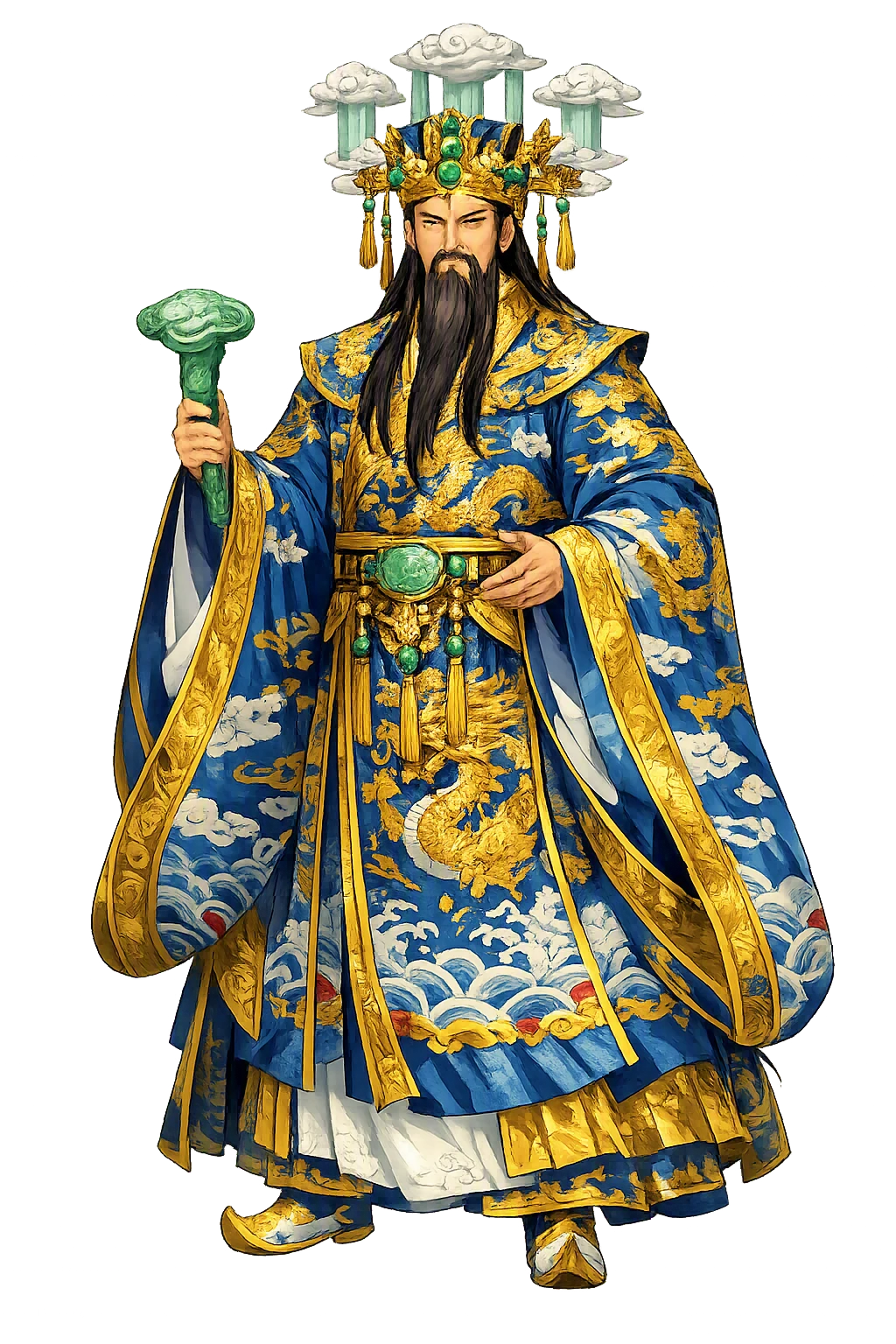
Shàngdì: the stories first, then the spelling
The marks in Shàngdì make the most sense standing next to the myths they have to carry. So the myths come first.
The Stories That Carry the Name
The King’s Reports. At Yinxu, the last Shang capital (modern Anyang), the kings spoke with Shàngdì through bone and shell. Diviners cracked turtle plastrons and ox scapulae over heat and read the fractures; the questions — Will the harvest be good? Should the king hunt at X?
The Duke of Zhou’s Proclamation. When the Zhōu overthrew the Shang (traditional date 1046 BCE), they faced a theological crisis: how could Heaven’s own dynasty fall? The answer, forged in the Duke of Zhōu’s proclamations, became China’s central political doctrine. The Shang kings had reigned by a charge from on high — the oracle bones already call the god 上帝, and the Zhōu hymns sing ‘Vast is Shàngdì, the ruler of the people below’ (Shijing, Dàyǎ, ‘Dàng’) — but Heaven withdraws its mandate from unvirtuous rulers and bestows it elsewhere: ‘Heaven sees as my people see, Heaven hears as my people hear’ (Shūjīng, ‘Tàishì’).
Nothing Between Offering and Sky. The rite that joined king and god was the jiào, the border sacrifice, performed on open ground at the southern edge of the capital. The Lǐjì devotes its ‘Jiāo Tè Shēng’ chapter to the doctrine: the offering is made on unroofed soil — in its developed form at the winter solstice — because nothing may stand between the sacrifice and the sky. The right to perform it belonged to the Son of Heaven alone; a feudal lord who sacrificed at the borders was a rebel in the act itself.
And Here Is What the Spelling Preserves
Against those stories, the attestation: 上帝. The name means "Highest Emperor; the supreme god of early Chinese religion".
The restoration keeps 2 features the ASCII form shangdi cannot show:
- a → à — Grave tone mark: where the voice peaks.
- i → ì — Grave tone mark: where the voice peaks.
A storyteller pronouncing the name would restore every one of them by instinct. The file only writes down what the voice already knows.
At a Glance
- Restored name: Shàngdì
- ASCII form: shangdi
- Meaning: "Highest Emperor; the supreme god of early Chinese religion"
- Domain of influence: Supreme Deity, Heaven, Sovereign
- Pantheon: Chinese
- Classification: Tier 1
- Original script: 上帝
- Series: The Restoration Files, No. 439 of 548
The Name Travels
The Han dynasty absorbed Shàngdì into a larger heaven: Tiān became the all-encompassing term while the five directional Thearchs (Wǔdì) shared honours once his alone, a syncretism recorded in the ritual debates of the Shǐjì and the Báihǔtōng. The most consequential identification, however, came from Europe.
The Address It Earned
The temple of Shàngdì stands at /shangdi/ — lore, scholars, patterns — because a name carrying this much story deserves more than a parking page. The restoration preserves more than the ASCII form can express — stress, length, or a letter the Latin keyboard lost — which places it, mechanically, in Tier-1.
The Sources Are Open
The myths above are retold from the temple's record; the primary voices are in the Sacred Texts: Tao Te Ching. Nothing in this file outranks them.
The File Continues
Read the founding dispatch for the name's full story, the Resonance File for the archetype at work — or the whole archive in one sitting.
Continue the series — previous file: Šamaš (read it here) · next file: Ṣàngó (read it here).
The Restoration Files are written from the same canonical record as the temples themselves: the lexicon, the lore catalog, the pattern atlas, and the cited scholarly sources. If a file ever disagrees with its temple, the temple is right — tell us, and the file will be corrected.