
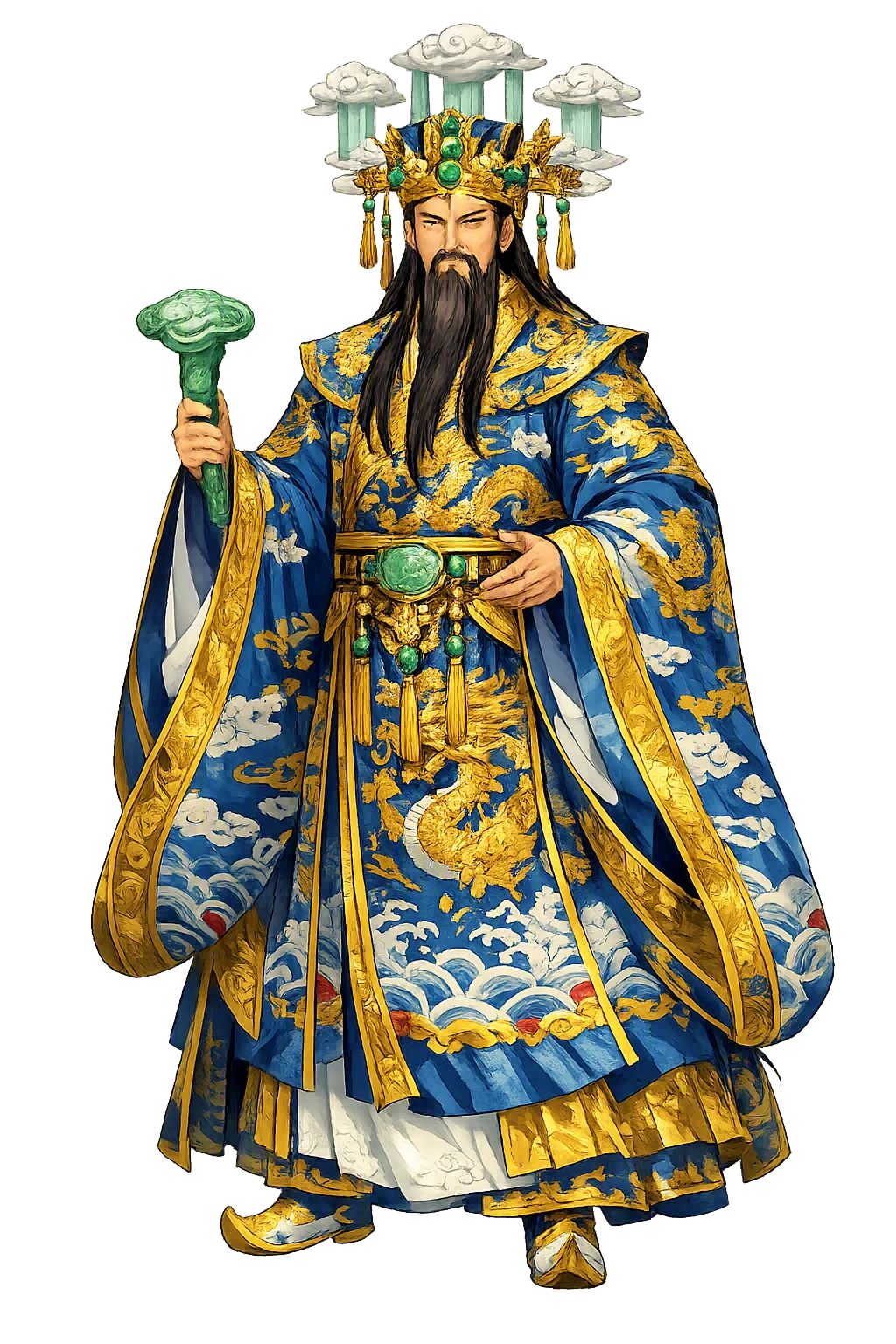
The hidden history behind Shàngdì
Behind the modern ASCII form shangdi hides a much longer story. Shàngdì reaches back through manuscripts, inscriptions, and oral tradition long before it ever touched a keyboard, and every mark in the restored spelling is a receipt from that journey. In what follows we trace the name from its Chinese characters attestations through its mythology, its cult, its symbols, and its afterlife in other cultures — and we show how the PuniCodex project turned that philological record into a Unicode domain that resolves today. The history was never lost. It was only waiting for the infrastructure to catch up.
At a Glance
- Restored name: Shàngdì
- ASCII form: shangdi
- Meaning: "Highest Emperor; the supreme god of early Chinese religion"
- Domain of influence: Supreme Deity, Heaven, Sovereign
- Pantheon: Chinese
- Restoration: Preserves stress
- Original script: 上帝 (Chinese characters)
- Live domain: shàngdì.com
Overview
Shàngdì (shangdi) — Supreme Deity, Heaven, Sovereign · Highest Emperor; the supreme god of early Chinese religion — belongs to the Chinese tradition, where it is catalogued under the domain "Supreme Deity, Heaven, Sovereign". The name means "Highest Emperor; the supreme god of early Chinese religion".
Shàngdì belongs to the Chinese tradition, where it is associated with supreme deity, heaven, sovereign.
PuniCodex restores the name as Shàngdì and serves its temple at shangdi.com. The restoration preserves at least one distinctive feature — a diacritic or a distinctive letter — that the ASCII form loses, and exactly one historically valid Unicode restoration exists. The plain ASCII form shangdi survives as a modern convenience imposed by the early domain-name system; the restoration, not the fallback, is the form the project defends as philologically complete.
The Name
The name is attested in Chinese characters as 上帝. Etymologically it means "Highest Emperor; the supreme god of early Chinese religion".
Shàng (上) 'above, highest'; Dì (帝) 'emperor, thearch' — the high god of Shang and Zhou religion, later identified with Tian.
The ASCII form shangdi survives only because the early domain-name system could not carry diacritics; it is a technological compromise, not an ancient spelling. The Unicode restoration Shàngdì recovers the stress accent of the original directly in the address bar. The restoration preserves at least one distinctive feature — a diacritic or a distinctive letter — that the ASCII form loses, and exactly one historically valid Unicode restoration exists.
The letter-by-letter transformation runs:
- s → S — Same, capitalized
- h → h — Same
- a → à — Grave tone mark
- n → n — Same
- g → g — Same
- d → d — Same
- i → ì — Grave tone mark
The canonical temple for this name is served at shangdi.com.
Etymology & Roots
The recorded derivation reads: Shàng (上) 'above, highest'; Dì (帝) 'emperor, thearch' — the high god of Shang and Zhou religion, later identified with Tian.
The root gloss is "supreme deity."
The reconstruction is classed as attested.
The Original Script
The name is written in Chinese characters as 上帝. This original script is the form against which the ASCII fallback shangdi and the PuniCodex restoration Shàngdì are measured: the restoration preserves its pitch accent of the written form, so that a reader typing the modern address still speaks the ancient name.
Pronunciation
The reconstructed pronunciation of the name is /shangdi/ — Chinese Reconstruction.
Phoneme by phoneme:
- S — Initial character of the restored form Shàngdì.
- hàngdì — Remainder of the name, preserving the distinctive marks of the Chinese tradition.
For the modern speaker, the closest approximation is: 'SHANGDI' — pronounce the restored form with attention to the preserved diacritics and length.
Kindred and historical forms of the name:
- Chinese — Shàngdì, the restored Unicode form of the name
Shàngdì preserves both features because the Chinese form preserves distinctive features that ASCII loses: stress, length, or special characters.
Mythology
The stories of Shàngdì circulate within the Chinese corpus, where the figure embodies supreme deity, heaven, sovereign.
Primary Attestation (Sources)
Shàngdì is attested in the canonical Chinese sources as a figure associated with supreme deity, heaven, sovereign.
Name and Meaning (Etymology)
The name means "Highest Emperor; the supreme god of early Chinese religion" and reflects the figure's role in the tradition. Shàngdì, the Supreme Lord, was the high god of the Shang and early Zhou dynasties. He received sacrifices from the Son of Heaven and controlled harvest, warfare, and the weather. Later Chinese religion absorbed Shàngdì into the more bureaucratic Tiāndào, but the name retained its aura of absolute, personal sovereignty. Oracle bones ask whether Shàngdì will grant rain, bless the harvest, or approve a military campaign, revealing a direct, petitionary relationship between king and high god.
The King’s Reports (Oracle Bones)
At Yinxu, the last Shang capital (modern Anyang), the kings spoke with Shàngdì through bone and shell. Diviners cracked turtle plastrons and ox scapulae over heat and read the fractures; the questions — Will the harvest be good? Should the king hunt at X? Will Lady Hǎo’s childbearing be lucky? — were carved beside the cracks, and sometimes the outcomes were recorded after the fact. The inscriptions show a god who governs wind, rain, drought, and disease, accepts sacrifice, and stands above the royal ancestors yet communes with them (Yinxu oracle-bone corpus, ca. 1250–1046 BCE). What survives is not scripture but correspondence: the oldest continuously readable archive on earth is a king’s file of reports to his god. The mythic grammar is already fully formed — heaven sends misfortune when neglected and favour when fed — and it would structure Chinese political theology for three thousand years.
The Duke of Zhou’s Proclamation (The Mandate)
When the Zhōu overthrew the Shang (traditional date 1046 BCE), they faced a theological crisis: how could Heaven’s own dynasty fall? The answer, forged in the Duke of Zhōu’s proclamations, became China’s central political doctrine. The Shang kings had reigned by a charge from on high — the oracle bones already call the god 上帝, and the Zhōu hymns sing ‘Vast is Shàngdì, the ruler of the people below’ (Shijing, Dàyǎ, ‘Dàng’) — but Heaven withdraws its mandate from unvirtuous rulers and bestows it elsewhere: ‘Heaven sees as my people see, Heaven hears as my people hear’ (Shūjīng, ‘Tàishì’). In the transmission the name itself migrates: Shàngdì’s personal sovereignty becomes Tiān, Heaven, the Zhōu’s more abstract guarantor (Shūjīng, ‘Dà Gào’). One conquest thus rewrote the supreme god into a principle — and made every later rebellion a theological argument armed with a scriptural proof-text.
Nothing Between Offering and Sky (The Border Sacrifice)
The rite that joined king and god was the jiào, the border sacrifice, performed on open ground at the southern edge of the capital. The Lǐjì devotes its ‘Jiāo Tè Shēng’ chapter to the doctrine: the offering is made on unroofed soil — in its developed form at the winter solstice — because nothing may stand between the sacrifice and the sky. The right to perform it belonged to the Son of Heaven alone; a feudal lord who sacrificed at the borders was a rebel in the act itself. Around it grew the full liturgy of cosmic kingship: the round jade disk offered to Heaven, the Hall of Light where the ruler faced the directional thearchs, the calendar promulgated as the king’s gift to time. The myth’s logic is exquisite: to monopolise the god is to monopolise legitimacy, and the monopoly is enforced not by swords but by the rules of the altar.
Symbols & Iconography
The iconography associated with Shàngdì concentrates in a small set of recurring attributes, each a compressed statement about the name:
- Restored Name — The Unicode form Shàngdì carries the original marks of the Chinese tradition.
- Source Script — Attested in the original script as 上帝.
- Domain — Supreme Deity, Heaven, Sovereign
- Etymology — Highest Emperor; the supreme god of early Chinese religion
- The graph 帝 — The ‘thearch’ sign — the high god’s title on the oracle bones, later inherited by every human emperor.
- The oracle bone — Turtle plastron and ox scapula, cracked and inscribed: the medium through which the Shang kings reported to Shàngdì.
- The southern border altar (郊) — Open-air sacrifice on bare ground south of the capital — no roof allowed to stand between offering and sky.
- The jade disk (璧) — The round jade symbol of Heaven, paired in royal offerings with the square cōng tube of earth.
- The Hall of Light (明堂) — The cosmological hall where the king faced the directions of Shàngdì’s realm and enacted the seasons (Liji, ‘Míngtáng wèi’).
Archaeology & Evidence
The material record for Shàngdì survives in a small number of securely identified remains, catalogued below; the corpus is thin but unambiguous, and each site is tied to the name by ancient testimony.
Shàngdì is attested in the textual and iconographic record of the Chinese tradition.
Realm & Domain
Shàngdì belongs to the Chinese tradition, where it is associated with supreme deity, heaven, sovereign.
Supreme Deity
The central domain of Shàngdì in the chinese tradition.
Highest Emperor; the supreme god of earl
The name signifies "Highest Emperor; the supreme god of early Chinese religion".
Unicode Restoration
The restoration Shàngdì recovers what plain ASCII shangdi flattens.
Original Attestation
Attested in the sources as 上帝.
The Border Sacrifice
The jiào 郊 at the southern suburban altar: the Son of Heaven’s open-air offering to Shàngdì, performed for three millennia.
Heaven’s Mandate
天命 Tiānmìng: dynasties reign by Shàngdì’s charge and fall when the charge is exhausted — the oldest Chinese theory of legitimacy.
Across Cultures
Shàngdì appears within the Chinese tradition and has influenced later retellings, artistic depictions, and scholarly study. The Unicode restoration preserves the name's distinctive orthography for contemporary use.
Within the Chinese tradition, closely related names in the corpus include Bāguà, Cáishén, Cháng'é, Fúxī, Guāndì, and Guānyīn.
Cultural Legacy
Shàngdì continues to appear in scholarship, art, and popular reception as a significant figure of the Chinese tradition. Restoring the name in Unicode returns the original marks that ASCII removes. The concept influenced later Daoist and Confucian theology and was translated by Jesuits as "Lord on High," shaping early Sino-Christian dialogue.
The Scholarly Record
The account of Shàngdì given in this edition rests on the witnesses and reference works listed below. Lexica and etymological dictionaries secure the form and meaning of the name; the literary and religious texts supply the narrative evidence.
- Unihan Database.
- Hanyu Da Zidian. Oracle-bone inscriptions and the Shangshu provide the earliest evidence; later scholarship traces the concept's transformation.
A Meditation
Shàngdì embodies supreme deity, heaven, sovereign in the Chinese imagination. The name's restoration is not merely cosmetic: it recovers the stress, length, and script that make the figure recognizable in the source tradition.
The Unicode Restoration
Shàngdì preserves stress. The ASCII fallback shangdi still resolves everywhere, but it is the restored form that carries the name's full information. Across the 7 characters of the name, the restoration adjusts 2: 2 marks of stress (à, ì). That is the whole thesis of this temple: the marks are the message.
Character by Character
The journey from shangdi to Shàngdì, one character at a time:
- s → S — Same, capitalized
- h → h — Same
- a → à — Grave tone mark
- n → n — Same
- g → g — Same
- d → d — Same
- i → ì — Grave tone mark
The Domain Name
The restored name is live as a working domain: shàngdì.com, which the DNS carries in punycode form as xn--shngd-sqa1g.com — an ASCII-compatible encoding that lets a non-ASCII name travel the global network without breaking older infrastructure. The visitor sees Shàngdì; the machines see the encoding. That duality is the engineering compromise on which the entire restoration rests, and it is why a name written the way its own tradition wrote it in Chinese characters can now be typed into any browser on earth.
The Chinese Pantheon
Shàngdì is one of 59 entries the PuniCodex lexicon catalogues under the Chinese pantheon. The Pantheon page gathers the tradition's major figures in one place, and the Lexicon lets you filter all 983 restorations by tradition or script — the fastest way to see where this name sits among its kin.
Frequently Asked Questions
What does Shàngdì mean? The traditional gloss is "Highest Emperor; the supreme god of early Chinese religion."
Which tradition does Shàngdì belong to? Shàngdì is catalogued in the Chinese pantheon of the PuniCodex lexicon.
What does Shàngdì preserve that ASCII cannot show? The form itself answers: Shàngdì preserves stress — and the marks in the restored spelling are exactly that evidence.
Is Shàngdì a working domain? Yes — shàngdì.com resolves today and routes to this temple.
What is the punycode for shàngdì.com? The DNS encoding is xn--shngd-sqa1g.com; browsers perform the translation automatically, so visitors only ever see the restored name.
Can I use Shàngdì in a normal browser? Yes. The DNS resolves the punycode form automatically, and the type tool on this site converts shangdi to Shàngdì for copying and pasting.
Where does the scholarly information come from? The entry is built from lexica, inscriptional evidence, and reviewed scholarly sources listed in the Scholarly Edition. Every claim is traceable to a canonical source.
Typing Shàngdì
You do not need a special keyboard to use this restoration. The PuniCodex Type Tool converts the ASCII form shangdi into Shàngdì as you type, and the browser extension offers the same conversion inside any text field. Copy the restored form, paste it into the address bar, and the DNS does the rest.
Sister Temples
Other temples in the Chinese pantheon include Huángdì, and Kūnlún — each with its own restoration story, its own scholarly record, and its own place in the lexicon.
Why This Restoration Matters
The story of Shàngdì did not end in antiquity; it changed medium. Names that survive for millennia do so because each generation finds a new carrier for them — clay, papyrus, print, and now DNS. The PuniCodex restoration simply makes the carrier honest: the spelling that resolves is the spelling the evidence supports. If this post showed anything, it is that shangdi and Shàngdì are not the same name with different styling. They are a summary and the text it summarizes. The web can now serve the text.
Explore Further
This post is one doorway into the temple. The home page carries the full character breakdown and the ambient canvas; the lore page tells the myths in long form; the Scholarly Edition preserves the sources, pronunciation data, and revision history; and the patron wall supports the restoration directly. For the wider map, browse the Lexicon, explore the Pantheon, or return to the PuniCodex blog.
A Closer Look at the Marks
A restored name is a small map. In Shàngdì, the journey from the ASCII fallback shangdi to the Unicode form can be read letter by letter, and each letter tells a story. Of the 7 characters, 5 remain unchanged; they anchor the name to its modern shape. The remaining adjustments recover marks the source tradition used to distinguish this name from every other word built from the same letters.
The s stays as it is — Same, capitalized.
The h stays as it is — Same.
The a becomes à — Grave tone mark.
The n stays as it is — Same.
The g stays as it is — Same.
The d stays as it is — Same.
The i becomes ì — Grave tone mark.
Together these changes are not decoration. They are the minimum set of marks needed to keep the name legible in its own tradition. Remove them and you still have a string of letters; you no longer have the name as it was written.
Shàngdì in Its Tradition
Shàngdì does not stand alone. It belongs to the Chinese tradition, where it is counted among 59 names in the PuniCodex lexicon. Its sphere — Supreme Deity, Heaven, Sovereign — places it beside other figures who govern similar aspects of experience. The restored spelling is therefore not only a philological decision; it is a way of keeping the name in the company of its kin. When the address bar shows Shàngdì, it marks the boundary between a generic search term and a named entry in a living catalog of myth. That catalog is the point of the project. Every restored name is a vote for specificity: the web should know the difference between a figure and a keyword, between a tradition and a trend. Shàngdì is one such vote.
Related Names
Sources
The full scholarly apparatus — every citation, revision, and review — lives in the Scholarly Edition. Key references for this post:
- Shujing (Classic of Documents).
- Shijing (Classic of Poetry).
- Huainanzi.
- Daoist Canon (Daozang), cosmogonic and ritual texts.
- Chinese Buddhist canon (Dàzàngjīng / Taishō Tripiṭaka).
- Chinese classics (Buddhist-Confucian debates).
- Unihan Database.
- Hanyu Da Zidian.
- Lexicon authorities for this entry: Shang oracle bones, Shijing, Shujing.