The Living Myth
Supreme Deity, Heaven, Sovereign · Highest Emperor; the supreme god of early Chinese religion
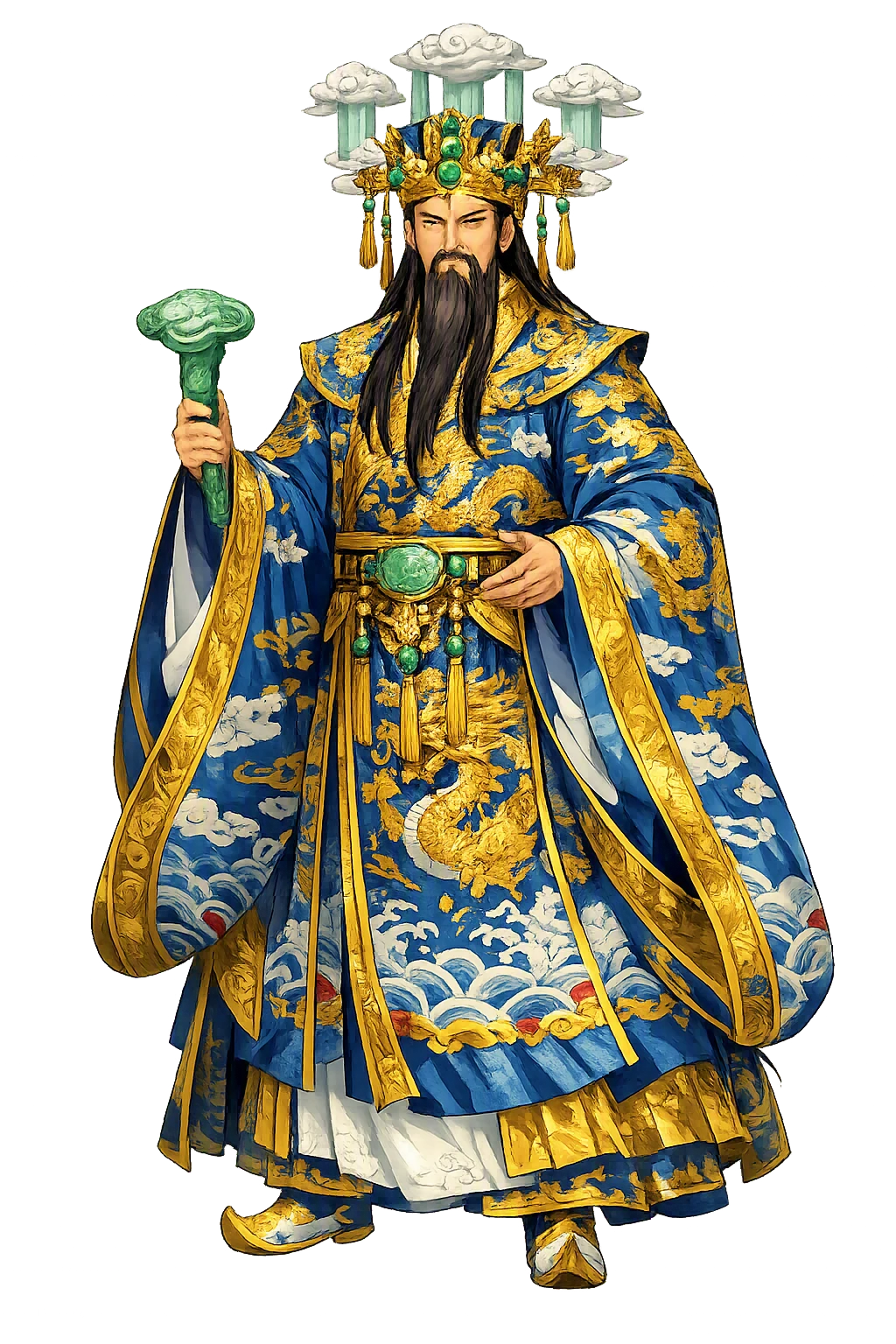
Stories of Shàngdì
Shàngdì has no birth-story and no wandering heroics: the earliest Chinese supreme god rules from above as a sovereign, granting harvest, victory, and the mandate to kings who sacrifice at his altar. What survives is not a cycle of myths but three thousand years of court theology — divination, sacrifice, and the argument over what it means that Heaven is watching.
At Yinxu, the last Shang capital (modern Anyang), the kings spoke with Shàngdì through bone and shell. Diviners cracked turtle plastrons and ox scapulae over heat and read the fractures; the questions — Will the harvest be good? Should the king hunt at X? Will Lady Hǎo’s childbearing be lucky? — were carved beside the cracks, and sometimes the outcomes were recorded after the fact. The inscriptions show a god who governs wind, rain, drought, and disease, accepts sacrifice, and stands above the royal ancestors yet communes with them (Yinxu oracle-bone corpus, ca. 1250–1046 BCE). What survives is not scripture but correspondence: the oldest continuously readable archive on earth is a king’s file of reports to his god. The mythic grammar is already fully formed — heaven sends misfortune when neglected and favour when fed — and it would structure Chinese political theology for three thousand years.
When the Zhōu overthrew the Shang (traditional date 1046 BCE), they faced a theological crisis: how could Heaven’s own dynasty fall? The answer, forged in the Duke of Zhōu’s proclamations, became China’s central political doctrine. The Shang kings had reigned by a charge from on high — the oracle bones already call the god 上帝, and the Zhōu hymns sing ‘Vast is Shàngdì, the ruler of the people below’ (Shijing, Dàyǎ, ‘Dàng’) — but Heaven withdraws its mandate from unvirtuous rulers and bestows it elsewhere: ‘Heaven sees as my people see, Heaven hears as my people hear’ (Shūjīng, ‘Tàishì’). In the transmission the name itself migrates: Shàngdì’s personal sovereignty becomes Tiān, Heaven, the Zhōu’s more abstract guarantor (Shūjīng, ‘Dà Gào’). One conquest thus rewrote the supreme god into a principle — and made every later rebellion a theological argument armed with a scriptural proof-text.
The rite that joined king and god was the jiào, the border sacrifice, performed on open ground at the southern edge of the capital. The Lǐjì devotes its ‘Jiāo Tè Shēng’ chapter to the doctrine: the offering is made on unroofed soil — in its developed form at the winter solstice — because nothing may stand between the sacrifice and the sky. The right to perform it belonged to the Son of Heaven alone; a feudal lord who sacrificed at the borders was a rebel in the act itself. Around it grew the full liturgy of cosmic kingship: the round jade disk offered to Heaven, the Hall of Light where the ruler faced the directional thearchs, the calendar promulgated as the king’s gift to time. The myth’s logic is exquisite: to monopolise the god is to monopolise legitimacy, and the monopoly is enforced not by swords but by the rules of the altar.
In 219 BCE the First Emperor of Qín — who had burnt the classics and buried the scholars — climbed Mount Tài to perform the Fēng and Shàn, the twin rites by which a ruler seals a written report to Heaven into the earth and beneath the mountain (Sīmǎ Qiān, Shǐjì 28, ‘Fēngshàn shū’). The text of Qín Shǐhuáng’s report was kept secret; what matters is that it existed. The most anti-traditional ruler in Chinese history still required the oldest god’s receipt for his achievement — a bureaucracy of one document, addressed upward, more binding than any law he had issued downward. The episode closes the archaic theology on a note of purest pragmatism: Heaven, whatever it was, had to be answered to. The dynasty of the iron bureaucrat still needed the older bureaucracy — the one whose office was the sky itself.
Supreme Deity, Heaven, Sovereign
Shàngdì (上帝), the “Highest Thearch,” is the supreme god of earliest recorded Chinese religion — the divine sovereign to whom the Shang kings reported through oracle-bone divination and border sacrifice, ancestor of the later concept of Tiān (Heaven), and the distant original of the imperial Temple of Heaven.
The jiào 郊 at the southern suburban altar: the Son of Heaven’s open-air offering to Shàngdì, performed for three millennia.
天命 Tiānmìng: dynasties reign by Shàngdì’s charge and fall when the charge is exhausted — the oldest Chinese theory of legitimacy.
The tones in Shàngdì carry meaning; plain ‘shangdi’ flattens the name into something no dynasty would recognise.
Written 上帝 on oracle bones from Yinxu (Anyang), ca. 1250–1046 BCE — China’s oldest readable archive.
From the original script to the living URL
上帝
The name in its original Chinese form. Shàngdì (上帝) is attested in the source tradition — “Highest Emperor; the supreme god of early Chinese religion”. Its original diacritics and script distinctions carry the full phonetic and orthographic weight of the source tradition.
shangdi
Reduced to plain shangdi, the name loses everything that made it specific: original diacritics and script distinctions. What remains is an ASCII string that machines can parse but that no longer speaks with its original voice.
Shàngdì
The Unicode restoration recovers what ASCII flattened. Shàngdì restores original diacritics and script distinctions, returning the name to its original written dignity. The domain encodes to Punycode, but the browser displays the truth.
Shàngdì.com → xn--shngd-sqa1g.com
The non-ASCII characters in Shàngdì are encoded while the ASCII remains visible. To the DNS, it is Punycode. To humanity, it is Shàngdì.
Owned, ideal, and ASCII forms of Shàngdì
Shàngdì
Restores 上帝. The live temple domain — shàngdì.com.
shangdi
Flattens 上帝. The plain ASCII fallback — what DNS and legacy systems see.
How Shàngdì was spoken
How Shàngdì is preserved in writing
A bespoke provenance study for Shàngdì is being prepared by the PUNICODEX scholarly team.
Contribute scholarly provenance →The lore you have read is the living myth. Extended Lore opens the scholarly vault beneath it: the cult and its material remains, a history of the image, the name after antiquity, a meditation on what the name still means, and the full scholarly apparatus — etymology, orthography, sources.
Enter Extended Lore