
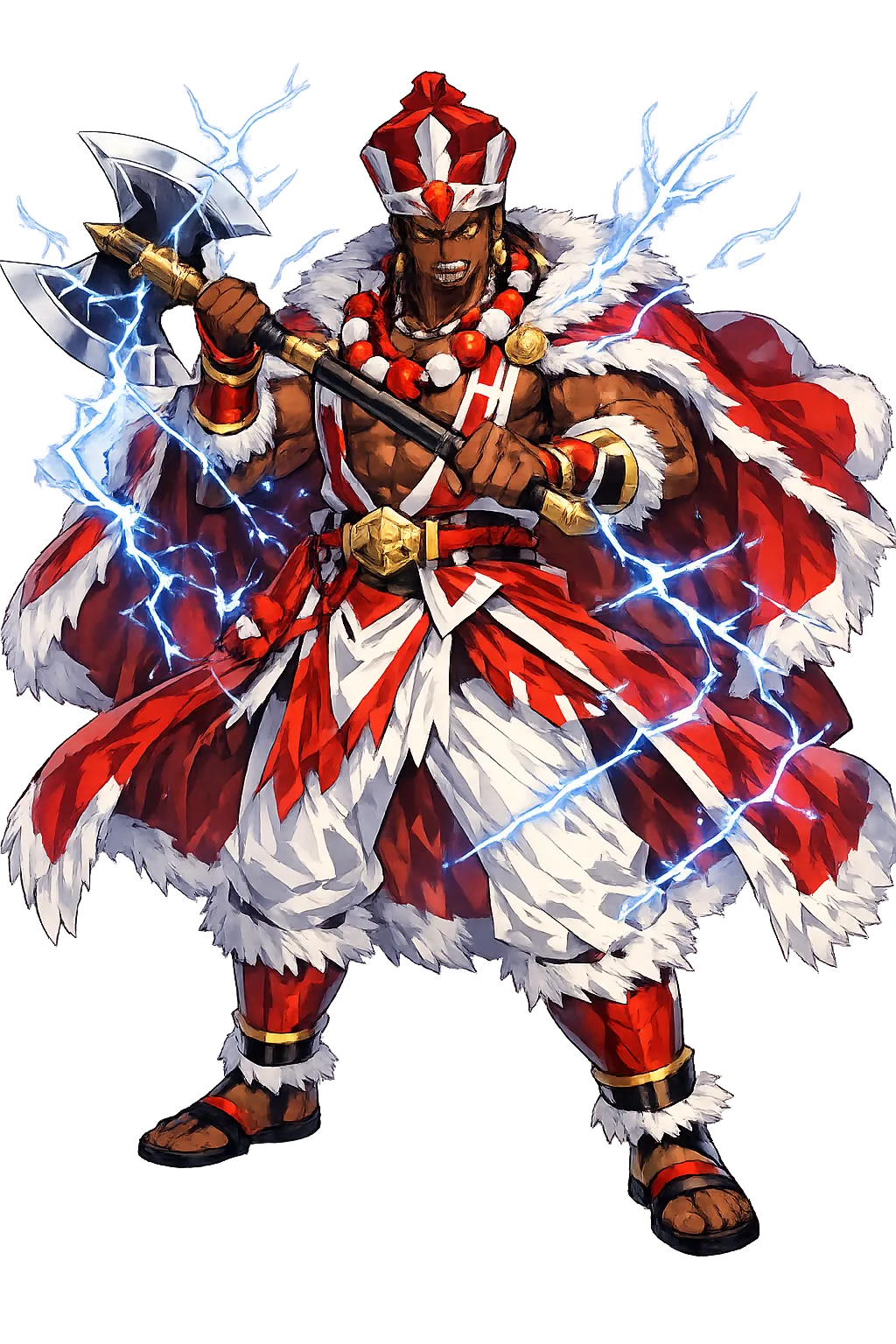
Stress-testing Ṣàngó: do the industry seats hold?
Audit notes, Ṣàngó: we took every seat the atlas claims for this temple and tried to break it against the myths. What survived is below.
At a Glance
- Temple: Ṣàngó
- Pantheon: Yoruba
- Domain of influence: Thunder, Fire, Justice
- Pattern seats: 5
- Sectors touched: Energy & Natural World · Society & Spirit · Commerce & Governance
- Strongest seat: Meteorology & Weather Intelligence
- Series: The Resonance Files, No. 438 of 546
The Test
Seat 1: Meteorology & Weather Intelligence
Claim: The deified king who became the storm itself — “he who strikes”; thunder is his name and his judgment. Exhibit: The Fourth Aláàfin of Ọ̀yọ́ — Ṣàngó was the fourth Aláàfin — king — of Ọ̀yọ́, and the traditions collected by Samuel Johnson (The History of the Yorubas, 1921), checked against the chronicles analysed by Robin Law (The Oyo Empire, 1977), make him a historical ruler later wrapped in divinity.
Verdict: survives scrutiny. The myth and the trade do the same work.
Seat 2: Faith & Spiritual Organizations
Claim: The deified king at the heart of Santería and Candomblé. Exhibit: The Fire That Consumed the Palace — Johnson's chronicle credits Ṣàngó with a fearful sorcery: charms that breathed fire on his enemies.
Verdict: survives scrutiny. The myth and the trade do the same work.
Seat 3: Leadership, Governance & Public Administration
Claim: The deified king of Oyo; thunder with a crown. Exhibit: Three Wives of Thunder — Ṣàngó's household is a small pantheon, and its myths are the corpus's sharpest studies of desire and power.
Verdict: survives scrutiny. The myth and the trade do the same work.
Seat 4: Legal, Justice & Compliance
Claim: Thunder justice; the king who judges with fire. Exhibit: The Fourth Aláàfin of Ọ̀yọ́ — Ṣàngó was the fourth Aláàfin — king — of Ọ̀yọ́, and the traditions collected by Samuel Johnson (The History of the Yorubas, 1921), checked against the chronicles analysed by Robin Law (The Oyo Empire, 1977), make him a historical ruler later wrapped in divinity.
Verdict: survives scrutiny. The myth and the trade do the same work.
Seat 5: Thermal, Geothermal & Fire Energy
Claim: Fire and thunder together; the strike that ignites. Exhibit: The Fire That Consumed the Palace — Johnson's chronicle credits Ṣàngó with a fearful sorcery: charms that breathed fire on his enemies.
Verdict: stands. Strip both to their function and the functions match.
The Control Group
Against the seats that survived, one control: the temple's own summary of its figure — Ṣàngó's mythology moves between the palace and the sky. The seats do not drift far from it. That is the audit's cleanest result.
The Method, Stated Plainly
None of this is numerology. A seat exists only where the match can be argued from the deity’s documented domains and deeds — weighted, published, and falsifiable. The derivation, the weights, and the challenge process are public on the methodology page. If a seat in this file reads wrong, the atlas itself tells you how to prove it — and the correction becomes part of the record.
For the Ones Who Work There
For a sponsor in meteorology & weather intelligence, the fit here is not adjacency — it is inheritance. Your trade already tells this story every working day; the temple simply holds the original. The patron tier and the advertising terms carry the mechanics; the myths above carry the reason.
The File Continues
This is one of 546 Resonance Files — the third dispatch from every flagship temple, where the myths meet the markets. The temple's founding dispatch tells the name's story; its Restoration File tells the spelling's; the blog index holds the whole archive.
Continue the series — previous: Shàngdì (read it) · next: Šāpšu (read it).
The Resonance Files are argued from the same canonical record as the pattern atlas itself: the lexicon, the lore catalog, and the cited sources. Every seat can be challenged at the methodology page — and the challenge is the point.