
Why Raijin is spelled that way — and what it costs to get it right
There is no broken version of this name to repair. There is a record to preserve: Raijin, exactly as the scholarly convention supports it.
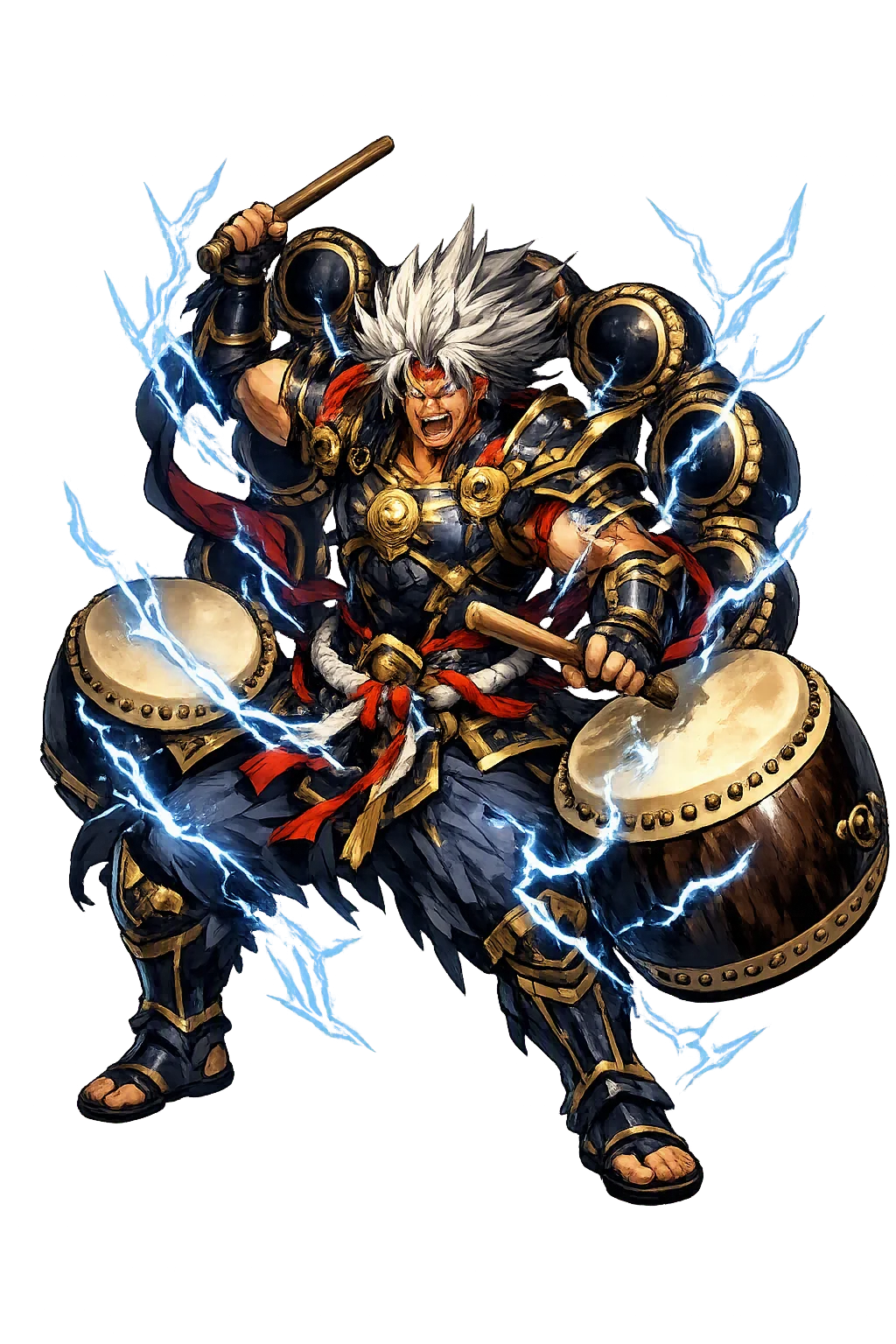
Raijin's mythology is a palimpsest: the thunder kami of the Kojiki, the Buddhist guardian of esoteric temple art, the storm god of the Mongol-invasion legend, and the bogey of nursery warnings — four layers of one drumbeat. The sources are layered and partly at odds, and each layer tells us what thunder meant to a different Japan.
At a Glance
- Canonical name: Raijin
- ASCII form: raijin
- Meaning: "Thunder god"
- Domain of influence: Thunder, Lightning
- Pantheon: Japanese
- Restoration: ASCII-equivalent form
- Original script: 雷神
- Series: The Restoration Files, No. 445 of 597
The Name, Plain and Exact
The name is attested as 雷神, as Kojiki (thunder deities born of Izanami; Fūjin born of Izanagi's breath) and Nihon Shoki (parallel variants) record. On the evidence, it means "Thunder god".
Spoken, the name runs `/ɾa.i.dʑiɴ/` — 'RAH-ee-jeen' — the 'r' is a light tap, and the final 'n' is a soft nasal.
The Temple That Stands Now
The canonical name is not a plaque; it is an address. The temple of Raijin lives at /raijin/, with its mythology in the lore halls, its peer-reviewed record in the Scholarly Edition, and its place in the pattern atlas on the patterns floor.
The displayed form is ASCII-equivalent.
Where the Name Stood First
Raijin's material record is pictorial and architectural rather than inscriptional. The supreme witness is Tawaraya Sōtatsu's Fūjin-Raijin-zu (early seventeenth century, ink and color on paper, National Treasure, Kennin-ji, Kyoto), which fixed the modern image of the drum-ringed thunderer. The Kaminarimon ('Thunder Gate') of Sensō-ji, Asakusa, first built in 942 and rebuilt in 1960 after the 1865 fire, enshrines Fūjin and Raijin statues above its famous lantern. Sets of the Twelve Devas (Jūni-ten) at esoteric temples such as Tō-ji in Kyoto preserve Heian-period sculptural lineages of the thunder guardian, and Hokusai's manga sketches spread his likeness to every corner of Japan. The temple on the web is the newest of these addresses — the first one that fits in a pocket.
The Archetype at Work
The pattern atlas seats this temple in 3 industries, each match argued and weighted: Music, Arts & Performance (the thunder kami whose taiko drums circle every storm; Sōtatsu's Fūjin-Raijin screens are national treasures.); Meteorology & Weather Intelligence (the thunder kami who beats his drums around the storm; Japanese art pairs him with Fūjin as the weather itself.); Insurance & Protection Services (thunder and lightning are the oldest insurable risks; his drums are the claim siren.). The Resonance File reads those seats through the myths themselves.
In the Sacred Texts
The Japanese tradition is not a vibe; it is a library. The Sacred Texts collection holds Kojiki and Nihon Shoki — the primary sources the temple's scholarship is built on. The temple is the argument; the texts are the evidence.
The File Continues
The temple's founding dispatch tells the name's story; its Resonance File reads the myths into the industries; the blog index holds the whole archive.
Continue the series — previous file: Ragnarǫk (read it here) · next file: Rāma (read it here).
The Restoration Files are written from the same canonical record as the temples themselves: the lexicon, the lore catalog, the pattern atlas, and the cited scholarly sources. If a file ever disagrees with its temple, the temple is right — tell us, and the file will be corrected.