Stories of Raijin
Raijin's mythology is a palimpsest: the thunder kami of the Kojiki, the Buddhist guardian of esoteric temple art, the storm god of the Mongol-invasion legend, and the bogey of nursery warnings — four layers of one drumbeat. The sources are layered and partly at odds, and each layer tells us what thunder meant to a different Japan.
In the Kojiki, Izanami dies from the burns of the fire god Kagutsuchi, and her grieving husband Izanagi pursues her into Yomi, the land of the dead. When he breaks his promise not to look, he sees her body corrupted; in her fury Izanami sends the yakusa no ikazuchi — the eight thunder spirits — in pursuit, together with the hags of Yomi. The text explains that these thunderers were born from the filth of Izanami's dying body. Izanagi escapes at the Even Pass of Yomotsu Hirasaka and seals the way with a boulder. Thunder, then, is older than the cleanly born gods: it issues from death itself, from the corruption of the beloved. Fūjin, by contrast, is born later, from Izanagi's breath during his river purification — wind as the breath of the purified, thunder as the voice of the dead. The later Buddhist painters gave this archaic terror his demon drums and his cloud-island, but the Kojiki keeps the older truth: the storm speaks with the voice of the world we have lost.
With the arrival of esoteric Buddhism, the thunder power was enrolled in the defenses of the Dharma. From the Heian period, Raijin appears among the Jūni-ten, the Twelve Devas who guard the four directions and the zenith and nadir of the mandala, and with Fūjin he comes to stand at temple gatehouses — the pair most famously at the great Nioh-mon gates of Zen temples, where their sculpted forms confront visitors with the storm itself. His drumbeats scatter demons; his lightning burns away obstacles; his ugliness is itself a weapon, since in Buddhist iconography the fierce faces (the same grammar as the Nioh guardians) are shields that frighten evil before it can enter. Native kami and Buddhist guardian are not rivals here but one figure read twice: the Kojiki's thunderer and the mandala's defender are the same sound heard through two theologies. Japan's thunder god guards the gate because thunder has always guarded the boundary between worlds.
In 1274 and again in 1281, typhoons destroyed the invasion fleets Kublai Khan sent against Japan. The warrior Takezaki Suenaga, who fought in both campaigns, commissioned the picture-scroll Mōko Shūrai Ekotoba (c. 1293), whose final scenes show the fleet shattered and drowning in the tempest. Medieval chronicles credited the court's prayers to Hachiman and Amaterasu, but in the popular imagination the storms were the direct work of the storm gods — Raijin drumming the clouds open above the strait while Fūjin filled them with wind. Later tradition named the typhoons kamikaze, the 'divine wind'. The legend grew into one of Japan's foundational stories of being saved by the gods, invoked again in the twentieth century — for catastrophic ends — as proof that the islands enjoyed supernatural protection. Whatever the theology, the myth records a real memory: that the sea between Japan and the continent belongs to the storm gods, and that they have defended it before.
Japanese folk belief holds that Raijin eats the navels of children. During thunderstorms, parents ordered children to cover their bellies — heso o kakusu — and the custom persists idiomatically today, where covering the navel is also said to prevent catching cold. Behind the bogey lies an older logic: the navel is the body's center and its first scar, the mark of the cut that began independent life, and in folk anatomy it is the belly that illness and hunger strike first. Lightning, the sky's predator, seeks the exposed center of life just as thunder frightens the body's center of courage. The belief turns Raijin into the most domestic of terrors — not a god of cosmic battles but the reason a child clutches a blanket in a storm. The thunder god lives in the nursery because that is where fear is taught, and where protection is first learned.
Storms, Drums, and Temple Guardianship
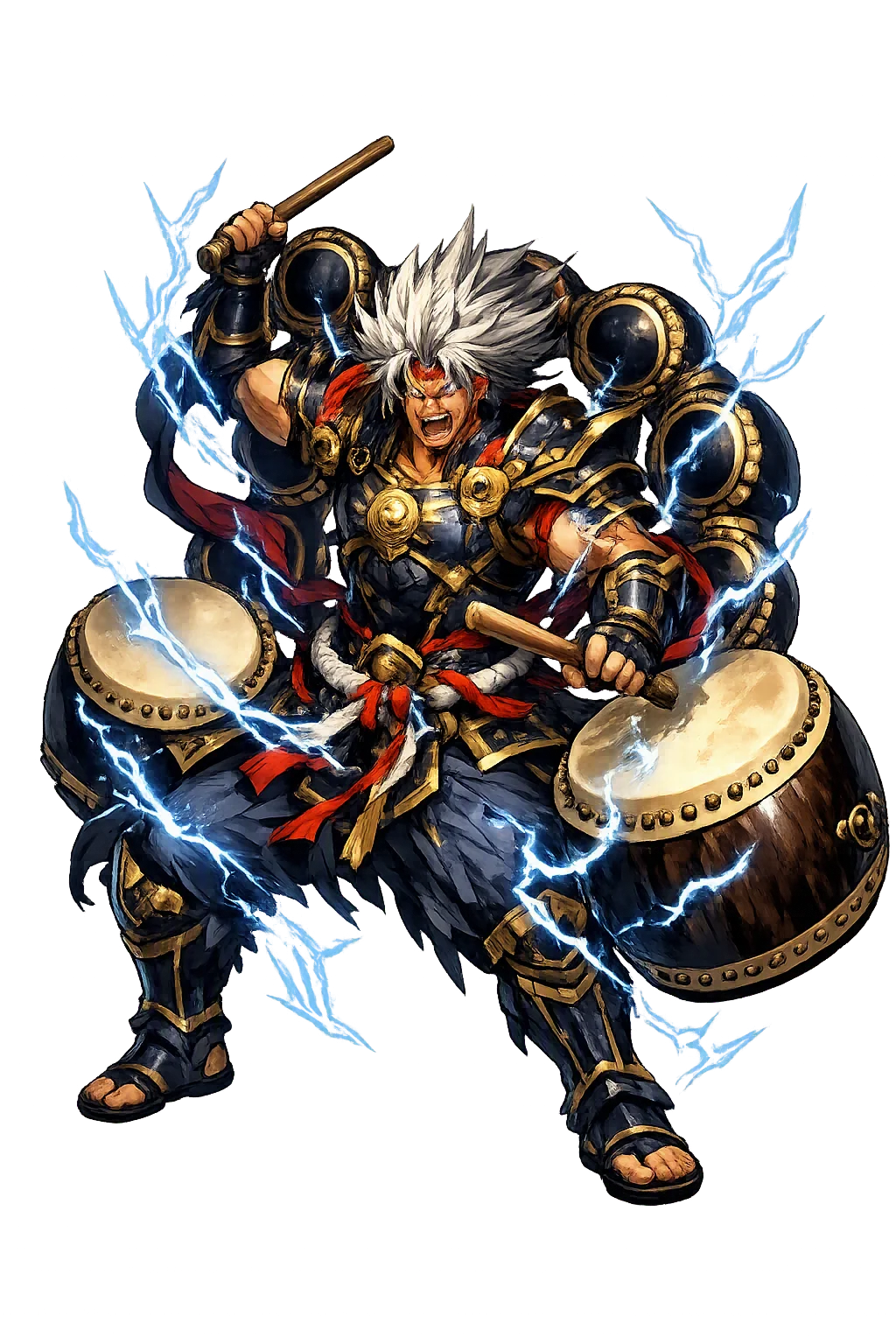
Raijin is the thunder god of Japan, a fierce, demon-like kami who beats drums to create thunder and hurls lightning bolts. He is the counterpart of Fūjin, the wind god, and the two are often depicted together at the gates of Buddhist temples, where their terrifying forms ward off evil. Beneath the demon mask lives one of Japan's oldest powers: thunder, the voice of the dead world breaking into ours.
He beats drums set around his body to produce thunder; the number of rings on the drums counts the storm's strength.
He casts lightning in the shape of arrows or writhing thunder-snakes from the storm clouds.
Paired with the wind god in temple art and architecture for more than a thousand years.
His fierce form protects temples from harmful influences; as one of the Twelve Devas he guards the Dharma itself.
From the original script to the living URL
雷神
The name in its original Japanese form. Raijin (雷神) is attested in the source tradition — “Thunder god”. Its original diacritics and script distinctions carry the full phonetic and orthographic weight of the source tradition.
raijin
The plain raijin form is identical to the Unicode restoration. Because this name is already written in Latin letters, no diacritics, stress, or script information were lost — only capitalization differs.
Raijin
The Unicode restoration does not need to recover lost marks for Raijin. Its value is canonical spelling and consistent cataloguing, not the reconstruction of erased orthography. The domain is readable as-is to both DNS and humanity.
Raijin.com
This restoration is written entirely in ASCII letters — no Punycode encoding stands between Raijin and the DNS. The domain reads identically to machines and to human eyes.
Owned, ideal, and ASCII forms of Raijin
Raijin
Restores 雷神. The full Unicode restoration. raijin.com is not in the PuniCodex collection — it is watched for release; if it drops, this temple upgrades to an owned flagship.
How Raijin was spoken
How Raijin is preserved in writing
A bespoke provenance study for Raijin is being prepared by the PUNICODEX scholarly team.
Contribute scholarly provenance →The lore you have read is the living myth. Extended Lore opens the scholarly vault beneath it: the cult and its material remains, a history of the image, the name after antiquity, a meditation on what the name still means, and the full scholarly apparatus — etymology, orthography, sources.
Enter Extended Lore