
Why Ragnarǫk is spelled that way — and what it costs to get it right
There is a version of this name the early internet had to settle for: ragnarok. This is the file on how Ragnarǫk replaced it.
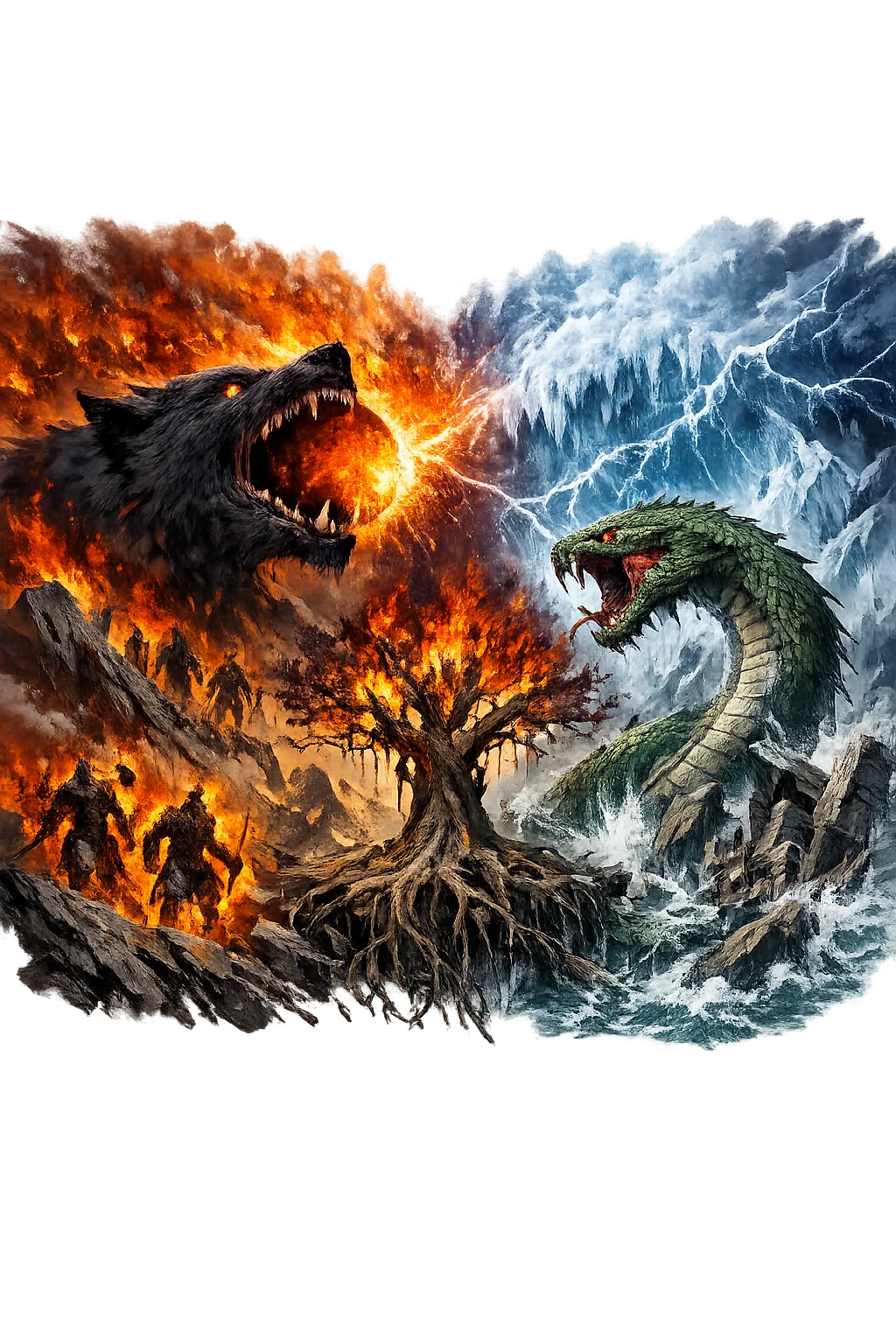
Ragnarǫk is the end of the Norse cosmos and its secret rebirth. Foretold by the seeress of Völuspá and narrated by Snorri, it runs from fimbulvetr — three winters with no summer — through the breaking of every bond to the last battle on Vígríðr, and ends not in ash but in green grass.
At a Glance
- Restored name: Ragnarǫk
- ASCII form: ragnarok
- Meaning: "Twilight of the gods (from ragna + rǫk)"
- Domain of influence: Doom of the Gods
- Pantheon: Norse
- Classification: Tier 1
- Original script: ᚱᛅᚴᚾᛅᚱᚢᚴ
- Series: The Restoration Files, No. 409 of 546
The Name Before the Marks
Spoken, the name runs `/ˈraɣ.naˌrɔk/` — 'RAGH-na-rok' — the middle consonant is a throaty 'gh', and the final vowel is a short, rounded 'o' like 'hot'.
The Temple That Stands Now
The restored name is not a plaque; it is an address. The temple of Ragnarǫk lives at /ragnarok/, with its mythology in the lore halls, its peer-reviewed record in the Scholarly Edition, and its place in the pattern atlas on the patterns floor.
The restoration preserves more than the ASCII form can express — stress, length, or a letter the Latin keyboard lost — which places it, mechanically, in Tier-1.
Where the Name Stood First
The end-time myth is carved on the Gosforth Cross in Cumbria, where a bound figure, the serpent, and cosmic combat appear together. The Rök runestone (Ög 136) names Baldr's death and the doom of the gods, while the Ledberg stone in Östergötland has been read as Óðinn devoured by Fenrir. These monuments show eschatology circulating in Christianizing Scandinavia. The temple on the web is the newest of these addresses — the first one that fits in a pocket.
The Archetype at Work
The pattern atlas seats this temple in 4 industries, each match argued and weighted: Disaster Resilience & Recovery (the world destroyed and risen green from the sea; recovery as cosmic doctrine.); Gaming, Fantasy & Entertainment IP (god of War Ragnarök and Thor: Ragnarok made the doom of the gods a franchise event.); AI, Data & Predictive Intelligence (a doom foretold with watchable warning signs; Völuspá is prediction's oldest text.). The Resonance File reads those seats through the myths themselves.
In the Sacred Texts
The Norse tradition is not a vibe; it is a library. The Sacred Texts collection holds Poetic Edda and Prose Edda — the primary sources the temple's scholarship is built on. The temple is the argument; the texts are the evidence.
The File Continues
The temple's founding dispatch tells the name's story; its Resonance File reads the myths into the industries; the blog index holds the whole archive.
Continue the series — previous file: Rādhā (read it here) · next file: Raijin (read it here).
The Restoration Files are written from the same canonical record as the temples themselves: the lexicon, the lore catalog, the pattern atlas, and the cited scholarly sources. If a file ever disagrees with its temple, the temple is right — tell us, and the file will be corrected.