
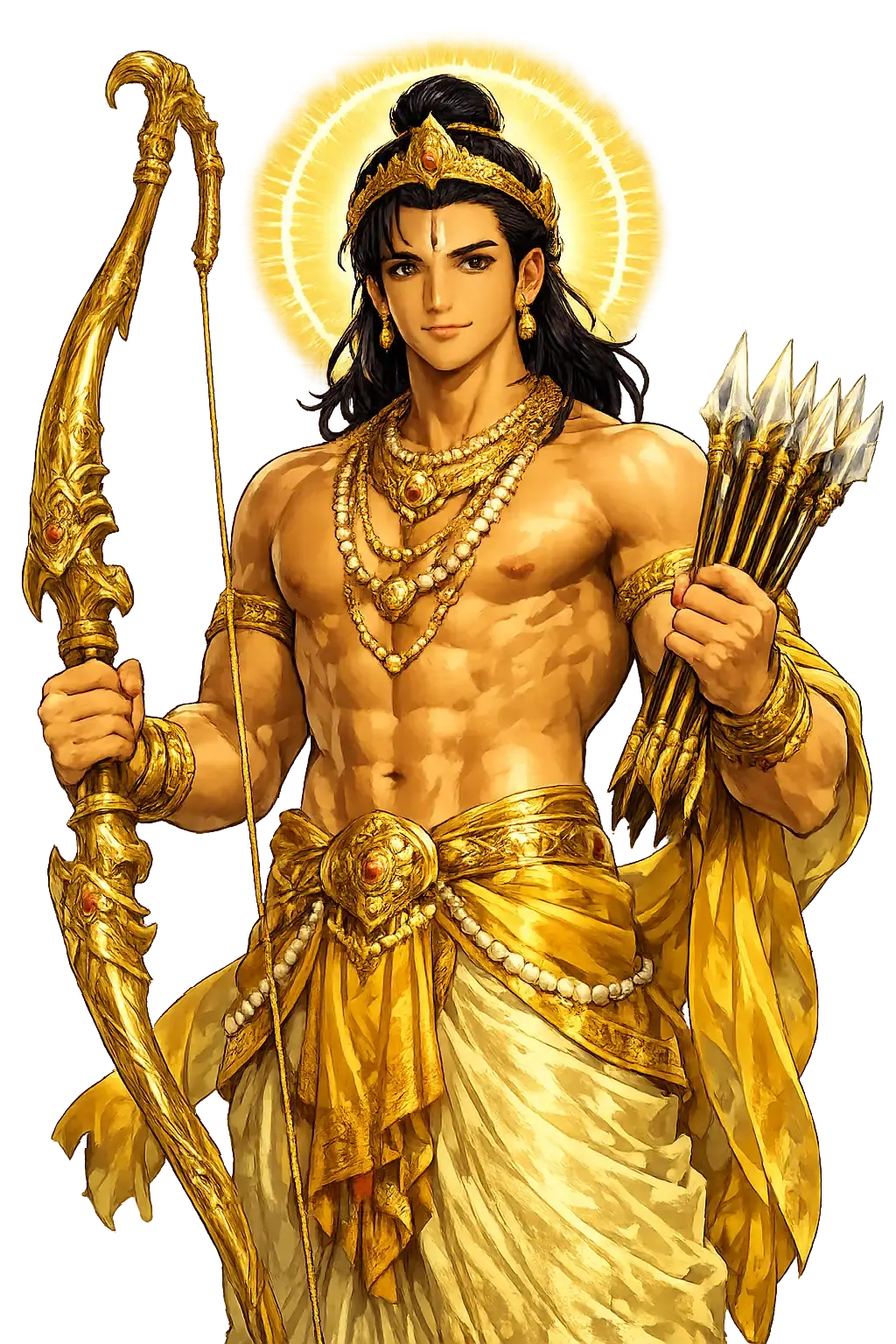
How Rāma was rebuilt, mark by mark
From the restoration bench — the working notes on Rāma, kept because the process is the proof.
What We Found
The attestation runs through the tradition's own sources: राम. Meaning: "The beloved prince of Ayodhyā — hero of the Rāmāyaṇa and seventh avatāra of Viṣṇu (from √ram, to delight)".
The figure behind the name: Rāma's mythology is the Rāmāyaṇa — Vālmīki's poem and the centuries of retelling it generated.
What the Name Carried In
The Exile. On the day Rāma was to be crowned, his stepmother Kaikeyī asked King Daśaratha for her two long-promised boons: the throne for her son Bharata, and fourteen years' exile for Rāma (Rāmāyaṇa, Ayodhyākāṇḍa 8–12). The king, bound by his word, collapsed between the pillars of his palace like a man already dead.
The Abduction of Sītā. In the forest of Pañcavaṭī, the demoness Śūrpaṇakhā offered herself to Rāma and threatened Sītā; Lakṣmaṇa cut off her nose and ears (Araṇyakāṇḍa 17–18). She ran to her brother Rāvaṇa, king of Laṅkā, and the abduction was planned with a demon's cunning: a golden deer made from illusion lured Rāma away, a false cry for help in his own voice drew Lakṣmaṇa after, and the vulture-king Jāṭāyu — who alone tried to stop the chariot — died at the roadside with the news of which way Sītā had been taken (Araṇyakāṇḍa 43–49).
A spelling that has to carry stories like these is not a label. It is equipment.
Where It Stood Before Us
Archaeological and epigraphic references to Rāma appear from the early centuries CE, with Rāmāyaṇa scenes carved on Gupta-period temples and beyond. The site identified as Rāma's birthplace at Ayodhyā has been a focus of pilgrimage and, in recent decades, of legal and political contestation. Temples dedicated to Rāma are found across South and Southeast Asia, and the epic's visual narrative is a staple of Indian miniature painting, temple sculpture, and performing arts. The bench inherits all of it — the web temple is the newest site, not the first.
What We Kept
The evidence, mark by mark — 1 feature the keyboard form rama cannot hold:
- a → ā — Macron: long /aː/. Kept.
What We Rejected
rama as the primary form. It survives as the convenience it is; it does not get to lead. The hierarchy is full restoration first, and this name can afford to stand at the top of it.
What We Set Down
Rāma — What survives here cannot be shown in ASCII: a feature of the original that the fallback alphabet flattens. That is the Tier-1 test, and this name passes it without argument.
For the voice: 'RAH-muh' — roll or tap the 'r', hold the first syllable long, and let the second syllable relax.
The temple stands at /rama/ — the notes above are public in its Scholarly Edition, sources and all.
At a Glance
- Restored name: Rāma
- ASCII form: rama
- Meaning: "The beloved prince of Ayodhyā — hero of the Rāmāyaṇa and seventh avatāra of Viṣṇu (from √ram, to delight)"
- Domain of influence: Virtue, Kingship, Avatar of Vishnu
- Pantheon: Sanskrit
- Classification: Tier 1
- Original script: राम
- Series: The Restoration Files, No. 411 of 546
The File Continues
The temple's founding dispatch tells the name's story; its Resonance File reads the myths into the industries; the blog index holds the whole archive.
Continue the series — previous file: Raijin (read it here) · next file: Ranginui (read it here).
The Restoration Files are written from the same canonical record as the temples themselves: the lexicon, the lore catalog, the pattern atlas, and the cited scholarly sources. If a file ever disagrees with its temple, the temple is right — tell us, and the file will be corrected.