
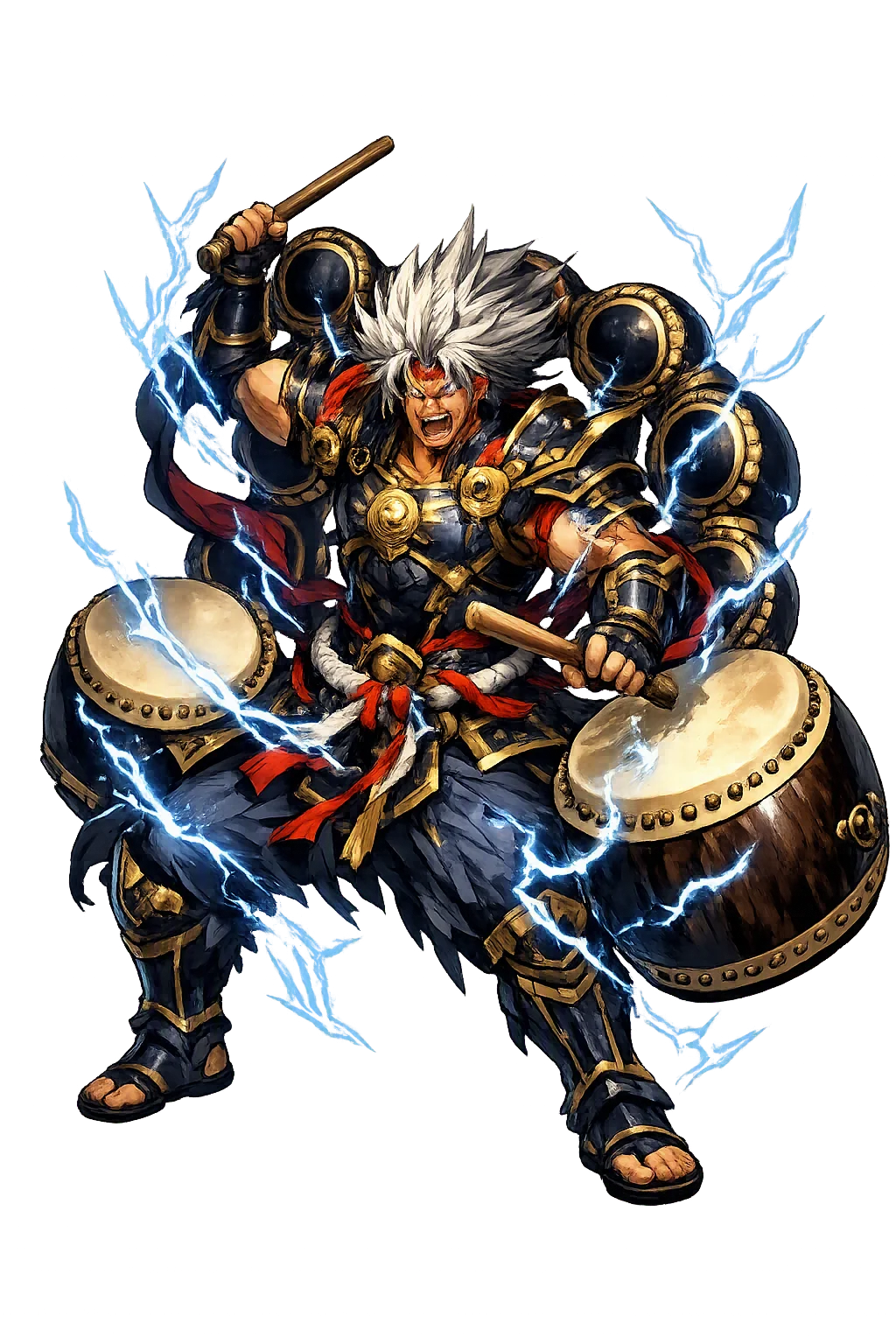
The working life of Raijin: from the myths to the modern trades
The myths did not retire. They moved offices. This is the file on where Raijin works now.
Raijin's mythology is a palimpsest: the thunder kami of the Kojiki, the Buddhist guardian of esoteric temple art, the storm god of the Mongol-invasion legend, and the bogey of nursery warnings — four layers of one drumbeat. The sources are layered and partly at odds, and each layer tells us what thunder meant to a different Japan.
The pattern atlas — which maps every flagship temple to the industries its archetype demonstrably resonates with, each match argued and open to challenge — seats this temple in 3 industries. This file reads those seats the way they were earned: through the myths.
At a Glance
- Temple: Raijin
- Pantheon: Japanese
- Domain of influence: Thunder, Lightning
- Pattern seats: 3
- Sectors touched: Culture & Entertainment · Energy & Natural World · Commerce & Governance
- Strongest seat: Music, Arts & Performance
- Series: The Resonance Files, No. 412 of 548
The Myth at Work
Thunder Born of the Dead Goddess. In the Kojiki, Izanami dies from the burns of the fire god Kagutsuchi, and her grieving husband Izanagi pursues her into Yomi, the land of the dead. When he breaks his promise not to look, he sees her body corrupted; in her fury Izanami sends the yakusa no ikazuchi — the eight thunder spirits — in pursuit, together with the hags of Yomi. — hold that image; the industries below are where it goes to work.
Guardian of the Dharma. With the arrival of esoteric Buddhism, the thunder power was enrolled in the defenses of the Dharma. From the Heian period, Raijin appears among the Jūni-ten, the Twelve Devas who guard the four directions and the zenith and nadir of the mandala, and with Fūjin he comes to stand at temple gatehouses — the pair most famously at the great Nioh-mon gates of Zen temples, where their sculpted forms confront visitors with the storm itself. — hold that image; the industries below are where it goes to work.
The Seats
Each of these is argued in the atlas with a weight and a why-line. What the atlas cannot fit in one line is the whole myth — so here is each seat with its story restored.
Music, Arts & Performance
Music, theatre, dance, and the performing arts. (Sector: Culture & Entertainment)
The thunder kami whose taiko drums circle every storm; Sōtatsu's Fūjin-Raijin screens are national treasures. — the atlas stops there, out of discipline. The myth keeps going: the function Raijin performs in the stories is precisely the function this industry sells.
Meteorology & Weather Intelligence
Forecasting, storm tracking, and climate analytics. (Sector: Energy & Natural World)
The thunder kami who beats his drums around the storm; Japanese art pairs him with Fūjin as the weather itself. — the atlas stops there, out of discipline. The myth keeps going: the function Raijin performs in the stories is precisely the function this industry sells.
Insurance & Protection Services
Insurance, assurance, and risk protection. (Sector: Commerce & Governance)
Thunder and lightning are the oldest insurable risks; his drums are the claim siren. — the atlas stops there, out of discipline. The myth keeps going: the function Raijin performs in the stories is precisely the function this industry sells.
The Long Employment
Raijin remains one of Japan's most visually striking deities. His most famous portrait, Tawaraya Sōtatsu's Fūjin-Raijin-zu screens (early seventeenth century, now a National Treasure at Kennin-ji in Kyoto), is a canonical image of Japanese art, endlessly reproduced. The age changed. The work did not.
The Method, Stated Plainly
None of this is numerology. A seat exists only where the match can be argued from the deity’s documented domains and deeds — weighted, published, and falsifiable. The derivation, the weights, and the challenge process are public on the methodology page. If a seat in this file reads wrong, the atlas itself tells you how to prove it — and the correction becomes part of the record.
For the Ones Who Work There
If you work in music, arts & performance, meteorology & weather intelligence, or any trade this temple holds a seat in, this is the honest version of what a placement means: your industry beside the story it has been re-telling all along — on the temple floor itself, before an audience that came specifically to read it. The patron tier and the advertising terms describe the mechanics; the resonance above describes the fit.
The File Continues
One of 548 Resonance Files — the series where the pantheon goes to work. Read the founding dispatch for the name, the Restoration File for the spelling, or the whole archive end to end.
Continue the series — previous: Ragnarǫk (read it) · next: Rāma (read it).
The Resonance Files are argued from the same canonical record as the pattern atlas itself: the lexicon, the lore catalog, and the cited sources. Every seat can be challenged at the methodology page — and the challenge is the point.