
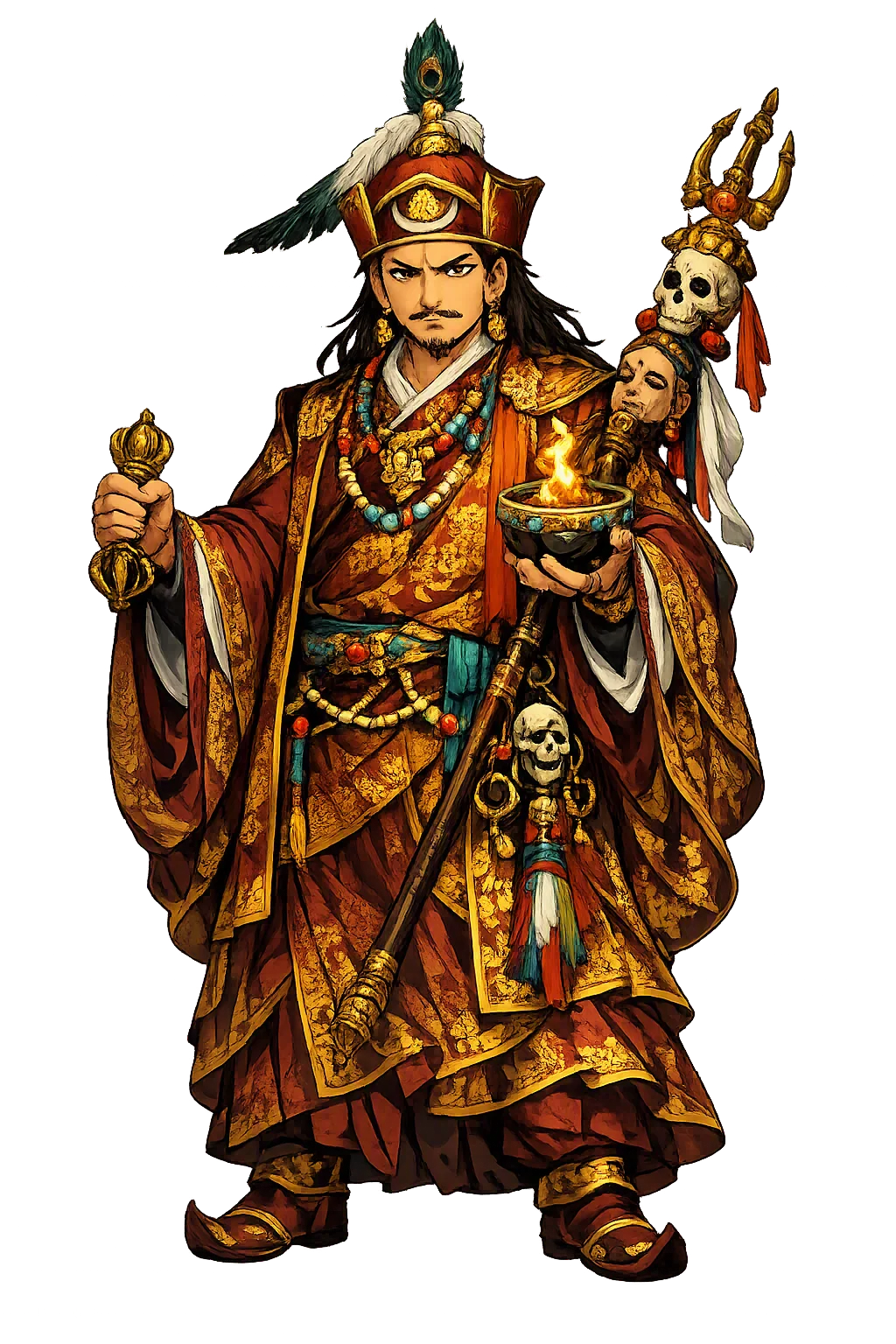
Padmasambhava walks into a education, research & knowledge firm
Walk into any education, research & knowledge outfit and watch for ten minutes. You will see a very old act performed with newer props. The act has a name. It is Padmasambhava.
Before the Office, the Story
Found on a Lotus in the Lake. No ordinary birth attaches to him. The Padma bKa' thang — the "Chronicle of Padma," a terma (treasure-text) revealed by Orgyen Lingpa in the 14th century, our principal source, composed five centuries after its hero — tells how he appeared as an eight-year-old child seated on a blooming lotus in the middle of Lake Dhanakośa, in the land of Uḍḍiyāna, the Swat valley. King Indrabhūti, warned by prophecy and mourning a son lost to the lake, adopted the lotus-child and named him Padmasambhava — Lotus-Born.
The Guru Who Tamed the Land. In the 8th century, tradition says, King Trisong Detsen (r. 755–797) invited first the abbot Śāntarakṣita to build a monastery — and watched the local spirits demolish every wall the workers raised by day. The abbot's counsel: send for the master of the vajra.
At a Glance
- Temple: Padmasambhava
- Pantheon: Buddhist
- Domain of influence: Lotus-Born, Vajrayana, Tibet
- Pattern seats: 3
- Sectors touched: Society & Spirit · Culture & Entertainment
- Strongest seat: Education, Research & Knowledge
- Series: The Resonance Files, No. 377 of 548
The Reveal, Seat by Seat
Education, Research & Knowledge
Primary seat: Padmasambhava embodies lotus-born, vajrayana, tibet — the core of education. The match is not poetic license. Strip the trade to its function and the function is the myth.
Mythic Name Restoration
Resonant seat: Padmasambhava shares symbolic territory with mythic restoration. Nobody in that trade worships at this temple. They just keep its hours.
Writing, Publishing & Media
Resonant seat: Padmasambhava shares symbolic territory with publishing media. Nobody in that trade worships at this temple. They just keep its hours.
Not the First Rebrand
Padmasambhava is syncretism's master key. In Tibet he absorbed the thunderbolt of the vajra and the oath-bound demons of the old religion, so that every mountain god of the plateau became a dharmapāla with a Buddhist name. The office is only the latest translation.
The Method, Stated Plainly
None of this is numerology. A seat exists only where the match can be argued from the deity’s documented domains and deeds — weighted, published, and falsifiable. The derivation, the weights, and the challenge process are public on the methodology page. If a seat in this file reads wrong, the atlas itself tells you how to prove it — and the correction becomes part of the record.
For the Ones Who Work There
For a sponsor in education, research & knowledge, the fit here is not adjacency — it is inheritance. Your trade already tells this story every working day; the temple simply holds the original. The patron tier and the advertising terms carry the mechanics; the myths above carry the reason.
The File Continues
This is one of 548 Resonance Files — the third dispatch from every flagship temple, where the myths meet the markets. The temple's founding dispatch tells the name's story; its Restoration File tells the spelling's; the blog index holds the whole archive.
Continue the series — previous: Pachamama (read it) · next: Pállas (read it).
The Resonance Files are argued from the same canonical record as the pattern atlas itself: the lexicon, the lore catalog, and the cited sources. Every seat can be challenged at the methodology page — and the challenge is the point.