
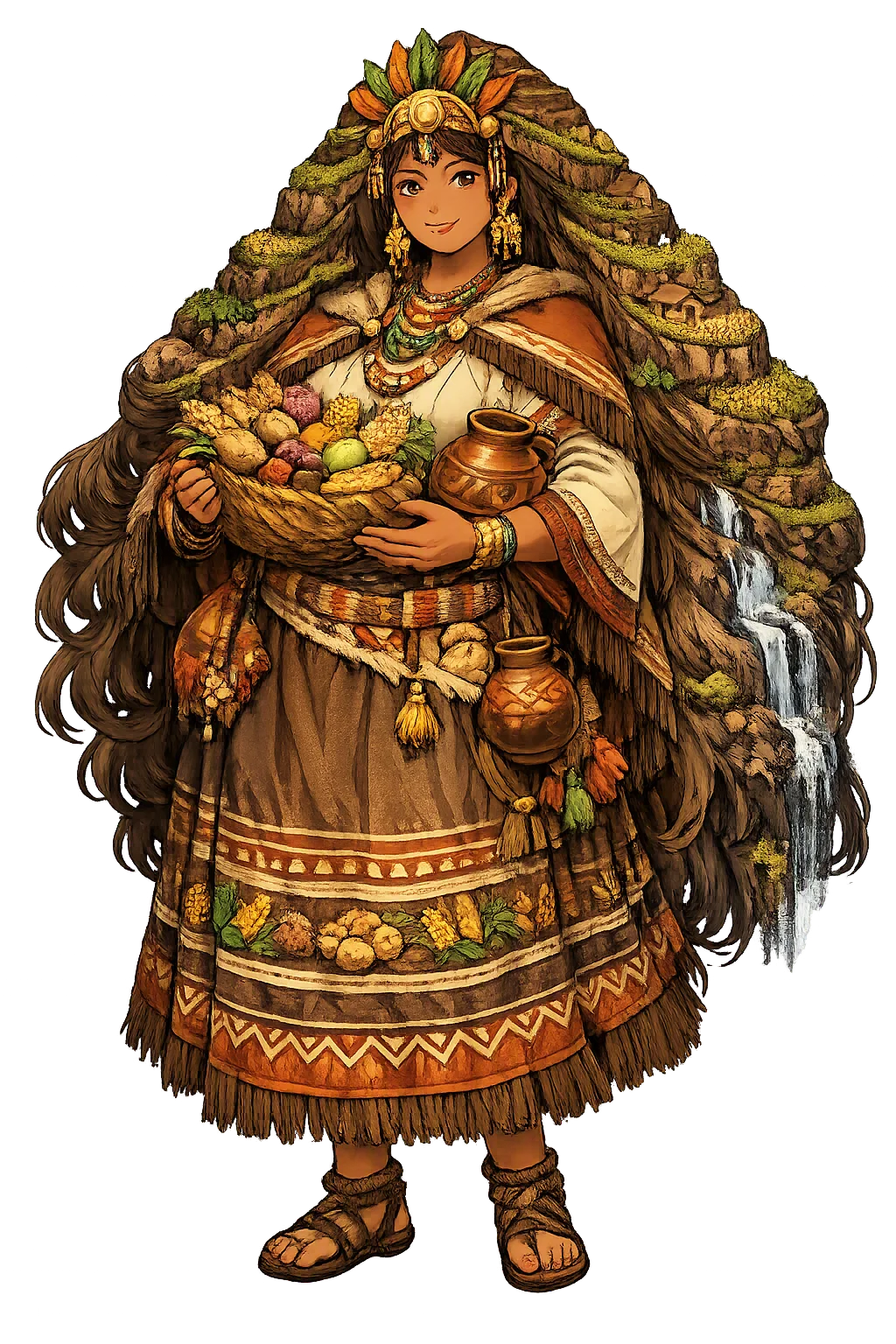
Pachamama at work: agriculture, food & harvest, environmental & climate services, and the myths that got there first
The myths did not retire. They moved offices. This is the file on where Pachamama works now.
Pachamama has no surviving epic. Andean theology lived in ritual, not scripture, and the written record begins only with the conquest, in chronicles already half-Christian. Her 'myths' are therefore creation reports, foundation legends, and — most authentically — the living practice of feeding the earth.
The pattern atlas — which maps every flagship temple to the industries its archetype demonstrably resonates with, each match argued and open to challenge — seats this temple in 5 industries. This file reads those seats the way they were earned: through the myths.
At a Glance
- Temple: Pachamama
- Pantheon: Incan
- Domain of influence: Earth, Harvest, Mother
- Pattern seats: 5
- Sectors touched: Energy & Natural World · Culture & Entertainment · Home & Lifestyle
- Strongest seat: Agriculture, Food & Harvest
- Series: The Resonance Files, No. 376 of 548
The Myth at Work
The World the Creator Entrusted to Her. Pachamama has no surviving epic of her own; the Andean world kept its theology in ritual, and the written record begins only with the Spanish conquest, in chronicles already half-Christian. Juan de Santa Cruz Pachacuti Yamqui, in his Relación de antigüedades deste Reyno del Piru (1613), and the Jesuit Bernabé Cobo, in his Historia del Nuevo Mundo (1653), tell a creation in which the god Viracocha — he of the staff and the tears — rose from the depths of Lake Titicaca at Tiahuanaco, made the sun, moon, and stars, and fashioned each people from stone before sending them under the earth to their appointed lands. — that is not just a story. It is a business model, four thousand years early.
The Golden Staff Sinks into Her Ground. The founding myth of Cusco is also a myth of her consent. Bernabé Cobo tells that the Sun, Inti, grieving over the savagery of humankind, sent his own children — Manco Cápac and his sister-wife Mama Ocllo — out of Lake Titicaca to find a valley where a golden staff, sunk into the earth, would disappear: a sign of ground blessed enough to found a city. — that is not just a story. It is a business model, four thousand years early.
The Seats
Each of these is argued in the atlas with a weight and a why-line. What the atlas cannot fit in one line is the whole myth — so here is each seat with its story restored.
Agriculture, Food & Harvest
Farming, grain, food production, and agtech. (Sector: Energy & Natural World)
Primary seat: Pachamama embodies earth, harvest, mother — the core of agriculture food. — the atlas stops there, out of discipline. The myth keeps going: the function Pachamama performs in the stories is precisely the function this industry sells.
Environmental & Climate Services
Climate science, ecology, and sustainability consulting. (Sector: Energy & Natural World)
The why-line says it in one breath: Resonant seat: Pachamama shares symbolic territory with environment climate. That is not a resemblance; it is the same act, performed in a newer building.
Forestry, Conservation & Outdoor Industries
Forestry, wildlife protection, and outdoor recreation. (Sector: Energy & Natural World)
Resonant seat: Pachamama shares symbolic territory with forestry conservation. Swap the costume and the sentence is indistinguishable from the myth. That is what a resonance seat means.
Music, Arts & Performance
Music, theatre, dance, and the performing arts. (Sector: Culture & Entertainment)
Resonant seat: Pachamama shares symbolic territory with music arts. — the atlas stops there, out of discipline. The myth keeps going: the function Pachamama performs in the stories is precisely the function this industry sells.
Home, Hearth & Real Estate
Property, home goods, and domestic services. (Sector: Home & Lifestyle)
Resonant seat: Pachamama shares symbolic territory with real estate home. — the atlas stops there, out of discipline. The myth keeps going: the function Pachamama performs in the stories is precisely the function this industry sells.
The Long Employment
Pachamama never stopped being worshipped. On the first of August, from Colombia's highlands to Bolivia's altiplano, households still pour chicha into the ground, bury coca, and feast; builders in Lima and La Paz commission ritual specialists to 'pay the earth' before breaking ground. The age changed. The work did not.
The Method, Stated Plainly
The atlas is not a horoscope. Seats are earned from the sources — argued, weighted, published — and every one of them can be challenged at the methodology page. A match that cannot survive an argument does not survive review. That is the whole trick: the patterns are claims, and claims can be tested.
For the Ones Who Work There
If you work in agriculture, food & harvest, environmental & climate services, or any trade this temple holds a seat in, this is the honest version of what a placement means: your industry beside the story it has been re-telling all along — on the temple floor itself, before an audience that came specifically to read it. The patron tier and the advertising terms describe the mechanics; the resonance above describes the fit.
The File Continues
One of 548 Resonance Files — the series where the pantheon goes to work. Read the founding dispatch for the name, the Restoration File for the spelling, or the whole archive end to end.
Continue the series — previous: Ọya (read it) · next: Padmasambhava (read it).
The Resonance Files are argued from the same canonical record as the pattern atlas itself: the lexicon, the lore catalog, and the cited sources. Every seat can be challenged at the methodology page — and the challenge is the point.