
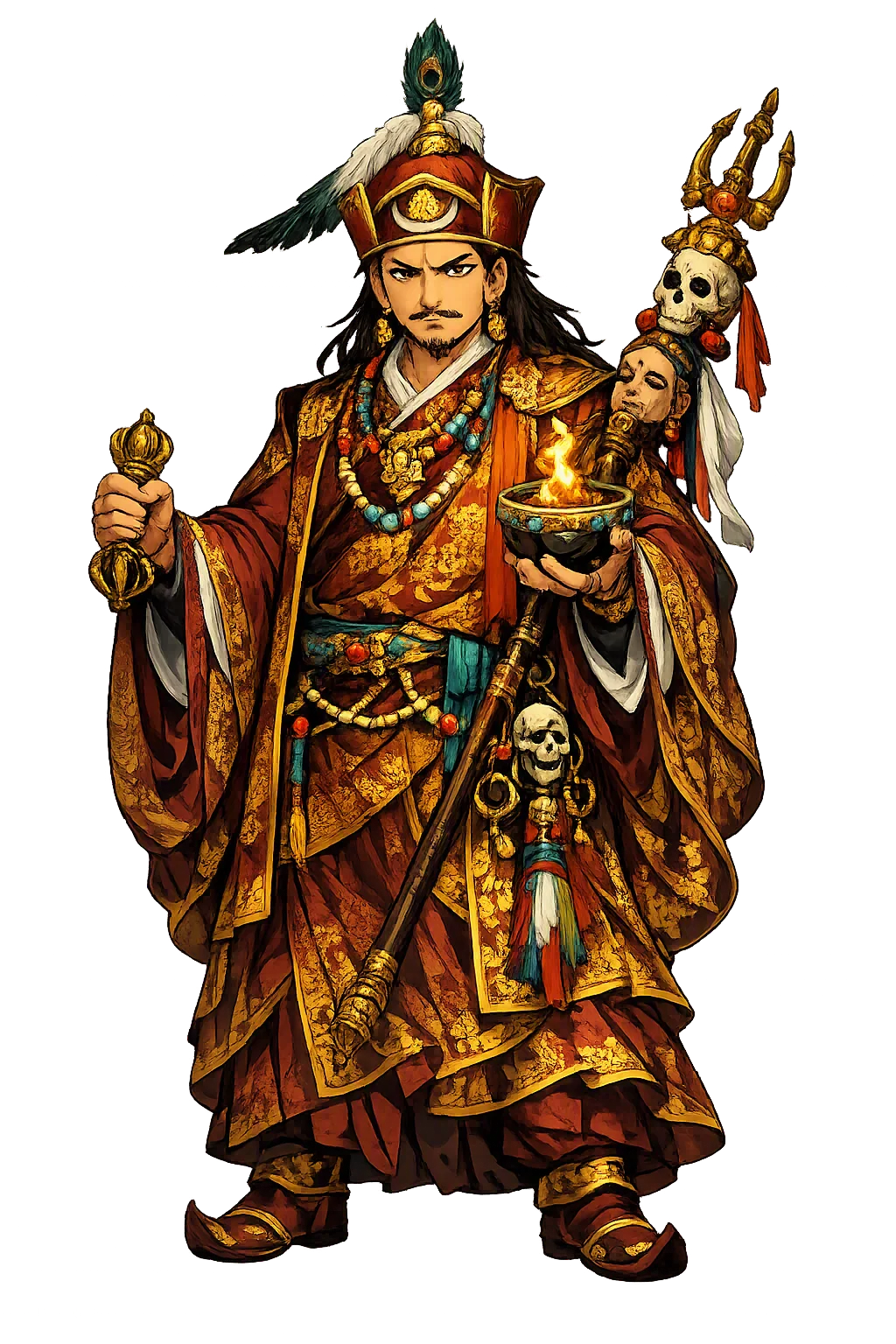
Padmasambhava — the one true spelling, and the forms that fail it
Evidence dossier 377 — Padmasambhava. Every exhibit catalogued, every ruling stated with its grounds.
At a Glance
- Canonical form: Padmasambhava
- Original script: पद्मसम्भव
- Pantheon: Buddhist
- Convention: the tradition’s own scholarly transliteration standard
- False forms on record: 1
- Contested forms: none attested
- Series: The Canonical Register, No. 377 of 548
The Evidence
Exhibit 1 — the attestation. The name is attested as पद्मसम्भव, on the evidence Padma bKa' thang (Padma Kathang), terma of Orgyen Lingpa (14th c.) and Basm yas Debate records set down. On the evidence, it means "'Lotus-born' (padma 'lotus' + sambhava 'born, arisen'), 'Guru Rinpoche', the tantric master revered as the founder-figure of Tibetan Buddhism.". The canonical transliteration is Padmasambhava.
Exhibit 2 — the flattened form. The plain form padmasambhava differs from the canonical Padmasambhava only by convention of display — case, not content. It is acceptable everywhere: in legacy systems, in plain-text citation, in the DNS itself. What is not acceptable is what follows in the register: respellings that change the letters, not just their case.
Exhibit 3 — struck from the record: padmasambava. Origin: the anglicized respelling — the name written the way English guesses it sounds. Grounds: rewrites attested consonant clusters to fit English spelling habits; every cluster simplified this way erases a letter the sources write.
Exhibit 4 — the physical record. The historical Padmasambhava leaves no contemporary trace — the earliest sources are three to five centuries later — and the archaeology of his legend is the archaeology of Samye itself: excavations at Dranang have confirmed an 8th-century mandala-planned monastery with central Wutse and four temples matching the chronicles, and Dunhuang manuscripts (closed c. 1000) already circulate his name. His landscape, though, is thoroughly mapped: the Tiger's Nest (Taktsang) above the Paro valley, the cave-temples of Nepal's upper valleys where he meditated en route, the statue at Tso Pema (Rewalsar) where he hid from the king of Zahor — every site an enacted chapter. Uḍḍiyāna, his birthplace, is fixed by the Swat valley's ruins and inscriptions. The figure is a study in how a people builds monuments to a man the record cannot see — and calls the monuments evidence.
Exhibit 5 — the continuing record. Every Nyingma monastery is his house twice over: Samye, Tibet's first, was raised on his taming; and in Bhutan, the cliff-hanging Tiger's Nest (Taktsang) marks the cave where he is said to have meditated on the tigress's back — the kingdom's defining image. The annual 10th-day rituals across the Tibetan world re-enact his arrival; the Seven Line Prayer — "I pray to the Lotus-Born of Uḍḍiyāna...
The Convention's Own History
Every tradition in this register has its own scholarly transliteration standard, built by its own specialists over decades or centuries, and the register follows each on its own terms: the tradition’s own standard. The principle that unifies them is the one the whole project stands on: a name is evidence, and evidence is not negotiable — not for keyboards, not for convenience, not for anyone.
The Protocol's Position
Can the canonical form live in the address bar? Almost always, yes. IDNA 2008 admits every mark this register defends — the DNS stores them as `xn--` punycode and modern browsers render them natively. The real frictions are practical, not legal: some registrars stock only part of the IDN space, so a theoretically valid name can be temporarily unbuyable; and stacked combinations (an acute riding a macron) remain awkward to type on mobile keyboards even where the protocol accepts them.
The project's answer is a ranked ladder, not a compromise: the full restoration first, then attested fallbacks in descending order of completeness. The ladder's lowest rung, plain ASCII, is a vehicle for legacy systems — sanctioned, but never presented as the scholarly form.
The Verdict
Case closed on Padmasambhava: canonical, cited, and defended. The keyboard form padmasambhava is the same name in another register of display — always acceptable. The register's files remain open: if a source surfaces that changes any line of this entry, the entry changes. Until then, the temple at /padmasambhava/ holds the canonical form.
The docket for this ruling: 1 false form ruled against, padmasambava first on the docket; no contested forms attested; the attestation rests on 5 cited sources — Padma bKa' thang (Padma Kathang), terma of Orgyen Lingpa (14th c.), Basm yas Debate records, Demiéville, Le Concile de Lhasa (1952).
The Register Continues
Entry 377 of 548 in the Canonical Register. Around it: the temple's founding dispatch, the Restoration File on the marks themselves, the Resonance File on the archetype at work, and the Rulebook behind all of it.
Continue the register — previous entry: Pachamama (read it) · next entry: Pállas (read it).
The Canonical Register is written from the same canonical record as the lexicon itself. If a false form is missing from this page, it is because the evidence does not support calling it false — or because we have not seen it yet. Show us, with a citation, and the register will answer.