The Living Myth
Lotus-Born, Vajrayana, Tibet · 'Lotus-born' (padma 'lotus' + sambhava 'born, arisen'), 'Guru Rinpoche', the tantric master revered as the founder-figure of Tibetan Buddhism.
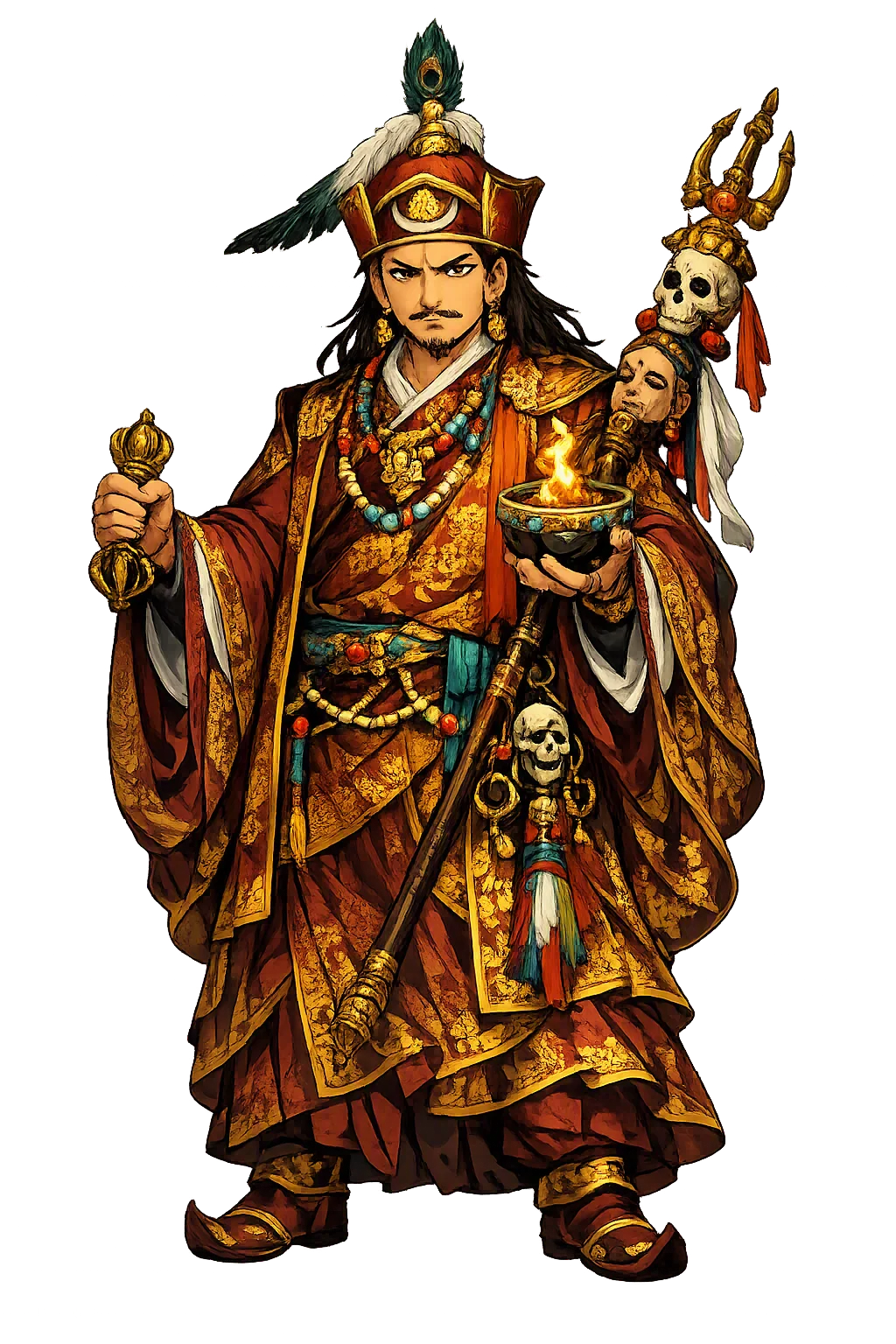
Stories of Padmasambhava
Padmasambhava's mythology is a hagiography written centuries after its hero — the principal source, the Padma bKa' thang, is a 14th-century treasure-text about an 8th-century man. That distance is not a defect to apologize for; it is the figure's native element, a teacher whose whole meaning is that the teaching keeps being found.
No ordinary birth attaches to him. The Padma bKa' thang — the "Chronicle of Padma," a terma (treasure-text) revealed by Orgyen Lingpa in the 14th century, our principal source, composed five centuries after its hero — tells how he appeared as an eight-year-old child seated on a blooming lotus in the middle of Lake Dhanakośa, in the land of Uḍḍiyāna, the Swat valley. King Indrabhūti, warned by prophecy and mourning a son lost to the lake, adopted the lotus-child and named him Padmasambhava — Lotus-Born. A being without parents comes from nowhere in particular, so his teaching belongs everywhere; the story inverts the Buddha's nativity deliberately — not a queen's grove but an empty lake, not a clan but no lineage at all. Later scholars note what the myth performs: the historical 8th-century teacher is all but unrecoverable, and the tradition seems not to mind — a founder born of a flower needs no biography, only a legend.
In the 8th century, tradition says, King Trisong Detsen (r. 755–797) invited first the abbot Śāntarakṣita to build a monastery — and watched the local spirits demolish every wall the workers raised by day. The abbot's counsel: send for the master of the vajra. Padmasambhava traveled from Nepal through the passes, and Tibet's own account of his progress — the Padma bKa' thang again — reads like a conquest itinerary: at each valley he bound the nyen, the nāgas, and the demoness of the land by oath, converting them into dharmapālas, sworn protectors of the teaching. Only then could Bsam yas (Samye) rise (consecrated c. 779) — monastery, academy, and debating courtyard in one, modeled on the cosmic mountain. The myth's geography is exact: Buddhism in Tibet is pictured as a conquest not of men but of landscape, every river and pass given its oath-bound guardian. The teacher who entered Tibet as an exorcist left as its father.
Under Padmasambhava's shadow, Samye hosted Buddhism's most famous doctrinal duel. Around 792–794, the Indian gradualist Kamalaśīla — Śāntarakṣita's own disciple — debated the Chinese Chan master Moheyan, the "Heshang Mahāyāna," who taught that all thought, good or bad, must be cut off at a single stroke, "like cutting a cord." The Tibetan documents (the Basm yas Debate records, famously analyzed by Paul Demiéville in Le Concile de Lhasa, 1952) declare Kamalaśīla the victor and enshrine analysis, debate, and gradual cultivation as Tibet's official path; modern scholarship doubts the contest's every detail — the minutes may be a retrospective charter — but not its consequence. The myth matters more than the minutes: Tibet chose the ladder over the leap, scholarship over silence, and stamped that choice into every monastery courtyard it would build for the next twelve centuries.
Before departing — flying from the Gungthang pass on a pregnant tigress to the southwest, to his paradise Zangdok Palri, the Copper-Colored Mountain of Glory — Padmasambhava did what no teacher had done: he hid the teaching itself. Across Tibet he concealed terma, "treasures": texts, statues, and rituals sealed in rock, lake, pillar, and palace wall, and sealed also in the minds of disciples, to be discovered — by gter ston, treasure-revealers — when the age could bear them. The Padma bKa' thang is itself such a revelation. The Nyingma, the "Ancient" school, grounds its authority in this continuing disclosure: every tertön from the 11th century onward — Orgyen Lingpa who revealed the Chronicle among them — stands in the Guru's lineage, a founder whose school is re-founded at every discovery. The interpretive point: a teaching buried is a teaching guaranteed — the future written in advance, to be read only when it is true.
The Lotus-Born — Guru Rinpoche, the Second Buddha of Tibet
Padmasambhava — the Lotus-Born, revered across the Tibetan world as Guru Rinpoche, 'Precious Teacher' — is the tantric master credited with planting Buddhism in Tibet: taming its spirits, raising its first monastery, and hiding its deepest teachings as treasures for future ages.
Found as a child on a lotus in Lake Dhanakośa and adopted by King Indrabhūti of Uḍḍiyāna — a nativity with no mother, made for a teacher with no homeland.
Binding the nāgas and demonesses of the Tibetan landscape by oath into dharmapālas — protectors — until the walls of Samye could stand.
Tibet's first monastery (consecrated c. 779) and the council where Indian gradualism defeated Chinese Chan — shaping Tibetan Buddhism for twelve centuries.
Terma — texts, statues, and rituals sealed in rock and lake to be rediscovered when the age can bear them; the Padma bKa' thang is itself one.
From the original script to the living URL
पद्मसम्भव
The name in its original Buddhist form. Padmasambhava (पद्मसम्भव) is attested in the source tradition — “'Lotus-born' (padma 'lotus' + sambhava 'born, arisen'), 'Guru Rinpoche', the tantric master revered as the founder-figure of Tibetan Buddhism.”. Its original diacritics and script distinctions carry the full phonetic and orthographic weight of the source tradition.
padmasambhava
The plain padmasambhava form is identical to the Unicode restoration. Because this name is already written in Latin letters, no diacritics, stress, or script information were lost — only capitalization differs.
Padmasambhava
The Unicode restoration does not need to recover lost marks for Padmasambhava. Its value is canonical spelling and consistent cataloguing, not the reconstruction of erased orthography. The domain is readable as-is to both DNS and humanity.
Padmasambhava.com
This restoration is written entirely in ASCII letters — no Punycode encoding stands between Padmasambhava and the DNS. The domain reads identically to machines and to human eyes.
Owned, ideal, and ASCII forms of Padmasambhava
Padmasambhava
Restores पद्मसम्भव. The full Unicode restoration. padmasambhava.com is not in the PuniCodex collection — it is watched for release; if it drops, this temple upgrades to an owned flagship.
How Padmasambhava was spoken
How Padmasambhava travels from ancient script to the modern URL
The lore you have read is the living myth. Extended Lore opens the scholarly vault beneath it: the cult and its material remains, a history of the image, the name after antiquity, a meditation on what the name still means, and the full scholarly apparatus — etymology, orthography, sources.
Enter Extended Lore