
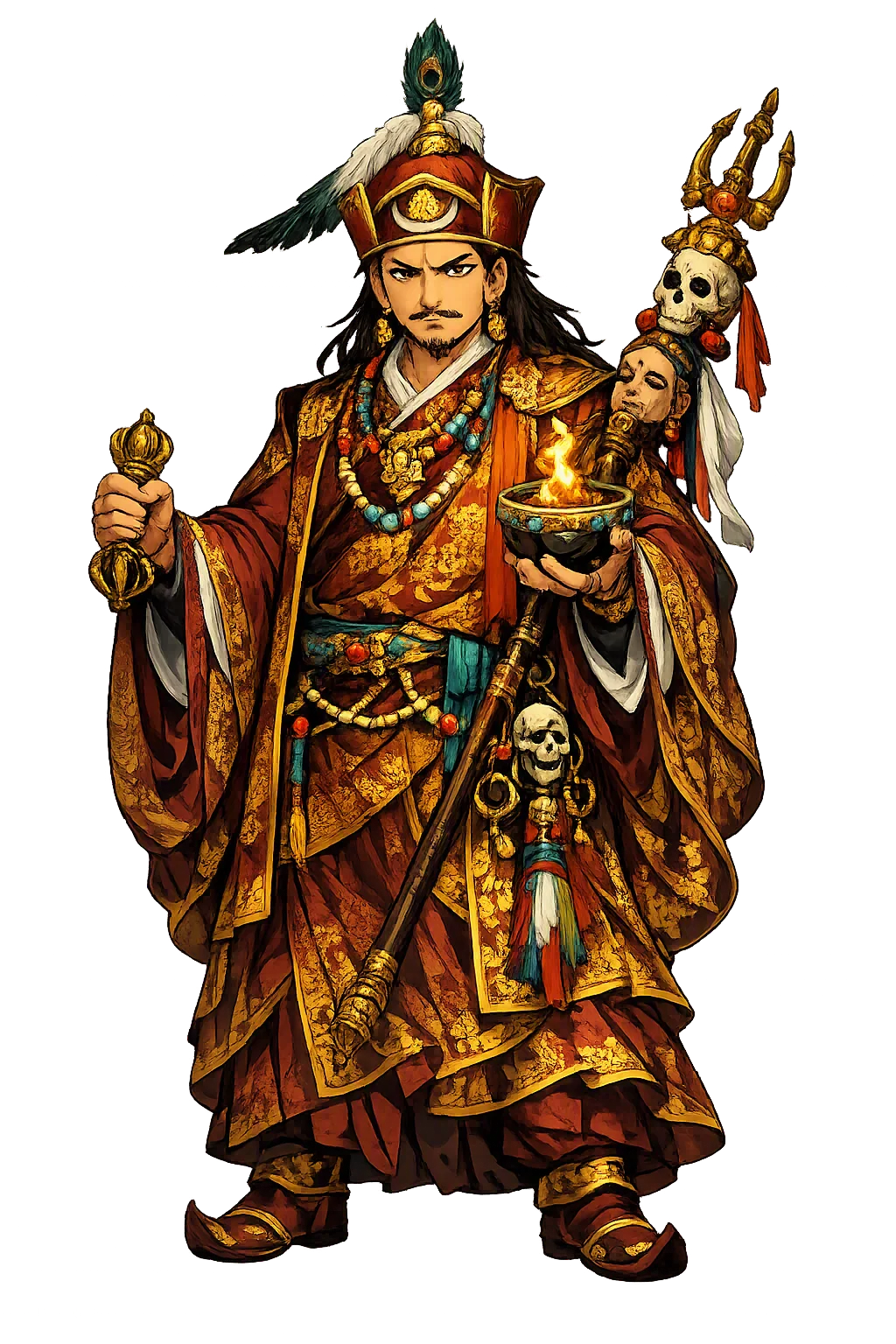
Padmasambhava: the stories first, then the spelling
The marks in Padmasambhava make the most sense standing next to the myths they have to carry. So the myths come first.
The Stories That Carry the Name
Found on a Lotus in the Lake. No ordinary birth attaches to him. The Padma bKa' thang — the "Chronicle of Padma," a terma (treasure-text) revealed by Orgyen Lingpa in the 14th century, our principal source, composed five centuries after its hero — tells how he appeared as an eight-year-old child seated on a blooming lotus in the middle of Lake Dhanakośa, in the land of Uḍḍiyāna, the Swat valley. King Indrabhūti, warned by prophecy and mourning a son lost to the lake, adopted the lotus-child and named him Padmasambhava — Lotus-Born.
The Guru Who Tamed the Land. In the 8th century, tradition says, King Trisong Detsen (r. 755–797) invited first the abbot Śāntarakṣita to build a monastery — and watched the local spirits demolish every wall the workers raised by day. The abbot's counsel: send for the master of the vajra.
The Council of the Two Vehicles. Under Padmasambhava's shadow, Samye hosted Buddhism's most famous doctrinal duel. Around 792–794, the Indian gradualist Kamalaśīla — Śāntarakṣita's own disciple — debated the Chinese Chan master Moheyan, the "Heshang Mahāyāna," who taught that all thought, good or bad, must be cut off at a single stroke, "like cutting a cord. " The Tibetan documents (the Basm yas Debate records, famously analyzed by Paul Demiéville in Le Concile de Lhasa, 1952) declare Kamalaśīla the victor and enshrine analysis, debate, and gradual cultivation as Tibet's official path; modern scholarship doubts the contest's every detail — the minutes may be a retrospective charter — but not its consequence.
And Here Is What the Spelling Preserves
Against those stories, the attestation: पद्मसम्भव, on the evidence Padma bKa' thang (Padma Kathang), terma of Orgyen Lingpa (14th c.) and Basm yas Debate records set down. The name means "'Lotus-born' (padma 'lotus' + sambhava 'born, arisen'), 'Guru Rinpoche', the tantric master revered as the founder-figure of Tibetan Buddhism.".
At a Glance
- Restored name: Padmasambhava
- ASCII form: padmasambhava
- Meaning: "'Lotus-born' (padma 'lotus' + sambhava 'born, arisen'), 'Guru Rinpoche', the tantric master revered as the founder-figure of Tibetan Buddhism."
- Domain of influence: Lotus-Born, Vajrayana, Tibet
- Pantheon: Buddhist
- Classification: Tier 2
- Original script: पद्मसम्भव
- Series: The Restoration Files, No. 377 of 548
The Name Travels
Padmasambhava is syncretism's master key. In Tibet he absorbed the thunderbolt of the vajra and the oath-bound demons of the old religion, so that every mountain god of the plateau became a dharmapāla with a Buddhist name.
The Address It Earned
The temple of Padmasambhava stands at /padmasambhava/ — lore, scholars, patterns — because a name carrying this much story deserves more than a parking page. The restoration keeps one feature the ASCII form drops. One is enough to matter, and the label says so plainly: Tier-2.
The Sources Are Open
The myths above are retold from the temple's record; the primary voices are in the Sacred Texts: Lotus Sutra and Sukhāvatīvyūha Sūtras. Nothing in this file outranks them.
The File Continues
Read the founding dispatch for the name's full story, the Resonance File for the archetype at work — or the whole archive in one sitting.
Continue the series — previous file: Pachamama (read it here) · next file: Pállas (read it here).
The Restoration Files are written from the same canonical record as the temples themselves: the lexicon, the lore catalog, the pattern atlas, and the cited scholarly sources. If a file ever disagrees with its temple, the temple is right — tell us, and the file will be corrected.