
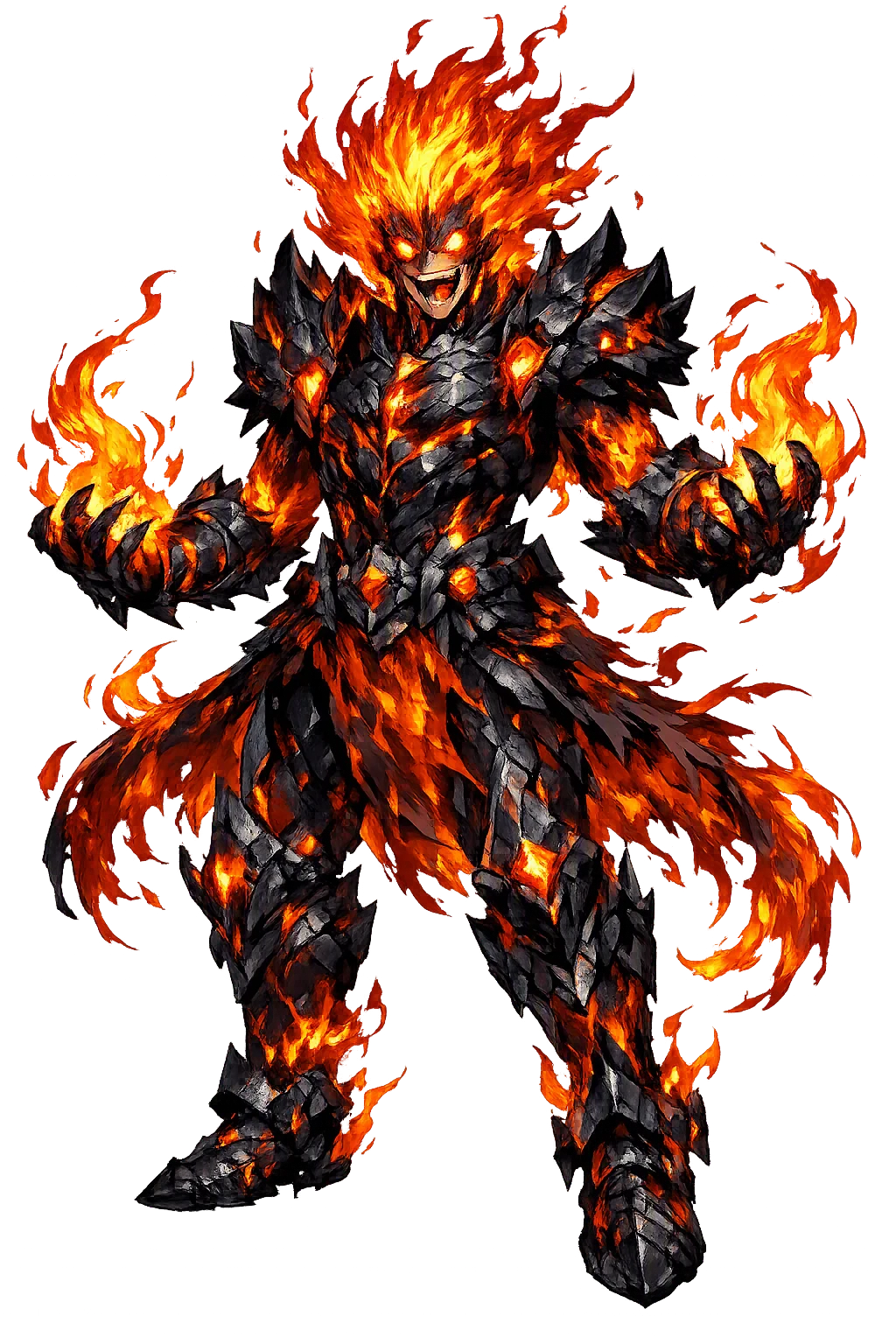
Why Logi is spelled that way — and what it costs to get it right
There is a version of this name the early internet had to settle for: logi. This is the file on how Logi replaced it.
Logi has one great scene and one great family. The scene is the eating contest in Útgarða-Loki's hall, the showpiece of Þórr's eastern journey in Gylfaginning; the family is the Fornjótr genealogy, which makes him fire brothered to sea and wind. Between them the mythology says everything it has to say about him: he is not a character with a history but an element with a name — and his single appearance is constructed to prove exactly that.
At a Glance
- Restored name: Logi
- ASCII form: logi
- Meaning: "Flame"
- Domain of influence: Fire, Flame, Giant
- Pantheon: Norse
- Classification: Tier 2
- Original script: ᛚᚢᚴᛁ
- Series: The Restoration Files, No. 280 of 548
The Name Before the Marks
Spoken, the name runs `/ˈlo.ɣi/` — 'LOH-yi' — two short, even syllables with the weight on the first; keep the o short and round, and let the medial g soften to a voiced friction in the throat, as in modern Icelandic logi.
The Temple That Stands Now
The restored name is not a plaque; it is an address. The temple of Logi lives at /logi/, with its mythology in the lore halls, its peer-reviewed record in the Scholarly Edition, and its place in the pattern atlas on the patterns floor.
Tier-2 here means one preserved truth — not less important, just singular. The temple shows it and names it.
Where the Name Stood First
Logi is a textual figure in the strictest sense: his attestations are the Snorra Edda manuscripts — Codex Regius (GKS 2367 4to), Codex Wormianus, Codex Upsaliensis — together with the þulur, the rhymed name-lists appended to the Prose Edda, which keep the common noun logi among the heiti for fire, and the Fornjótr genealogy of Hversu Noregr byggðist in the Flateyjarbók. No runic inscription names him, no place-name is securely his, and no cult could attach to a figure who is, by definition, an element rather than a person. His material context is the fire itself: the hearth-centered longhouse, the cremation pyres of the Late Iron Age, and the wildfire of the northern forests — the villieldr Snorri names as the truth behind the illusion. The temple on the web is the newest of these addresses — the first one that fits in a pocket.
The Archetype at Work
The pattern atlas seats this temple in 3 industries, each match argued and weighted: Environmental & Climate Services (wildfire personified — the element seated at a bench, consuming food, bones, and trough.); History, Archives & Records (fornjótr's line: Hlér, Logi, Kári — sea, fire, and wind written as genealogy.); Sports, Fitness & Competition (the eating contest no one can win — appetite as an element, not a competitor.). The Resonance File reads those seats through the myths themselves.
In the Sacred Texts
The Norse tradition is not a vibe; it is a library. The Sacred Texts collection holds Poetic Edda and Prose Edda — the primary sources the temple's scholarship is built on. The temple is the argument; the texts are the evidence.
The File Continues
The temple's founding dispatch tells the name's story; its Resonance File reads the myths into the industries; the blog index holds the whole archive.
Continue the series — previous file: Libyē (read it here) · next file: Loki (read it here).
The Restoration Files are written from the same canonical record as the temples themselves: the lexicon, the lore catalog, the pattern atlas, and the cited scholarly sources. If a file ever disagrees with its temple, the temple is right — tell us, and the file will be corrected.