
Why Logi belongs in the scholarly record
A name can be complete without carrying a single diacritic. Logi is a canonical scholarly spelling, not a damaged form waiting for decoration. This post follows the evidence behind that spelling: the scholarly record, the reconstructed sound, the myths, the material culture, and the reasons this particular romanization became the public reference. The plain ASCII letters already contain the whole form. The scholarly work is to prove their provenance, preserve their capitalization, and keep the name attached to its history.
At a Glance
- Canonical name: Logi
- ASCII form: logi
- Meaning: "Flame"
- Domain of influence: Fire, Flame, Giant
- Pantheon: Norse
- Restoration: ASCII-equivalent form
- Reconstructed form: ᛚᚢᚴᛁ (Younger Futhark)
Overview
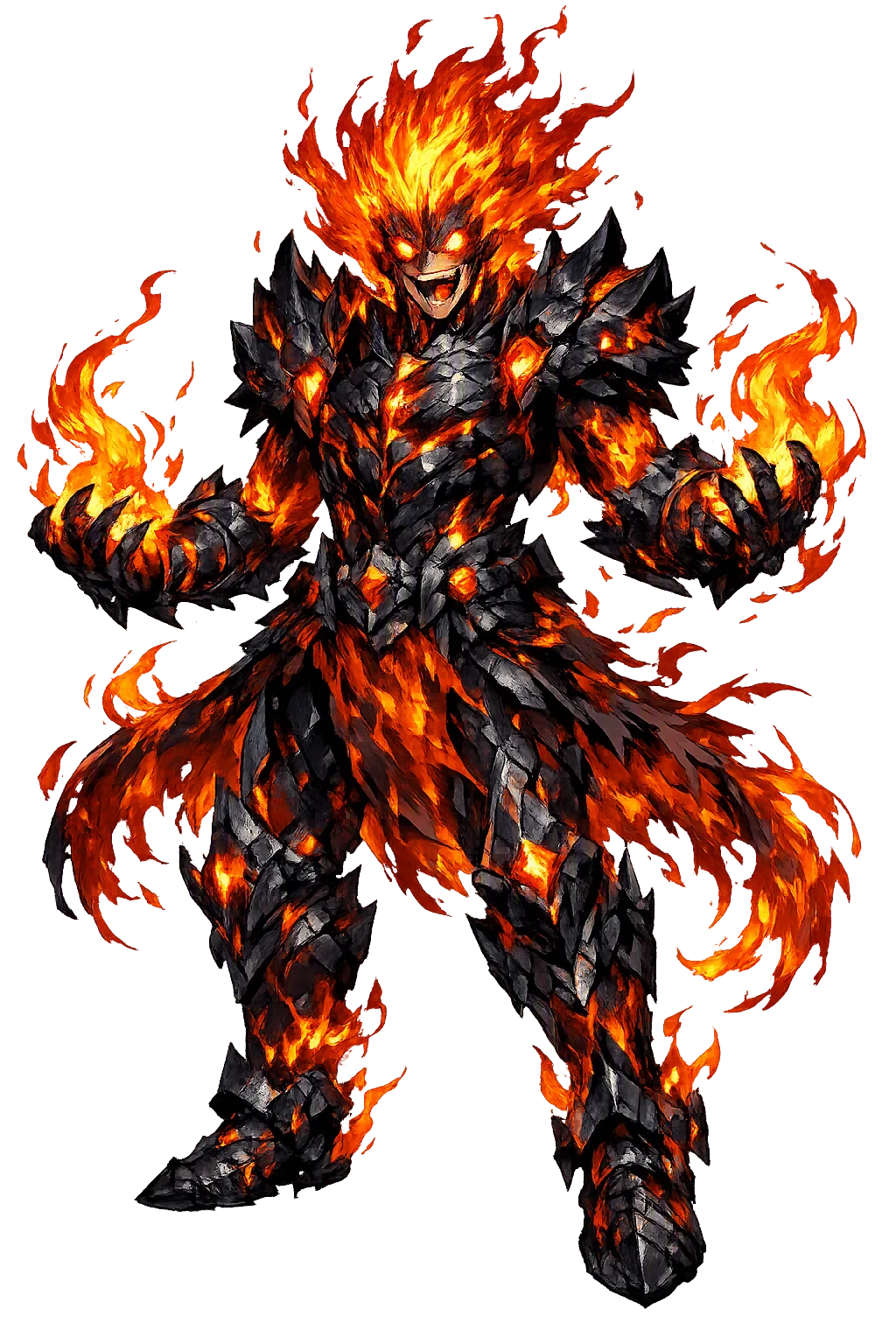
Logi (logi) — Fire, Flame, Giant · Flame — is the personified wildfire of the Norse corpus: the common noun logi ‘flame, blaze’ seated at a bench in the hall of Útgarða-Loki, where he meets the god Loki in an eating contest and wins it absolutely — consuming the meat, the bones, and the trough itself.
His attestation is spare and perfectly shaped. Gylfaginning gives him his single scene: Útgarða-Loki calls him from the bench to answer Loki's boast that no one eats faster, and only afterward, in the unmasking of the hall's illusions, does the giant-king explain what the company had watched — ‘he who contended with Loki in the eating-contest was wildfire itself’, villieldr, and it was no wonder the trough went so quickly. A second, genealogical tradition makes him elemental family: Skáldskaparmál's kennings for wind and the legendary preface Hversu Noregr byggðist name Logi among the three sons of the primeval giant Fornjótr — Hlér the sea (called Ægir), Logi the fire, and Kári the wind.
PuniCodex restores the name as Logi and serves its temple at /logi/. The restoration is identical to the ASCII form, because normalized Old Norse writes no diacritic or distinctive letter in this name; the mechanical rule therefore places it in a plain restoration. The plain-ASCII logi.com is the philologically complete form — it is registered to a third party, held outside the PuniCodex collection, and watched for release; no owned domain is claimed for this entry.
The Name
The name is attested in Old Norse as Logi (weak masculine; accusative Loga), and it is the commonest kind of mythological name in the North: a transparent appellative elevated to a person. The common noun logi, m., means ‘flame, blaze’; beside it stand log, n., ‘flame’, and the verb loga, ‘to burn with a flame’. Zoëga glosses the word simply ‘flame’, and Cleasby–Vigfusson record it in the full range of literal and figurative uses, from hearth-fire to poetic periphrasis.
Because the manuscripts write four plain Latin letters, the ASCII form loses nothing: the canonical restoration Logi and the ASCII input logi are the same word, and the mechanical restoration rule classifies the name a plain restoration — an honest report about orthography, not a judgment of the figure. The old scholarly temptation ran the other way, toward too much meaning rather than too little: nineteenth-century philology heard the fire-word in the god Loki and made Loki a fire-god, an equation modern scholarship rejects — the vowels differ in kind, and Gylfaginning itself stages Logi as Loki's opponent, not his double.
The letter-by-letter transformation runs:
- l → L — Same, capitalized
- o → o — Same
- g → g — Same
- i → i — Same
The project holds no domain for this name: the plain-ASCII logi.com is registered to a third party outside the collection and watched for release; the temple is served at /logi/.
The Original Script
The name is preserved in medieval Icelandic manuscripts in the Latin alphabet as Logi — Old Norse (North Germanic), attested 13th–14th c. CE in the Codex Regius of the Prose Edda (GKS 2367 4to), Codex Wormianus, and Codex Upsaliensis, recording material centuries older. Before the Latin bookhand, Old Norse names were carved in the younger futhark; no runic attestation of this figure survives, so the manuscript form is the primary witness.
The scholarly rendering proceeds step by step:
- The word is the common noun logi, m., ‘flame, blaze’, capitalized as a proper name; the weak-masculine inflection (accusative Loga) confirms the appellative origin.
- The vowel o is short; no acute accent, ogonek, or distinctive letter belongs in the normalized spelling.
- A hypothetical Younger Futhark carving would be ᛚᚢᚴᛁ — the same runes as Loki, since ᚴ writes both k and g.
- The canonical restoration Logi and the ASCII form are identical: there is nothing to recover, and the plain-form classification records exactly that.
Pronunciation
The reconstructed pronunciation of the name is /ˈlo.ɣi/ — Old Norse Reconstruction.
Phoneme by phoneme:
- L- — Voiced alveolar lateral [l], unchanged from Proto-Germanic; the name opens as cleanly as English low
- -o- — Short mid back [o], as in English lot; the Old Norse vowel is short, never the diphthong of English low
- -gi — Voiced velar fricative [ɣ], the soft medial g of Spanish lago, not the hard stop of English go — followed by short close front [i]; a light second syllable closed by the vowel
For the modern speaker, the closest approximation is: ‘LOH-yi’ — two short, even syllables with the weight on the first, the medial g softened to a voiced friction in the throat, as in modern Icelandic logi.
Kindred and historical forms of the name:
- Old Norse — logi, m., ‘flame, blaze’, the common noun borne as a proper name
- Modern Icelandic — logi, still the everyday word for a flame
- Word-family — log n. ‘flame’; loga v. ‘to burn with a flame, blaze’
- Genealogical form — Logi, son of Fornjótr, brother of Hlér (the sea, called Ægir) and Kári (the wind)
Logi is a simpler restoration because the restoration preserves nothing the ASCII form loses: no diacritic, no distinctive letter, no vowel length. English ‘Logi’ and Old Norse ‘Logi’ are, unusually, the same spelling.
Mythology
Logi's mythology is one scene and one genealogy, and the scene is constructed to prove the genealogy's point: he is an element with a name. When Þórr journeys east to Útgarðr with Loki and the servants Þjálfi and Rǫskva, every marvel on the road — the giant Skrýmir, the glove that serves as a hall, the blows that wake the sleeper — prepares the reader for a place where nothing is what it is called.
The Eating Contest (Gylfaginning 45)
Útgarða-Loki declares that no one may stay who is not master of some art beyond other men. Loki boasts that no one in the hall eats faster; the king calls Logi from the bench. A trough of meat is set on the floor; the two eat from opposite ends and meet in the middle. Loki has eaten all the meat from the bones — but Logi has eaten the meat, the bones, and the trough as well, ‘and it now seemed to everyone that Loki had lost the game’.
The Unmasking (Gylfaginning 46–47)
The evening's other contests fail the same way: Þjálfi is outrun by Hugi; Þórr cannot drain the horn, lift the grey cat, or throw the old woman Elli. In the morning the giant-king confesses the illusions outside the vanished stronghold: the horn's end stood in the sea, the cat was the Midgard Serpent, Elli was old age, Hugi was the king's own thought — ‘and he who contended with Loki in the eating-contest was wildfire itself’, villieldr. Fire against hunger was never a contest of the same kind.
The Sons of Fornjótr (Skáldskaparmál; Hversu Noregr byggðist)
Skáldskaparmál's kennings for wind name Kári as Fornjótr's son, with brothers Hlér and Logi; Hversu Noregr byggðist in the Flateyjarbók gives the triad its famous form — Fornjótr had three sons: Hlér, ‘whom we call Ægir’, Logi, and Kári. Sea, fire, and wind as one old giant's household: the genealogy is classification, not narrative.
The Flame That Goes Out (Vafþrúðnismál 51)
When Óðinn asks the giant Vafþrúðnir who will survive the world's burning, the answer keeps Víðarr and Váli in the gods' sanctuaries ‘when Surtr's flame dies down’ — þá er sloknar surtalogi. The compound welds Logi's noun to Surtr's name: the fire of Múspellheimr that ends the world and the flame that ate the trough are one word at two scales.
Symbols & Iconography
Logi's iconography is narrative rather than cultic — the corpus gives him no regalia, but the contest fixed a small set of attributes:
- The feeding-trough — Set the length of the hall floor, full of meat, with an eater at each end: appetite made measurable, and the only scoreboard in mythology that fire ever emptied
- The eaten bones — Loki strips the meat from the bones; Logi consumes meat, bones, and trough: the line between hunger and combustion drawn in leftovers
- The flame (logi) — His only emblem is his name itself, the common noun the hearth already used nightly, set in capital letters
- The brothers Hlér and Kári — Sea and wind: the genealogy that makes fire one element among three, not a freak among persons
Archaeology & Evidence
Logi is a textual figure in the strictest sense. His attestations are the Snorra Edda manuscripts — Codex Regius (GKS 2367 4to), Codex Wormianus, Codex Upsaliensis — together with the þulur, the rhymed name-lists appended to the Prose Edda, which keep the common noun logi among the heiti for fire, and the Fornjótr genealogy of Hversu Noregr byggðist in the Flateyjarbók.
No runic inscription names him, no place-name is securely his, and no cult could attach to a figure who is, by definition, an element rather than a person. His material context is the fire itself: the hearth-centered longhouse, the cremation pyres of the Late Iron Age, and the wildfire of the northern forests — the villieldr Snorri names as the truth behind the illusion.
Realm & Domain
Logi is catalogued under the domain Fire, Flame, Giant — three words that are, in his case, one fact stated three ways: he is a giant in the setting of Útgarðr, and he is fire in truth.
Fire
His name is the Old Norse common noun for flame; the unmasking in Gylfaginning confirms the personification outright: the eater was villieldr, wildfire itself.
The Eating Contest
His one scene is the mythology's cleanest fable of appetite: against Loki, the gods' own hunger, a trough of meat is set — and the verdict turns on what each eater leaves behind.
The Elemental Family
The Fornjótr genealogy makes him fire brothered to sea and wind — Hlér (called Ægir) and Kári — a family tree that is really a classification of elements.
The Giants' World
He belongs to the hall of Útgarða-Loki in Jǫtunheimr, the world of the jǫtnar, where strength, cunning, and illusion are the native arts; his kin at the world's edge is Surtr of Múspellheimr, whose fire ends the world.
Across Cultures
Logi's comparative history begins with a mistake and ends with a commonplace. The mistake is famous: nineteenth-century philology, from Grimm onward, heard the fire-word in the god Loki and made Loki a fire-god. The equation is now abandoned — the vowels differ in kind, the figures never merge in the texts, and Snorri stages them face to face across a trough, which is about as far apart as two beings can sit. Its monument survives in art rather than scholarship: Wagner's Loge, the flame-cynic of the Ring cycle, is the conflation set to music.
The commonplace is older than any comparison: every tradition that watches fire discovers that it eats. The Vedic hymns give flame a mouth and a priesthood in Agni, the devourer who carries the sacrifice; the Norse kept the same observation at the scale of a common noun, logi, and personified it once, brilliantly, as the unbeatable guest. Within the corpus his kin are elemental: Surtr of Múspellheimr, whose sword-fire burns the world; Ægir, the sea his own genealogy calls brother; and Loki, the god his name was once wrongly spent to explain.
Cultural Legacy
The eating contest is one of the most retold scenes of the Norse revival: the Kearys' The Heroes of Asgard (1857), the first popular English retelling of the myths, made Útgarða-Loki's hall a set-piece for generations of children, and every handbook since keeps Logi's trough beside Hugi's running and Elli's wrestling as the triad of unwinnable contests — fire, thought, and age, the three things no champion beats.
The nineteenth century's false etymology had an afterlife of its own: Wagner's Loge, and a long tail of fire-trickster Loki in popular fiction, are children of the conflation scholarship has buried. In Iceland the name never needed reviving: logi remains the everyday word for flame, from hearth-talk to weather reports, and Logi persists as a given name. Modern retellings and games cast him as he was written — fire wearing a face, the one opponent in Útgarðr who cheated by being exactly what he was.
The Scholarly Record
The account of Logi given in this edition rests on the witnesses and reference works listed below. The Eddas supply the scene and the genealogy; the lexica secure the name's meaning; the handbooks frame the rejected Loki–Logi equation.
- Snorri Sturluson, Edda, Gylfaginning 44–47 (the Útgarða-Loki journey; the eating contest and its unmasking), ed. and trans. Anthony Faulkes (London: Everyman, 1987).
- Snorri Sturluson, Edda, Skáldskaparmál (kennings for wind; the sons of Fornjótr), trans. Faulkes (1987).
- Hversu Noregr byggðist (Flateyjarbók): Fornjótr's three sons — Hlér, Logi, Kári.
- Vafþrúðnismál 51 (Poetic Edda), trans. Carolyne Larrington, The Poetic Edda, 2nd ed. (Oxford: Oxford University Press, 2014) — surtalogi, ‘Surtr's flame’.
- Cleasby, Richard, and Guðbrandur Vigfússon, An Icelandic-English Dictionary, 2nd ed. (Oxford: Clarendon Press, 1957), s.v. logi, log, loga.
- Zoëga, Geir T., A Concise Dictionary of Old Icelandic (Oxford: Clarendon Press, 1910), s.v. logi.
- de Vries, Jan, Altnordisches etymologisches Wörterbuch, 2nd ed. (Leiden: Brill, 1962), s.v. logi.
- Simek, Rudolf, Dictionary of Northern Mythology, trans. Angela Hall (Cambridge: D. S. Brewer, 1993), s.v. Logi.
- Lindow, John, Norse Mythology: A Guide to the Gods, Heroes, Rituals, and Beliefs (Oxford: Oxford University Press, 2001), s.v. Logi.
- Gordon, E. V., An Introduction to Old Norse, 2nd ed. rev. A. R. Taylor (Oxford: Clarendon Press, 1957).
A Meditation
Logi is the mythology's quietest lesson and one of its hardest: some appetites are animal, and some are elemental, and the two are not the same kind of thing. Loki, the gods' own hunger, eats well — no shame attaches to losing as he lost. But wildfire does not chew and does not stop; it consumes the meat, the bones, and the furniture, and it was never really competing.
The North kept that observation in a common noun and personified it once, brilliantly, as the unbeatable guest. Every household that has watched a fire take the beams as readily as the kindling already knows what Útgarða-Loki's hall was built to demonstrate: you can out-eat any man, and you cannot out-eat a flame.
The Canonical Spelling
Logi is the canonical spelling used by this temple. The plain ASCII form logi contains the same letters, so there are no lost diacritics to recover and no special encoding transition to explain. What the temple preserves is the reviewed reference form: capitalization, conventional romanization, original evidence, and a stable place to inspect them. The value here is not added decoration; it is fidelity to the attested record.
Why This Record Matters
Recording Logi accurately is part of a larger effort to make the web more faithful to the names it carries. This spelling needs no recovered marks; it needs a defensible chain of evidence. The script, sound, myths, and material record converge on the same point: the canonical form is information, and information deserves an address of its own. The temple keeps that address connected to the scholarship that justifies it.
Explore Further
This post is one doorway into the temple. The home page carries the full character breakdown and the ambient canvas; the lore page tells the myths in long form; the Scholarly Edition preserves the sources, pronunciation data, and revision history; and the patron wall supports the restoration directly. For the wider map, browse the Lexicon, explore the Pantheon, or return to the PuniCodex blog.
Related Names
Sources
The full scholarly apparatus — every citation, revision, and review — lives in the Scholarly Edition. Key references for this post:
- Snorri Sturluson, Prose Edda: Gylfaginning (the Útgarða-Loki journey; the eating contest and its unmasking; Brodeur translation)
- Gylfaginning, Old Norse text (Guðni Jónsson edition), chs. 44–47
- Skáldskaparmál, Old Norse text (the kennings for wind; the sons of Fornjótr)
- Hversu Noregr byggðist (Flateyjarbók; Fornjótr's three sons: Hlér, Logi, Kári)
- Poetic Edda: Vafþrúðnismál (st. 51, surtalogi — 'when Surtr's flame dies down'; Bellows translation)
- Cleasby & Vigfusson, An Icelandic-English Dictionary (1874), s.v. logi
- Snorri Sturluson, Edda, Gylfaginning 44–47 (the Útgarða-Loki journey; the eating contest and its unmasking), ed. and trans. Anthony Faulkes (London: Everyman, 1987).
- Snorri Sturluson, Edda, Skáldskaparmál (kennings for wind; the sons of Fornjótr), trans. Faulkes (1987); Hversu Noregr byggðist (Flateyjarbók).
- Cleasby, Richard, and Guðbrandur Vigfússon, An Icelandic-English Dictionary, 2nd ed. (Oxford: Clarendon Press, 1957), s.v. logi.
- Cleasby, Richard, and Guðbrandur Vigfússon, An Icelandic-English Dictionary, 2nd ed. (Oxford: Clarendon Press, 1957), s.v. logi, log, loga.
- Lexicon authorities for this entry: Cleasby-Vigfusson, Zoëga.