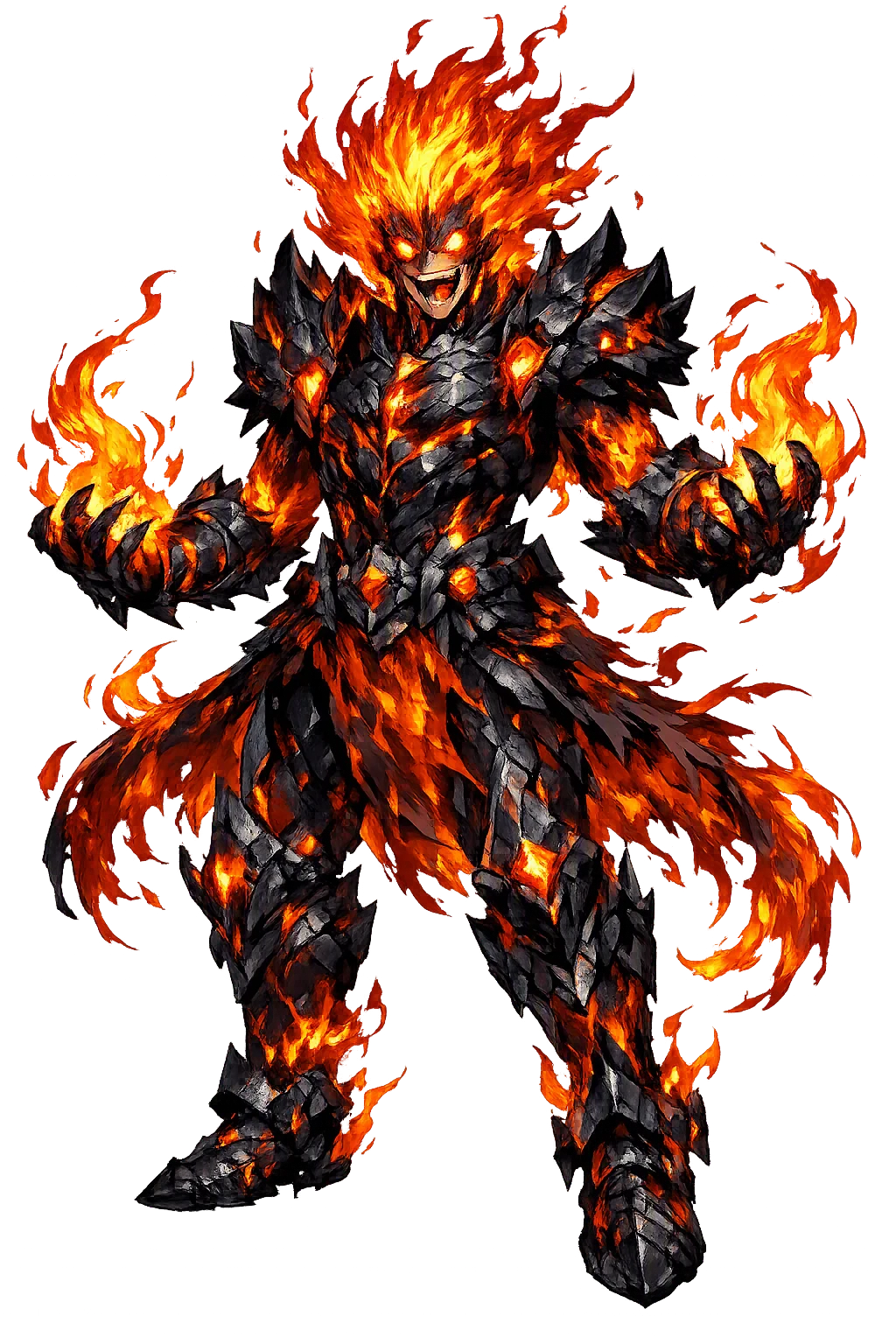
Stories of Logi
Logi has one great scene and one great family. The scene is the eating contest in Útgarða-Loki's hall, the showpiece of Þórr's eastern journey in Gylfaginning; the family is the Fornjótr genealogy, which makes him fire brothered to sea and wind. Between them the mythology says everything it has to say about him: he is not a character with a history but an element with a name — and his single appearance is constructed to prove exactly that.
Þórr sets out east for Jǫtunheimr with Loki for company, and at a peasant's farm takes the children Þjálfi and Rǫskva as his servants. On the road they meet the giant who calls himself Skrýmir: they sleep, unknowing, in the thumb of his dropped glove, and Þórr's three hammer-blows in the night — which the giant greets as a leaf, an acorn, and a bird's dropping — will be explained only later. Skrýmir points them to Útgarðr, a stronghold so vast the travellers must tilt their heads back to see the top of it, and vanishes. Every step of the journey is a setup: by the time the company reaches the hall, the story has already taught the reader that nothing here is what it is called.
Útgarða-Loki, the giant-king, declares that no one may stay in his hall who is not master of some art or accomplishment beyond other men. Loki, travel-hungry and never at a loss, speaks first: no one in the hall can eat faster than he can. The king accepts the challenge and calls from the far bench a man named Logi. A trough full of meat is set down on the floor between them; Loki takes one end, Logi the other, and they eat toward each other. They meet in the middle — and there the verdict lies in plain sight. Loki has eaten every shred of meat from the bones; but Logi has eaten the meat, and the bones, and the trough as well. 'And it now seemed to everyone,' Snorri says, 'that Loki had lost the game.' The scene is the mythology's cleanest joke about identity: Loki, whose own name was once misread as 'flame', meets the real thing across a trough — and the real thing is unbeatable precisely because it does not eat the way a person eats. Hunger chews; fire consumes.
The rest of the evening fails the same way: Þjálfi is outrun by Hugi, Þórr cannot drain the drinking-horn, cannot lift the grey cat, and is forced to one knee by the old foster-mother Elli. In the morning Útgarða-Loki walks the company outside — and when he has told the truth and they turn back, the stronghold is gone. Skrýmir was himself; the glove was the hall; the blows fell on three mountain-valleys. The horn's end stood in the sea, and the tide now answers to Þórr's drinking; the cat was the Midgard Serpent; Elli was old age, whom no one out-wrestles; Hugi was the king's own thought. 'And he who contended with Loki in the eating-contest was wildfire itself' — villieldr — and it was no wonder he made short work of the trough. Fire against hunger was never a contest of the same kind.
Logi's other attestation is genealogical. Skáldskaparmál, teaching the kennings for wind, names Kári as Fornjótr's son and his brothers as Hlér and Logi; Hversu Noregr byggðist, the legendary preface to the Norwegian settlement preserved in the Flateyjarbók, gives the triad its famous form: Fornjótr had three sons — Hlér, 'whom we call Ægir', Logi, and Kári. Sea, fire, and wind as one old giant's household: the genealogy is not narrative but classification, the North keeping its elements in a family tree, with the sea Logi's brother and the wind his kin.
The word's longest echo is eschatological. When Óðinn asks the giant Vafþrúðnir who will survive the world's burning, the answer keeps Víðarr and Váli in the gods' sanctuaries 'when Surtr's flame dies down' — þá er sloknar surtalogi. The compound welds Logi's common noun to Surtr's name: the fire that ends the world and the flame that eats the trough are one word at two scales. Even eschatology, in Old Norse, is written in the vocabulary of the hearth.
The Trough, the Wildfire, and the Sons of Fornjótr
Logi is the Norse name for flame itself — the common noun logi, 'blaze', walking on two legs into the greatest hall of giants the mythology knows. In Útgarða-Loki's court he is served a trough of meat against the god Loki, and when the two eaters meet in the middle, Logi has consumed the meat, the bones, and the trough besides: wildfire does not chew, it consumes. He is catalogued in the norse pantheon under the domain 'Fire, Flame, Giant', and his meaning is the plainest in the lexicon — 'Flame'.
The full-length feeding-trough set on the hall floor; Loki clears the meat from the bones — Logi clears everything.
The one fair contest of Útgarðr: no enchantment was needed — the opponent was fire.
'Wildfire', the unmasking word: what sat down to eat with Loki was flame itself.
His brothers in the Fornjótr genealogy: the sea and the wind — an elemental triad with fire between them.
From the original script to the living URL
ᛚᚢᚴᛁ
The name in its original Norse form. Logi (ᛚᚢᚴᛁ) is attested in the source tradition — “Flame”. Its original diacritics and script distinctions carry the full phonetic and orthographic weight of the source tradition.
logi
The plain logi form is identical to the Unicode restoration. Because this name is already written in Latin letters, no diacritics, stress, or script information were lost — only capitalization differs.
Logi
The Unicode restoration does not need to recover lost marks for Logi. Its value is canonical spelling and consistent cataloguing, not the reconstruction of erased orthography. The domain is readable as-is to both DNS and humanity.
Logi.com
This restoration is written entirely in ASCII letters — no Punycode encoding stands between Logi and the DNS. The domain reads identically to machines and to human eyes.
Owned, ideal, and ASCII forms of Logi
Logi
Restores ᛚᚢᚴᛁ. The full Unicode restoration. logi.com is not in the PuniCodex collection — it is watched for release; if it drops, this temple upgrades to an owned flagship.
How Logi was spoken
How Logi travels from ancient script to the modern URL
The lore you have read is the living myth. Extended Lore opens the scholarly vault beneath it: the cult and its material remains, a history of the image, the name after antiquity, a meditation on what the name still means, and the full scholarly apparatus — etymology, orthography, sources.
Enter Extended Lore