
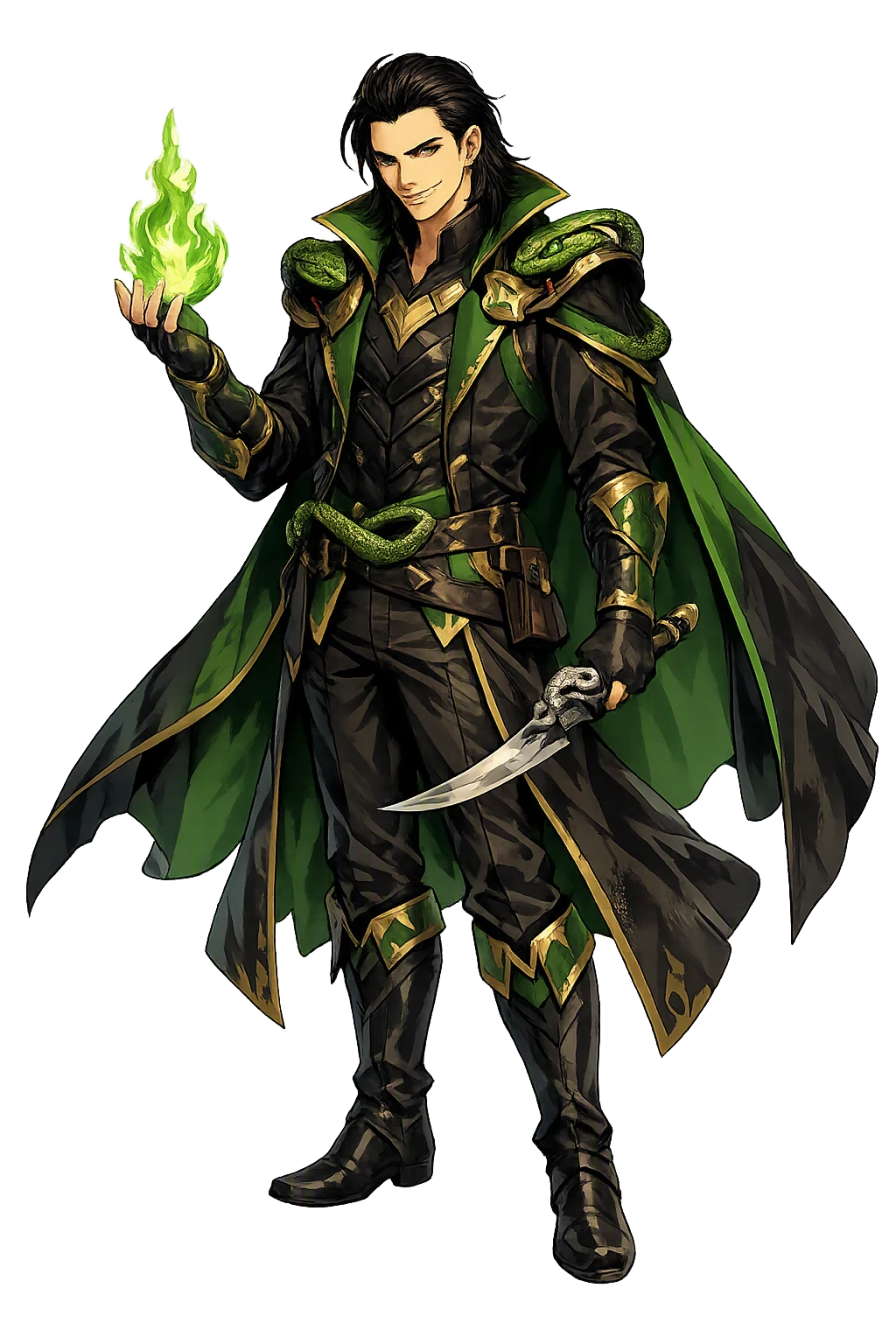
Why Loki is spelled that way — and what it costs to get it right
There is a version of this name the early internet had to settle for: loki. This is the file on how Loki replaced it.
Loki stands at the centre of more Eddic narrative than any figure save Þórr and Óðinn — and almost every road through the mythology crosses him at least once. The same wit that recovers Mjǫllnir in Þrymskviða engineers the death of Baldr; the Eddas hold both truths without reconciling them. By the giantess Angrboða he fathers Fenrir, Jǫrmungandr, and Hel; by his wife Sigyn, Nari and Váli, whose fates are spent in his own binding.
At a Glance
- Restored name: Loki
- ASCII form: loki
- Meaning: "Possibly knot, loop, or flame"
- Domain of influence: Trickery, Chaos, Shape-shifter
- Pantheon: Norse
- Classification: Tier 2
- Original script: ᛚᚢᚴᛁ
- Series: The Restoration Files, No. 281 of 548
The Name Before the Marks
Spoken, the name runs `/ˈlo.ke/` — 'LOH-kee' — two even syllables with the weight on the first; keep the o short and round, and let the second syllable fall away lightly.
The Temple That Stands Now
The restored name is not a plaque; it is an address. The temple of Loki lives at /loki/, with its mythology in the lore halls, its peer-reviewed record in the Scholarly Edition, and its place in the pattern atlas on the patterns floor.
One decisive feature survives — a single, honest mark — which places the restoration in Tier-2: exact, and exactly labeled.
Where the Name Stood First
One carved stone is the entire candidate corpus for Loki's image: the Snaptun stone (Denmark, c. 1000), a hearth-stone or bellows-shield bearing a bearded face with scarred, sewn-shut lips, commonly identified as Loki from the Brokkr episode — an identification widely repeated but unprovable, since the stone carries no inscription. The Kirkby Stephen stone in Cumbria, showing a bound horned figure, has likewise been read as the bound Loki, though scholars also read it as a bound devil of Christian iconography. His attestation is otherwise textual: the Poetic Edda poems survive chiefly in the Codex Regius (GKS 2365 4to, c. 1270) and the Hauksbók; Snorri's account is transmitted by the principal Snorra Edda manuscripts (GKS 2367 4to, Codex Wormianus, Codex Upsaliensis). No runic inscription names the god, and no Scandinavian place-name is securely his — a silence that matches his ambiguous cultic standing: the one major god for whom no temple, toponym, or votive deposit is known. The temple on the web is the newest of these addresses — the first one that fits in a pocket.
The Archetype at Work
The pattern atlas seats this temple in 3 industries, each match argued and weighted: Disaster Resilience & Recovery (the bound one whose breaking free opens Ragnarök — the stored-up catastrophe of the northern cosmos.); Gaming, Fantasy & Entertainment IP (the trickster archetype entire — from sagas to Marvel, the most-adapted Norse figure in modern fantasy IP.); Thermal, Geothermal & Fire Energy (the fire-side companion — fire personified at times, the wildfire that burns what it will.). The Resonance File reads those seats through the myths themselves.
In the Sacred Texts
The Norse tradition is not a vibe; it is a library. The Sacred Texts collection holds Poetic Edda and Prose Edda — the primary sources the temple's scholarship is built on. The temple is the argument; the texts are the evidence.
The File Continues
The temple's founding dispatch tells the name's story; its Resonance File reads the myths into the industries; the blog index holds the whole archive.
Continue the series — previous file: Logi (read it here) · next file: Lóng (read it here).
The Restoration Files are written from the same canonical record as the temples themselves: the lexicon, the lore catalog, the pattern atlas, and the cited scholarly sources. If a file ever disagrees with its temple, the temple is right — tell us, and the file will be corrected.