
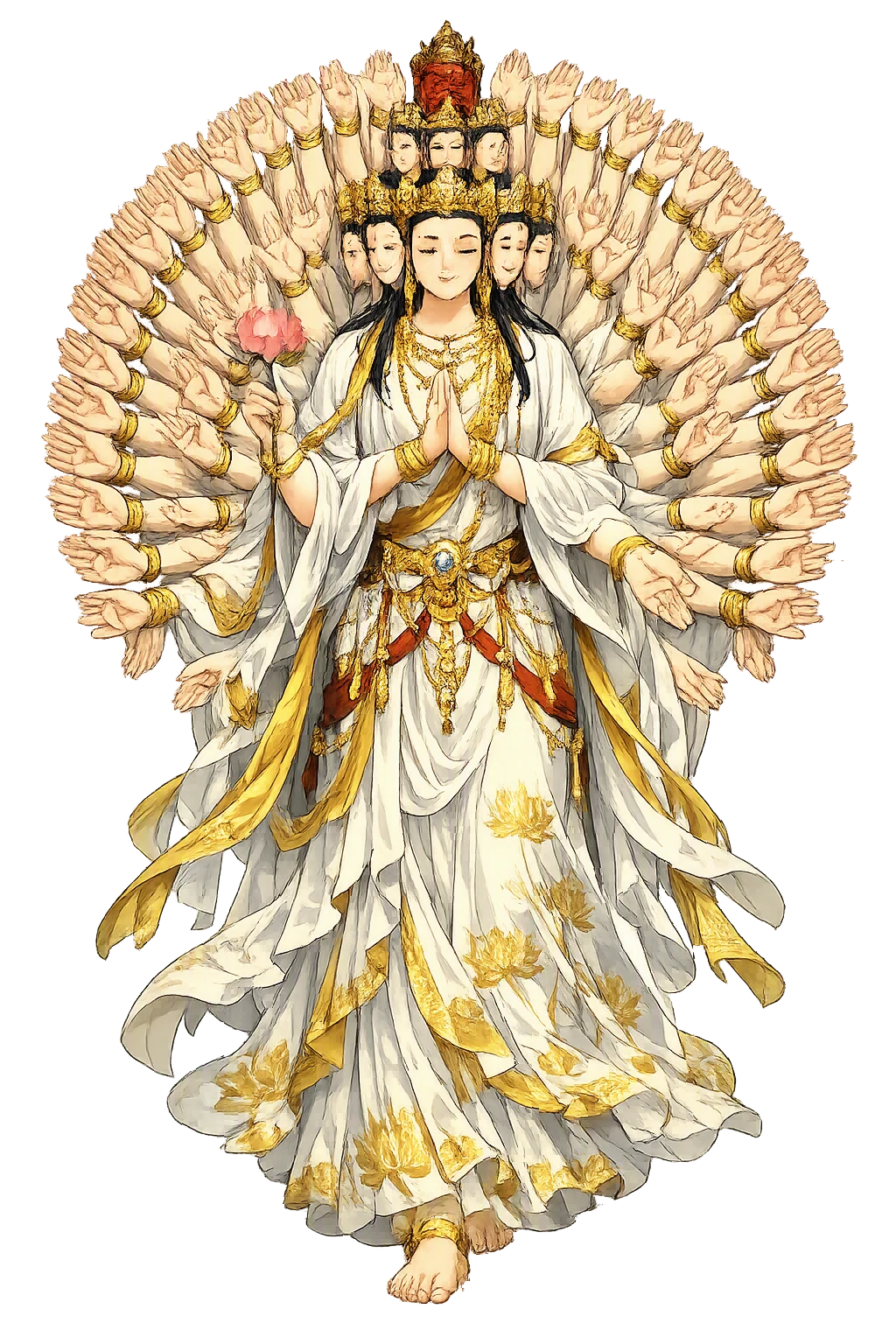
The working life of Avalokiteśvara: from the myths to the modern trades
The myths did not retire. They moved offices. This is the file on where Avalokiteśvara works now.
Avalokiteśvara's mythology is a geography of mercy: the Indian lord who hears cries, the Chinese princess who gave her eyes and arms, the Tibetan ancestor of a nation, the Japanese savior of the drowning. His stories share one grammar — someone suffers, and compassion arrives already looking.
The pattern atlas — which maps every flagship temple to the industries its archetype demonstrably resonates with, each match argued and open to challenge — seats this temple in 6 industries. This file reads those seats the way they were earned: through the myths.
At a Glance
- Temple: Avalokiteśvara
- Pantheon: Buddhist
- Domain of influence: Compassion, Mercy, Bodhisattva
- Pattern seats: 6
- Sectors touched: Society & Spirit · Culture & Entertainment · Health & Wellbeing · Technology & Innovation
- Strongest seat: Faith & Spiritual Organizations
- Series: The Resonance Files, No. 70 of 548
The Myth at Work
The Lord Who Looks Down. The name is an act of attention: ava-lokita, 'perceived, looked down upon,' joined to īśvara, 'lord' — the Lord Who Looks Down, as Monier-Williams parses the Sanskrit. The Lotus Sūtra's twenty-fifth chapter, the Universal Gateway, turns the etymology into a program: the Buddha declares that whoever calls Avalokiteśvara's name in the moment of terror — surrounded by fire, swept by flood, bound in chains, cornered by demons — will be saved, because this bodhisattva scans the world the way a parent scans a crowd for a child. — hold that image; the industries below are where it goes to work.
Thirty-Three Forms for Every Kind of Suffering. The Lotus Sūtra (ch. 25) closes its gateway chapter with a list that reads like a census of the human condition: to beings who can be saved through a Buddha's body, Avalokiteśvara appears as a Buddha; likewise as a pratyekabuddha, a śrāvaka, a king, a householder, a government official, a monk, a nun, a layman, a laywoman, a boy, a girl, a god, a nāga, a yaksha, a gandharva, an asura, a garuḍa, a kinnara, a mahoraga — the sūtra counts thirty-three bodies in all. — remember the shape of that act. You will see it again, wearing a logo.
The Seats
Each of these is argued in the atlas with a weight and a why-line. What the atlas cannot fit in one line is the whole myth — so here is each seat with its story restored.
Faith & Spiritual Organizations
Religious institutions, faith media, and devotional services. (Sector: Society & Spirit)
The most widely invoked bodhisattva in East Asian Buddhism — compassion as the heart of devotional practice. Swap the costume and the sentence is indistinguishable from the myth. That is what a resonance seat means.
Mythic Name Restoration
Scholarly Unicode restorations of mythic names for modern identity. (Sector: Culture & Entertainment)
The bodhisattva of compassion in IAST, a name whose length marks matter. Swap the costume and the sentence is indistinguishable from the myth. That is what a resonance seat means.
Yoga, Meditation & Holistic Wellness
Yoga, meditation, and mind-body practice. (Sector: Health & Wellbeing)
Compassion meditation, mettā, and the universal vow — wellness traditions across Asia invoke this name. — the atlas stops there, out of discipline. The myth keeps going: the function Avalokiteśvara performs in the stories is precisely the function this industry sells.
Diacritic-First Domains
IDN domains where the restored marks are the entire point. (Sector: Technology & Innovation)
The palatal ś and long vowels restore Avalokiteśvara in IAST. — the atlas stops there, out of discipline. The myth keeps going: the function Avalokiteśvara performs in the stories is precisely the function this industry sells.
Global Pantheon Brands
Cross-cultural deity and hero names as sovereign brand anchors. (Sector: Society & Spirit)
The bodhisattva of compassion in IAST, a name whose length marks matter. Swap the costume and the sentence is indistinguishable from the myth. That is what a resonance seat means.
The temple holds 1 further seat beyond these — the full, argued list lives on its patterns floor.
The Long Employment
Avalokiteśvara is, by nearly any measure, the most venerated bodhisattva on earth. His chapter of the Lotus Sūtra is chanted as a protective rite across East Asia; his mantra turns the prayer wheels of the entire Himalaya; and the Guanyin temples of the Chinese diaspora — from Putuo Island to San Francisco — count their visitors in the tens of millions. The age changed. The work did not.
The Method, Stated Plainly
Skeptical? Good — the system is built for you. Every seat in this file carries its why-line and its weight, the full derivation is public at the methodology page, and the challenge process is part of the design. Falsifiable is not a posture here; it is the mechanism.
For the Ones Who Work There
If you work in faith & spiritual organizations, mythic name restoration, or any trade this temple holds a seat in, this is the honest version of what a placement means: your industry beside the story it has been re-telling all along — on the temple floor itself, before an audience that came specifically to read it. The patron tier and the advertising terms describe the mechanics; the resonance above describes the fit.
The File Continues
One of 548 Resonance Files — the series where the pantheon goes to work. Read the founding dispatch for the name, the Restoration File for the spelling, or the whole archive end to end.
Continue the series — previous: Auðhumla (read it) · next: Bꜣ (read it).
The Resonance Files are argued from the same canonical record as the pattern atlas itself: the lexicon, the lore catalog, and the cited sources. Every seat can be challenged at the methodology page — and the challenge is the point.