The Living Myth
Compassion, Mercy, Bodhisattva · Lord who looks down in compassion
Stories of Avalokiteśvara
Avalokiteśvara's mythology is a geography of mercy: the Indian lord who hears cries, the Chinese princess who gave her eyes and arms, the Tibetan ancestor of a nation, the Japanese savior of the drowning. His stories share one grammar — someone suffers, and compassion arrives already looking.
The name is an act of attention: ava-lokita, 'perceived, looked down upon,' joined to īśvara, 'lord' — the Lord Who Looks Down, as Monier-Williams parses the Sanskrit. The Lotus Sūtra's twenty-fifth chapter, the Universal Gateway, turns the etymology into a program: the Buddha declares that whoever calls Avalokiteśvara's name in the moment of terror — surrounded by fire, swept by flood, bound in chains, cornered by demons — will be saved, because this bodhisattva scans the world the way a parent scans a crowd for a child. Kumārajīva translated the name into Chinese as Guanshiyin, 'Perceiver of the World's Sounds,' and the translation stuck: East Asia knows him by the listening. The name is the whole doctrine — compassion is not a mood but a gaze that never lifts.
The Lotus Sūtra (ch. 25) closes its gateway chapter with a list that reads like a census of the human condition: to beings who can be saved through a Buddha's body, Avalokiteśvara appears as a Buddha; likewise as a pratyekabuddha, a śrāvaka, a king, a householder, a government official, a monk, a nun, a layman, a laywoman, a boy, a girl, a god, a nāga, a yaksha, a gandharva, an asura, a garuḍa, a kinnara, a mahoraga — the sūtra counts thirty-three bodies in all. Śāriputra asks why he is called Perceiver of Sounds, and the answer is simplicity itself: he perceives the world's sounds and responds to each. The list is the myth's meaning: suffering has no shape the bodhisattva will not borrow to reach the sufferer, and mercy wears every uniform the world issues.
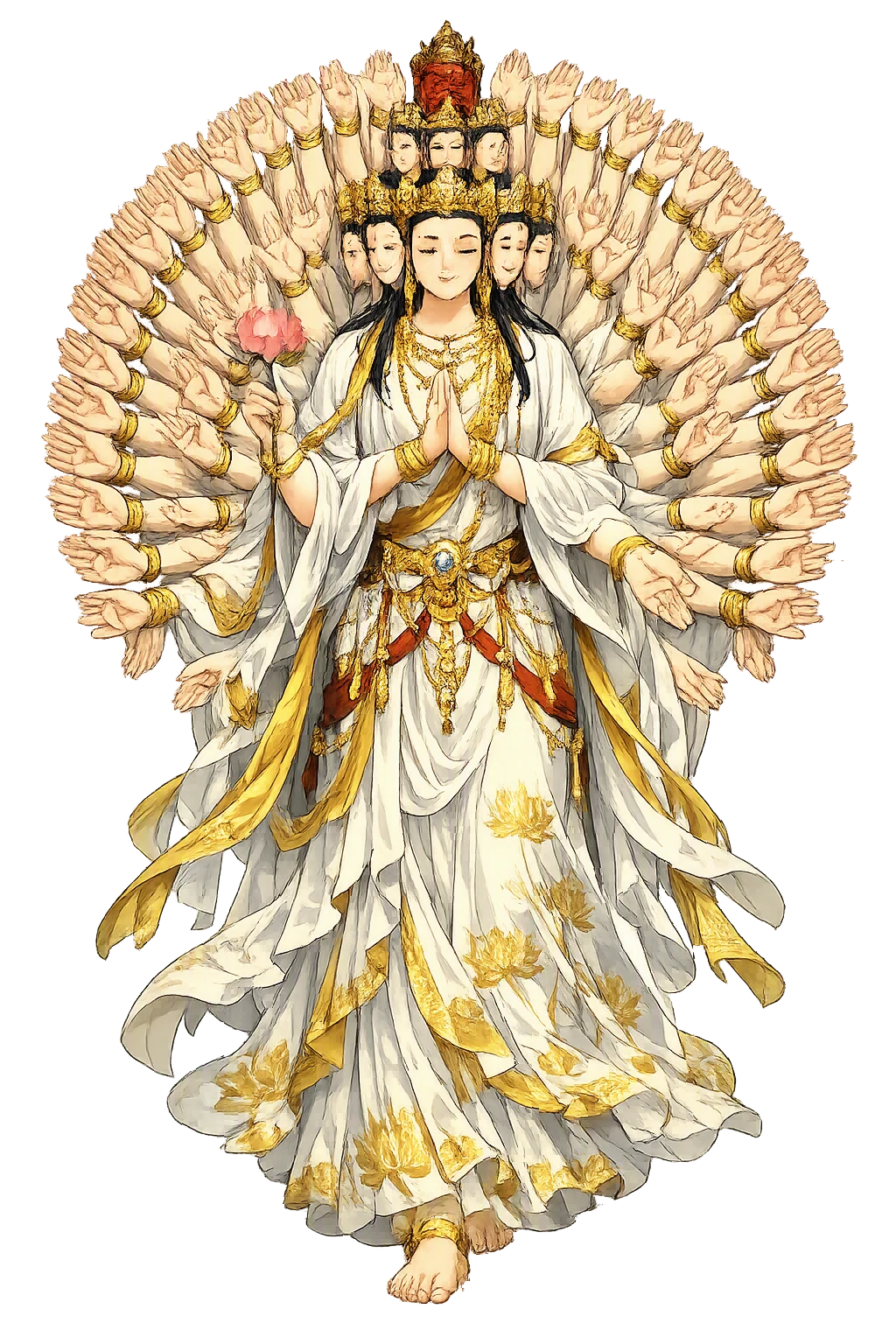
China's most beloved Guanyin legend is also its latest — recorded in the Song-dynasty Xiangshan baojuan, the 'Precious Scroll of the Fragrant Mountain.' King Miao Zhuang's youngest daughter Miaoshan refused every suitor and every palace command, asking only to become a nun; exiled and persecuted, she held to her practice while her father's hatred hardened. When the king fell mortally ill, the diviners declared that only the eyes and arms of a person without resentment could cure him. A mountain ascetic — Miaoshan in disguise — gave them, and died; as her body was carried off, she was received into the Fragrant Mountain, revealed as Guanyin herself, with a thousand hands and an eye in every palm. The late legend gives the bodhisattva's iconography its human face: every hand is a sacrifice once made, and compassion is the scar tissue of self-giving.
Indian Buddhism borrowed even wrath from Śiva. In the seventh-century dhāraṇī sūtras — Xuanzang's translation of the Nīlakaṇṭha-dhāraṇī and the Sūtra of the Great Compassionate One of a Thousand Hands and Eyes — Avalokiteśvara takes the Destroyer's own epithet: Nīlakaṇṭha, 'blue-throated,' the one whose throat holds the poison of a churned cosmos without flinching. Here the gentle perceiver multiplies into a thousand-armed sovereign whose Great Compassion Dhāraṇī subdues demons and burns away the gravest karma, and whose wrathful faces stand at the gates of mandalas across Asia. The texts themselves show the borrowing plainly — the bodhisattva of mercy wears the destroyer's name and drinks his poison. The myth's claim is that compassion has a frightening side: it will enter any form, even terror's, to reach those only terror can move.
Tibet's own creation myth, recorded in the twelfth-century Mani bka' 'bum and the treasure-texts of the Nyingma school, makes Avalokiteśvara — there called Chenrezig — the father of the entire nation. Gazing from his mountain, the bodhisattva saw that the snowy plateau was empty of beings fit for the Dharma; rays of his compassion fell upon a monkey who had withdrawn into meditation in a mountain cave and upon the rock-demoness who haunted the cliffs. Their union, blessed by the bodhisattva's light, produced six children — red-faced, hairy, the ancestors of Tibet's clans — and when the infants had nothing to eat, Chenrezig scattered barley over the snows so they could live and, in time, hear the teaching. The myth means that for Tibetans compassion is not one virtue among many: it is the literal parent of the people, and every Tibetan carries Avalokiteśvara's gaze as a birthright.
The Lord Who Looks Down in Compassion — Bodhisattva of Mercy, Lord of the World's Cries
Avalokiteśvara is compassion made a person: the bodhisattva who looks down upon every cry of suffering and answers it, postponing his own Buddhahood until no being is left unsaved. From the Lotus Sūtra's Universal Gateway to Tibet's patron deity and China's beloved Guanyin, he is the most widely venerated bodhisattva in the world.
Lotus Sūtra ch. 25: whoever calls his name in fire, flood, chains, or the jaws of demons is delivered at once.
His Great Compassion form: an arm for every cry, an eye in every palm so that seeing and saving happen together.
ava-lokita, 'perceived, looked down upon': his very name is an act of attention that never lifts.
His mantra on the lips of half the Himalaya — the jewel in the lotus — recited for every suffering being.
From the original script to the living URL
अवलोकितेश्वर
The name in its original Buddhist form. Avalokiteśvara (अवलोकितेश्वर) is attested in the source tradition — “Lord who looks down in compassion”. Its palatal/retroflex sibilants carry the full phonetic and orthographic weight of the source tradition.
avalokiteshvara
Reduced to plain avalokiteshvara, the name loses everything that made it specific: palatal/retroflex sibilants. What remains is an ASCII string that machines can parse but that no longer speaks with its original voice.
Avalokiteśvara
The Unicode restoration recovers what ASCII flattened. Avalokiteśvara restores palatal/retroflex sibilants, returning the name to its original written dignity. The domain encodes to Punycode, but the browser displays the truth.
Avalokiteśvara.com → xn--avalokitevara-4rc.com
The non-ASCII characters in Avalokiteśvara are encoded while the ASCII remains visible. To the DNS, it is Punycode. To humanity, it is Avalokiteśvara.
Owned, ideal, and ASCII forms of Avalokiteśvara
Avalokiteśvara
Restores अवलोकितेश्वर. The live temple domain — avalokiteśvara.com.
avalokiteshvara
Flattens अवलोकितेश्वर. The plain ASCII fallback — what DNS and legacy systems see.
How Avalokiteśvara was spoken
How Avalokiteśvara travels from ancient script to the modern URL
The lore you have read is the living myth. Extended Lore opens the scholarly vault beneath it: the cult and its material remains, a history of the image, the name after antiquity, a meditation on what the name still means, and the full scholarly apparatus — etymology, orthography, sources.
Enter Extended Lore