
How Avalokiteśvara got its accent back
The ASCII form avalokiteshvara is missing something. Avalokiteśvara restores the marks the source language used to distinguish this name from a thousand others — and those marks change how the name is read, pronounced, and understood. This post explains, with the full scholarly record behind it, what each restored mark preserves: the Devanagari evidence, the reconstructed sound, the myths the name carries, and the mechanical logic of what each restored mark preserves. By the end, the marks in Avalokiteśvara will look less like ornaments and more like what they are — recovered evidence, pinned back in its proper place.
At a Glance
- Restored name: Avalokiteśvara
- ASCII form: avalokiteshvara
- Meaning: "Lord who looks down in compassion"
- Domain of influence: Compassion, Mercy, Bodhisattva
- Pantheon: Buddhist
- Restoration: Preserves stress
- Original script: अवलोकितेश्वर (Devanagari)
- Live domain: avalokiteśvara.com
Overview
Avalokiteśvara (avalokiteshvara) — Compassion, Mercy, Bodhisattva · Lord who looks down in compassion — belongs to the Buddhist tradition, where it is catalogued under the domain "Compassion, Mercy, Bodhisattva". The name means "Lord who looks down in compassion".
Avalokiteśvara belongs to the Buddhist tradition, where it is associated with compassion, mercy, bodhisattva.
PuniCodex restores the name as Avalokiteśvara and serves its temple at avalokiteshvara.com. The restoration preserves at least one distinctive feature — a diacritic or a distinctive letter — that the ASCII form loses, and exactly one historically valid Unicode restoration exists. The plain ASCII form avalokiteshvara survives as a modern convenience imposed by the early domain-name system; the restoration, not the fallback, is the form the project defends as philologically complete.
The Name
The name is attested in Devanagari as अवलोकितेश्वर. Etymologically it means "Lord who looks down in compassion".
Sanskrit Avalokiteśvara, from avalokita 'beheld, looked down upon' + īśvara 'lord'; the bodhisattva of compassion, source-form of Guānyīn and Kannon.
The ASCII form avalokiteshvara survives only because the early domain-name system could not carry diacritics; it is a technological compromise, not an ancient spelling. The Unicode restoration Avalokiteśvara recovers the full diacritic detail of the scholarly transliteration directly in the address bar. The restoration preserves at least one distinctive feature — a diacritic or a distinctive letter — that the ASCII form loses, and exactly one historically valid Unicode restoration exists.
The letter-by-letter transformation runs:
- a → A — Same, capitalized
- v → v — Same
- a → a — Same
- l → l — Same
- o → o — Same
- k → k — Same
- i → i — Same
- t → t — Same
- e → e — Same
- s → ś — Ś: palatal sibilant, atomic letter (IAST ś)
- h → — — Not written: sh digraph realized as single letter ś
- v → v — Same
- a → a — Same
- r → r — Same
- a → a — Same
The canonical temple for this name is served at avalokiteshvara.com.
Etymology & Roots
The recorded derivation reads: Sanskrit Avalokiteśvara, from avalokita 'beheld, looked down upon' + īśvara 'lord'; the bodhisattva of compassion, source-form of Guānyīn and Kannon.
The root gloss is "lord who looks down."
The reconstruction is classed as attested.
The Original Script
The name is preserved in Devanagari as अवलोकितेश्वर.
The scholarly transliteration is Avalokiteśvara.
The rendering proceeds step by step:
- Sanskrit Avalokiteśvara is written in Devanagari as अवलोकितेश्वर
- IAST transliteration maps each Devanagari vowel and consonant to a Latin equivalent
- Macrons mark long vowels (ā, ī, ū); dots beneath consonants mark retroflex articulation (ṭ, ḍ, ṇ, ṣ)
Pronunciation
The reconstructed pronunciation of the name is /avalokiteshvara/ — Buddhist Reconstruction.
Phoneme by phoneme:
- A — Initial character of the restored form Avalokiteśvara.
- valokiteśvara — Remainder of the name, preserving the distinctive marks of the Buddhist tradition.
For the modern speaker, the closest approximation is: 'AVALOKITESHVARA' — pronounce the restored form with attention to the preserved diacritics and length.
Kindred and historical forms of the name:
- Buddhist — Avalokiteśvara, the restored Unicode form of the name
Avalokiteśvara preserves both features because the Buddhist form preserves distinctive features that ASCII loses: stress, length, or special characters.
Mythology
The stories of Avalokiteśvara circulate within the Buddhist corpus, where the figure embodies compassion, mercy, bodhisattva.
Primary Attestation (Sources)
Avalokiteśvara is attested in the canonical Buddhist sources as a figure associated with compassion, mercy, bodhisattva.
Name and Meaning (Etymology)
The name means "Lord who looks down in compassion" and reflects the figure's role in the tradition. Avalokiteśvara is the bodhisattva of compassion who hears the cries of all sentient beings. In Mahāyāna sutras he descends into every realm to save the suffering, manifesting in forms appropriate to those he teaches. In East Asia he became the goddess Guānyīn, while in Tibet he is the patron bodhisattva manifesting through the Dalai Lamas. The Heart Sūtra and Lotus Sūtra celebrate his willingness to assume any form—male, female, monarch, or beggar—to liberate beings from suffering.
The Lord Who Looks Down (The Name)
The name is an act of attention: ava-lokita, 'perceived, looked down upon,' joined to īśvara, 'lord' — the Lord Who Looks Down, as Monier-Williams parses the Sanskrit. The Lotus Sūtra's twenty-fifth chapter, the Universal Gateway, turns the etymology into a program: the Buddha declares that whoever calls Avalokiteśvara's name in the moment of terror — surrounded by fire, swept by flood, bound in chains, cornered by demons — will be saved, because this bodhisattva scans the world the way a parent scans a crowd for a child. Kumārajīva translated the name into Chinese as Guanshiyin, 'Perceiver of the World's Sounds,' and the translation stuck: East Asia knows him by the listening. The name is the whole doctrine — compassion is not a mood but a gaze that never lifts.
Thirty-Three Forms for Every Kind of Suffering (Lotus Sūtra)
The Lotus Sūtra (ch. 25) closes its gateway chapter with a list that reads like a census of the human condition: to beings who can be saved through a Buddha's body, Avalokiteśvara appears as a Buddha; likewise as a pratyekabuddha, a śrāvaka, a king, a householder, a government official, a monk, a nun, a layman, a laywoman, a boy, a girl, a god, a nāga, a yaksha, a gandharva, an asura, a garuḍa, a kinnara, a mahoraga — the sūtra counts thirty-three bodies in all. Śāriputra asks why he is called Perceiver of Sounds, and the answer is simplicity itself: he perceives the world's sounds and responds to each. The list is the myth's meaning: suffering has no shape the bodhisattva will not borrow to reach the sufferer, and mercy wears every uniform the world issues.
The Eyes and Arms She Gave Away (Princess Miaoshan)
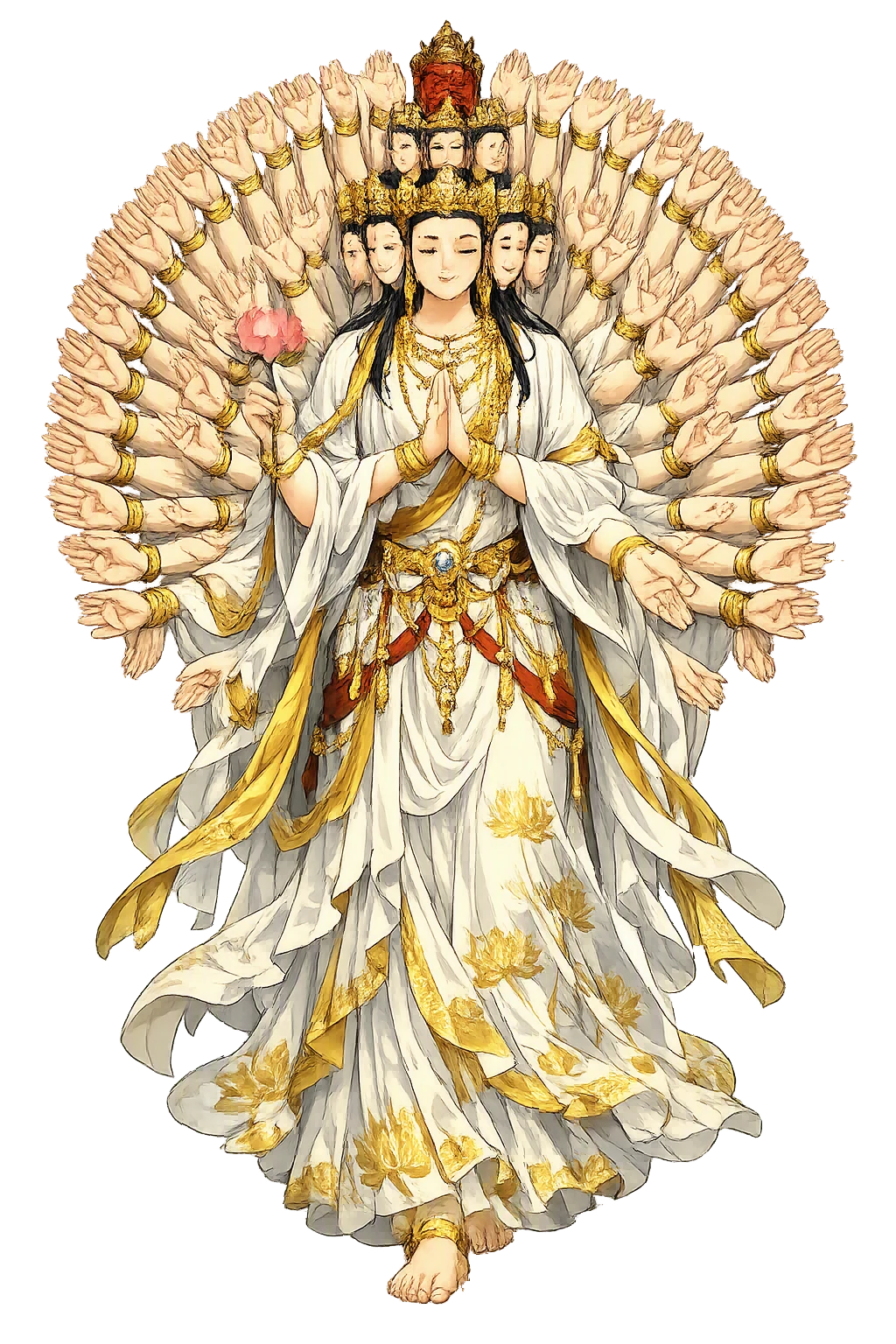
China's most beloved Guanyin legend is also its latest — recorded in the Song-dynasty Xiangshan baojuan, the 'Precious Scroll of the Fragrant Mountain.' King Miao Zhuang's youngest daughter Miaoshan refused every suitor and every palace command, asking only to become a nun; exiled and persecuted, she held to her practice while her father's hatred hardened. When the king fell mortally ill, the diviners declared that only the eyes and arms of a person without resentment could cure him. A mountain ascetic — Miaoshan in disguise — gave them, and died; as her body was carried off, she was received into the Fragrant Mountain, revealed as Guanyin herself, with a thousand hands and an eye in every palm. The late legend gives the bodhisattva's iconography its human face: every hand is a sacrifice once made, and compassion is the scar tissue of self-giving.
Symbols & Iconography
The iconography associated with Avalokiteśvara concentrates in a small set of recurring attributes, each a compressed statement about the name:
- Restored Name — The Unicode form Avalokiteśvara carries the original marks of the Buddhist tradition.
- Source Script — Attested in the original script as अवलोकितेश्वर.
- Domain — Compassion, Mercy, Bodhisattva
- Etymology — Lord who looks down in compassion
- The lotus — Purity rising unstained from the mud of samsara — the flower on which he stands above the world he refuses to leave
- The vase of amrita — The nectar of compassion in his left hand, poured out drop by drop on the burning places of beings
- Thousand arms with an eye in each palm — His vow rendered anatomically: a hand for every cry, an eye in every palm so that seeing and saving are one motion
- Om Mani Padme Hum — The six-syllable mantra — 'the jewel in the lotus' — recited across Tibet, Mongolia, and the Himalaya for a thousand years
- The blue throat of Nīlakaṇṭha — The wrathful form's throat stained blue from drinking the world's poison — compassion willing to take on even Śiva's darkest work
Archaeology & Evidence
The material record for Avalokiteśvara survives in a small number of securely identified remains, catalogued below; the corpus is thin but unambiguous, and each site is tied to the name by ancient testimony.
Avalokiteśvara is attested in the textual and iconographic record of the Buddhist tradition.
Realm & Domain
Avalokiteśvara belongs to the Buddhist tradition, where it is associated with compassion, mercy, bodhisattva.
Compassion
The central domain of Avalokiteśvara in the buddhist tradition.
Lord who looks down in compassion
The name signifies "Lord who looks down in compassion".
Unicode Restoration
The restoration Avalokiteśvara recovers what plain ASCII avalokiteshvara flattens.
Original Attestation
Attested in the sources as अवलोकितेश्वर.
The Universal Gateway
Lotus Sūtra ch. 25: whoever calls his name in fire, flood, chains, or the jaws of demons is delivered at once.
Thousand Arms, Thousand Eyes
His Great Compassion form: an arm for every cry, an eye in every palm so that seeing and saving happen together.
Perceiver of Sounds
ava-lokita, 'perceived, looked down upon': his very name is an act of attention that never lifts.
Om Mani Padme Hum
His mantra on the lips of half the Himalaya — the jewel in the lotus — recited for every suffering being.
Across Cultures
Avalokiteśvara appears within the Buddhist tradition and has influenced later retellings, artistic depictions, and scholarly study. The Unicode restoration preserves the name's distinctive orthography for contemporary use.
Within the Buddhist tradition, closely related names in the corpus include Akṣobhya, Amitābha, Bhaiṣajyaguru, Kṣitigarbha, Mañjuśrī, and Māra.
Cultural Legacy
Avalokiteśvara continues to appear in scholarship, art, and popular reception as a significant figure of the Buddhist tradition. Restoring the name in Unicode returns the original marks that ASCII removes. Avalokiteśvara/Guānyīn is one of the most widely venerated figures in Buddhist Asia, appearing in art, pilgrimage, and popular devotion.
The Scholarly Record
The account of Avalokiteśvara given in this edition rests on the witnesses and reference works listed below. Lexica and etymological dictionaries secure the form and meaning of the name; the literary and religious texts supply the narrative evidence.
- Saddharmapuṇḍarīkasūtra (Lotus Sutra), Translated by H. Kern (SBE 21), 100. Full text
- Mahāyāna Buddhist texts, Translated by E. B. Cowell, F. Max Müller, and J. Takakusu (SBE 49), 100. Full text
A Meditation
Avalokiteśvara embodies compassion, mercy, bodhisattva in the Buddhist imagination. The name's restoration is not merely cosmetic: it recovers the stress, length, and script that make the figure recognizable in the source tradition.
The Unicode Restoration
Avalokiteśvara preserves stress. The ASCII fallback avalokiteshvara still resolves everywhere, but it is the restored form that carries the name's full information. Across the 15 characters of the name, the restoration adjusts 2: 2 further adjustments (ś, h). That is the whole thesis of this temple: the marks are the message.
Character by Character
The journey from avalokiteshvara to Avalokiteśvara, one character at a time:
- a → A — Same, capitalized
- v → v — Same
- a → a — Same
- l → l — Same
- o → o — Same
- k → k — Same
- i → i — Same
- t → t — Same
- e → e — Same
- s → ś — Ś: palatal sibilant, atomic letter (IAST ś)
- h → h — Not written: sh digraph realized as single letter ś
- v → v — Same
- a → a — Same
- r → r — Same
- a → a — Same
The Domain Name
The restored name is live as a working domain: avalokiteśvara.com, which the DNS carries in punycode form as xn--avalokitevara-4rc.com — an ASCII-compatible encoding that lets a non-ASCII name travel the global network without breaking older infrastructure. The visitor sees Avalokiteśvara; the machines see the encoding. That duality is the engineering compromise on which the entire restoration rests, and it is why a name written the way its own tradition wrote it in Devanagari can now be typed into any browser on earth.
The Buddhist Pantheon
Avalokiteśvara is one of 26 entries the PuniCodex lexicon catalogues under the Buddhist pantheon. The Pantheon page gathers the tradition's major figures in one place, and the Lexicon lets you filter all 983 restorations by tradition or script — the fastest way to see where this name sits among its kin.
Frequently Asked Questions
What does Avalokiteśvara mean? The traditional gloss is "Lord who looks down in compassion."
Which tradition does Avalokiteśvara belong to? Avalokiteśvara is catalogued in the Buddhist pantheon of the PuniCodex lexicon.
What does Avalokiteśvara preserve that ASCII cannot show? The form itself answers: Avalokiteśvara preserves stress — and the marks in the restored spelling are exactly that evidence.
Is Avalokiteśvara a working domain? Yes — avalokiteśvara.com resolves today and routes to this temple.
What is the punycode for avalokiteśvara.com? The DNS encoding is xn--avalokitevara-4rc.com; browsers perform the translation automatically, so visitors only ever see the restored name.
Can I use Avalokiteśvara in a normal browser? Yes. The DNS resolves the punycode form automatically, and the type tool on this site converts avalokiteshvara to Avalokiteśvara for copying and pasting.
Where does the scholarly information come from? The entry is built from lexica, inscriptional evidence, and reviewed scholarly sources listed in the Scholarly Edition. Every claim is traceable to a canonical source.
Typing Avalokiteśvara
You do not need a special keyboard to use this restoration. The PuniCodex Type Tool converts the ASCII form avalokiteshvara into Avalokiteśvara as you type, and the browser extension offers the same conversion inside any text field. Copy the restored form, paste it into the address bar, and the DNS does the rest.
Sister Temples
Other temples in the Buddhist pantheon include Akṣobhya, Arhat, and Bodhisattva — each with its own restoration story, its own scholarly record, and its own place in the lexicon.
Why This Restoration Matters
The marks in Avalokiteśvara were never lost; they were only waiting for a carrier that could hold them. Now that the carrier exists, the burden flips: every use of avalokiteshvara is a choice to leave evidence on the table. The PuniCodex temple keeps the restored form in circulation — as a domain, a dataset entry, and a scholarly argument — so that the choice to use it stays easy. Accent by accent, macron by macron, that is how the original names come back: not with a single grand gesture, but with a spelling that finally works everywhere.
Explore Further
This post is one doorway into the temple. The home page carries the full character breakdown and the ambient canvas; the lore page tells the myths in long form; the Scholarly Edition preserves the sources, pronunciation data, and revision history; and the patron wall supports the restoration directly. For the wider map, browse the Lexicon, explore the Pantheon, or return to the PuniCodex blog.
A Closer Look at the Marks
A restored name is a small map. In Avalokiteśvara, the journey from the ASCII fallback avalokiteshvara to the Unicode form can be read letter by letter, and each letter tells a story. Of the 15 characters, 13 remain unchanged; they anchor the name to its modern shape. The remaining adjustments recover marks the source tradition used to distinguish this name from every other word built from the same letters.
The a stays as it is — Same, capitalized.
The v stays as it is — Same.
The a stays as it is — Same.
The l stays as it is — Same.
The o stays as it is — Same.
The k stays as it is — Same.
The i stays as it is — Same.
The t stays as it is — Same.
The e stays as it is — Same.
The s becomes ś — Ś: palatal sibilant, atomic letter (IAST ś).
The h becomes h — Not written: sh digraph realized as single letter ś.
The v stays as it is — Same.
The a stays as it is — Same.
The r stays as it is — Same.
The a stays as it is — Same.
Together these changes are not decoration. They are the minimum set of marks needed to keep the name legible in its own tradition. Remove them and you still have a string of letters; you no longer have the name as it was written.
Related Names
Sources
The full scholarly apparatus — every citation, revision, and review — lives in the Scholarly Edition. Key references for this post:
- Saddharmapuṇḍarīkasūtra (Lotus Sutra), Translated by H. Kern (SBE 21), 100.
- Mahāyāna Buddhist texts, Translated by E. B. Cowell, F. Max Müller, and J. Takakusu (SBE 49), 100.
- Pāli Canon (Tipiṭaka).
- Jātaka tales.
- Chinese Buddhist canon (Dàzàngjīng / Taishō Tripiṭaka).
- Monier-Williams Sanskrit-English Dictionary.
- Macdonell, Sanskrit Grammar for Students.
- Lexicon authorities for this entry: Lotus Sutra, Mahayana texts.