
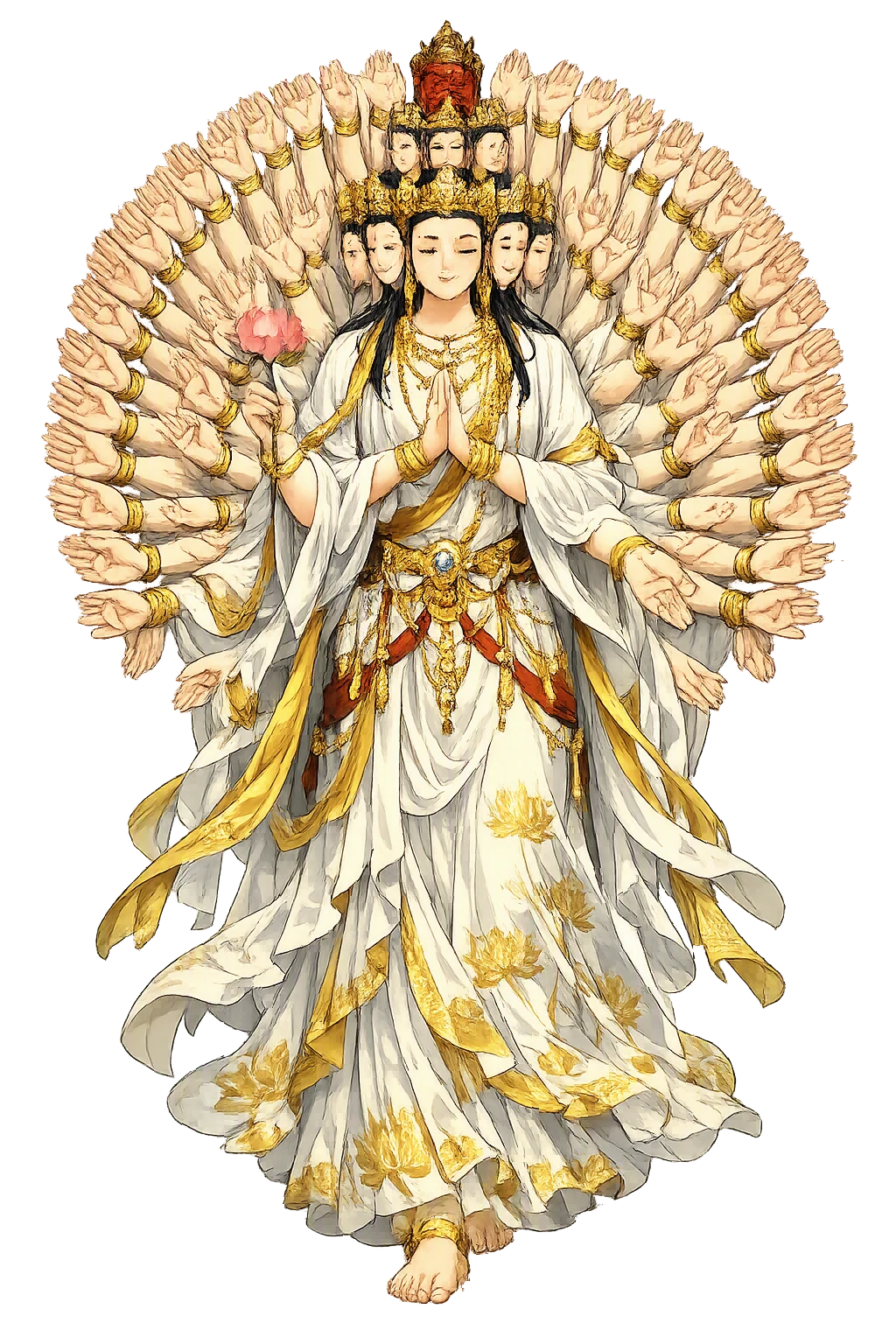
Why Avalokiteśvara is spelled that way — and what it costs to get it right
There is a version of this name the early internet had to settle for: avalokiteshvara. This is the file on how Avalokiteśvara replaced it.
Avalokiteśvara's mythology is a geography of mercy: the Indian lord who hears cries, the Chinese princess who gave her eyes and arms, the Tibetan ancestor of a nation, the Japanese savior of the drowning. His stories share one grammar — someone suffers, and compassion arrives already looking.
At a Glance
- Restored name: Avalokiteśvara
- ASCII form: avalokiteshvara
- Meaning: "Lord who looks down in compassion"
- Domain of influence: Compassion, Mercy, Bodhisattva
- Pantheon: Buddhist
- Classification: Tier 1
- Original script: अवलोकितेश्वर
- Series: The Restoration Files, No. 70 of 548
The Name Before the Marks
The name is attested as अवलोकितेश्वर, in the attestation Saddharma-puṇḍarīka Sūtra (Lotus Sūtra), ch. 25 and Nīlakaṇṭha-dhāraṇī Sūtra (Xuanzang's translation) give us. On the evidence, it means "Lord who looks down in compassion".
Spoken, the name runs `/ɐ.ʋɐ.loː.kɪ.teː.ɕʋɐ.ɾɐ/` — 'uh-vuh-LOH-kee-TAY-shvuh-ruh' — the ś is the soft 'sh' of 'ship'; hold both long vowels; the name ends lightly.
The Temple That Stands Now
The restored name is not a plaque; it is an address. The temple of Avalokiteśvara lives at /avalokiteshvara/, with its mythology in the lore halls, its peer-reviewed record in the Scholarly Edition, and its place in the pattern atlas on the patterns floor.
Tier-1 is not a compliment; it is a measurement. This restoration keeps something the ASCII form provably loses, and the measurement is repeatable.
Where the Name Stood First
Avalokiteśvara enters art early and never leaves: the fifth- and sixth-century cave paintings at Ajanta give him some of his oldest monumental images, compassionate bodhisattvas looming over the chaitya halls. The Library Cave at Dunhuang (sealed c. 1000, opened 1900) yielded painted banners of Guanyin among the most exquisite Buddhist paintings surviving — several now in the British Museum and Musée Guimet. At Borobudur in Java the Śailendra dynasty carved Lokeśvara into the monument's galleries in the eighth and ninth centuries, and the Kathmandu valley's Licchavi-period inscriptions invoke him by name. From Gandhāra's earliest standing bodhisattvas to the colossal Song dynasty Guanyin at Dazu, his is the longest continuous iconographic career of any Buddhist figure. The temple on the web is the newest of these addresses — the first one that fits in a pocket.
The Archetype at Work
The pattern atlas seats this temple in 6 industries, each match argued and weighted: Faith & Spiritual Organizations (the most widely invoked bodhisattva in East Asian Buddhism — compassion as the heart of devotional practice.); Mythic Name Restoration (the bodhisattva of compassion in IAST, a name whose length marks matter.); Yoga, Meditation & Holistic Wellness (compassion meditation, mettā, and the universal vow — wellness traditions across Asia invoke this name.). The Resonance File reads those seats through the myths themselves.
In the Sacred Texts
The Buddhist tradition is not a vibe; it is a library. The Sacred Texts collection holds Lotus Sutra and Sukhāvatīvyūha Sūtras — the primary sources the temple's scholarship is built on. The temple is the argument; the texts are the evidence.
The File Continues
The temple's founding dispatch tells the name's story; its Resonance File reads the myths into the industries; the blog index holds the whole archive.
Continue the series — previous file: Auðhumla (read it here) · next file: Bꜣ (read it here).
The Restoration Files are written from the same canonical record as the temples themselves: the lexicon, the lore catalog, the pattern atlas, and the cited scholarly sources. If a file ever disagrees with its temple, the temple is right — tell us, and the file will be corrected.