
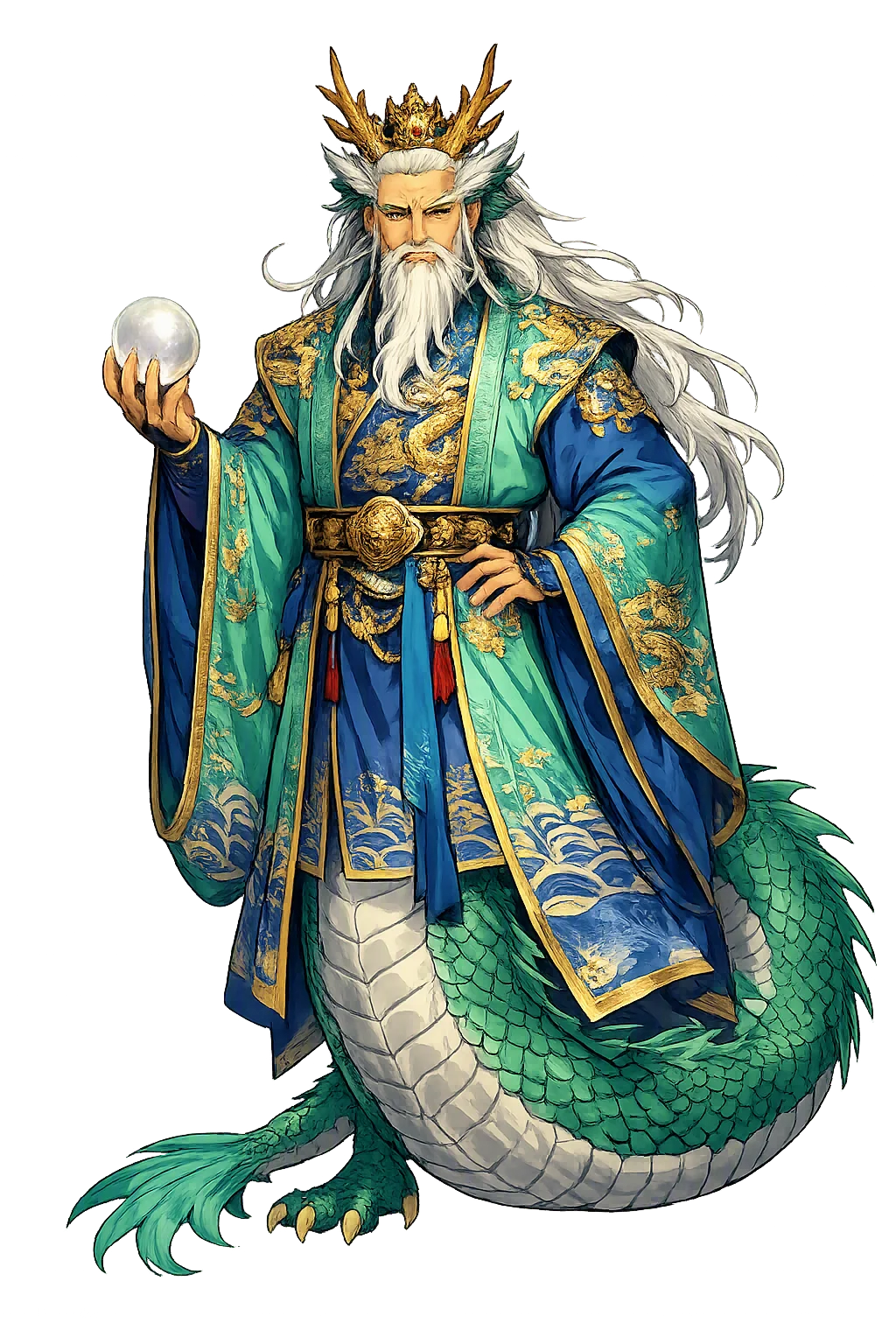
Yongwang: the stories first, then the spelling
Before the spelling, the story. Yongwang earns its restoration the old way — through what was actually told.
The Stories That Carry the Name
The Python and the Wish-Jewel. The Samguk Yusa, “Memorabilia of the Three Kingdoms” (13th century), tells of a poor but kind-hearted man who gave shelter to a strange traveller caught by night and rain. The stranger revealed himself as an imugi — a python that had waited a thousand years for the yeouiju, the wish-granting jewel that alone can raise a serpent to dragonhood. Entrusting the jewel to his host, the imugi attempted the ascent to heaven; when it slipped, the man caught it and set it upon the serpent’s head, and the imugi became a true dragon and rose into the sky.
The King Who Became a Dragon. The Samguk Sagi and Samguk Yusa record that King Munmu of Silla (r. 661–681), dying, commanded that his body be cremated and the ashes cast into the East Sea. “I will become a dragon,” he said, “and protect this kingdom from the pirates of the east.
The Yongwang-gut of the Fishing Villages. In the fishing villages of Korea’s south coast — Chaeseon in Tongyeong, Suyeong in Busan — shamans performed the Yongwang-gut, the rite of the Dragon King, to open the fishing season and beg calm seas. The folklorist Im Seok-jae recorded these rites in the twentieth century, when they were already old: the shaman invokes the dragon kings of the four seas in turn, receives their possessing presence, and sends a paper dragon-boat laden with rice, fruit, cloth, and coins out onto the water, the offering itself sailing to the palace beneath the waves. If the season proves good, the debt is remembered; if storms come, the rite is repeated with greater care.
And Here Is What the Spelling Preserves
At a Glance
- Restored name: Yongwang
- ASCII form: yongwang
- Meaning: "Dragon king"
- Domain of influence: Dragon King, Sea
- Pantheon: Korean
- Classification: Tier 2
- Original script: 용왕 (龍王)
- Series: The Restoration Files, No. 543 of 548
The Name Travels
Yongwang is part of a broader East Asian dragon-king tradition, with close parallels in Chinese, Japanese, and Vietnamese religion; the Sino-Korean name itself, 龍王, is borrowed directly. In Korea the figure was absorbed into both Buddhism and shamanism: he appears as a deva-like guardian and rain-maker in Buddhist temples, and as a sovereign spirit who must be formally petitioned in gut rituals.
The Address It Earned
The temple of Yongwang stands at /yongwang/ — lore, scholars, patterns — because a name carrying this much story deserves more than a parking page. One decisive feature survives — a single, honest mark — which places the restoration in Tier-2: exact, and exactly labeled.
The File Continues
Read the founding dispatch for the name's full story, the Resonance File for the archetype at work — or the whole archive in one sitting.
Continue the series — previous file: Ymir (read it here) · next file: Yùhuáng (read it here).
The Restoration Files are written from the same canonical record as the temples themselves: the lexicon, the lore catalog, the pattern atlas, and the cited scholarly sources. If a file ever disagrees with its temple, the temple is right — tell us, and the file will be corrected.