
Why Yùhuáng is spelled that way — and what it costs to get it right
There is a version of this name the early internet had to settle for: yuhuang. This is the file on how Yùhuáng replaced it.
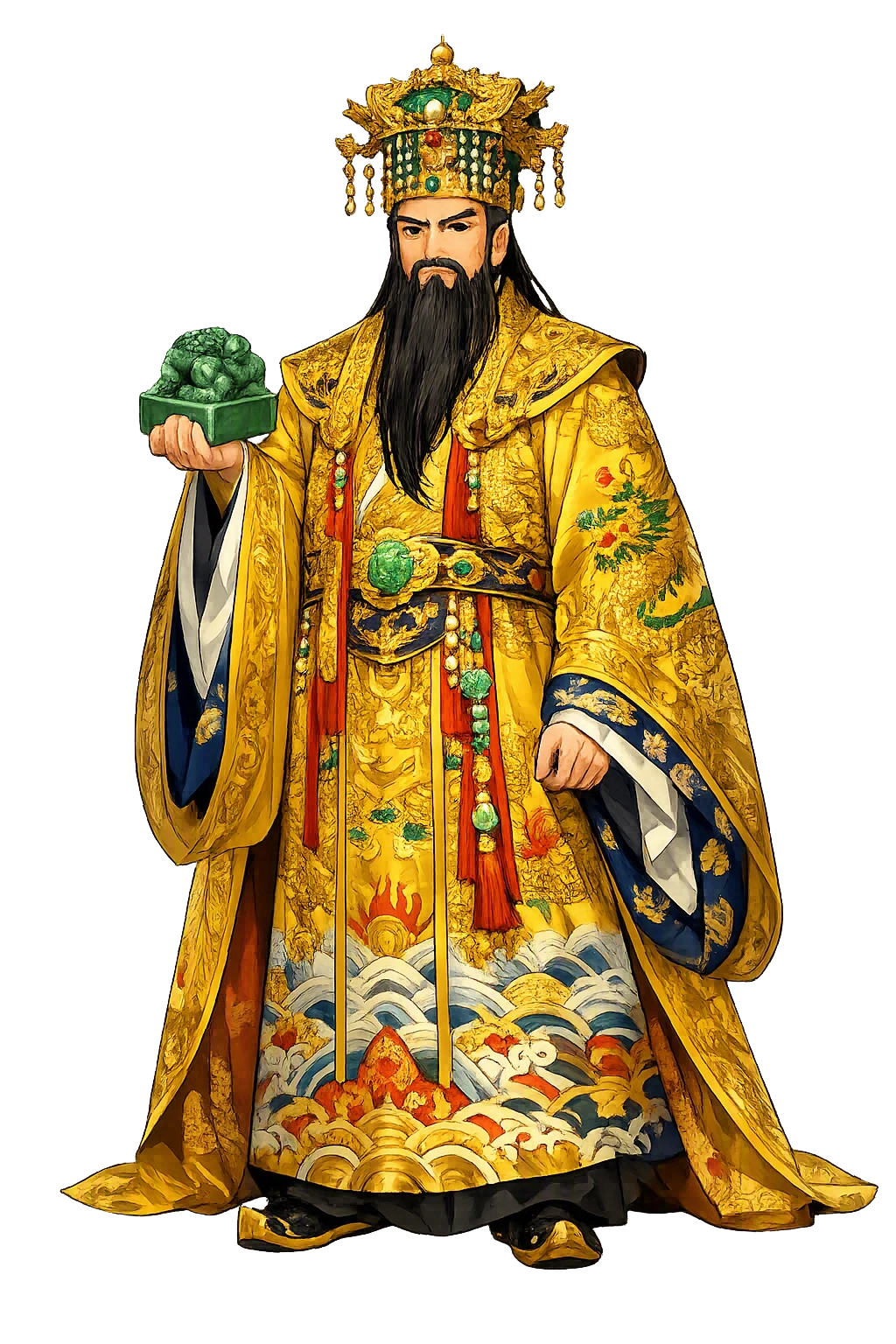
The Jade Emperor's mythology is a late, literate construction — scripture, novel, and folk tale jointly building a biography and a government for Heaven. His stories ask the great bureaucratic question: who, exactly, is in charge? The answer, assembled from the fifth century to the Ming novel, is a sovereign with a résumé, a war record, and a court that even comedy cannot overthrow.
At a Glance
- Restored name: Yùhuáng
- ASCII form: yuhuang
- Meaning: "Jade Emperor"
- Domain of influence: Jade Emperor, Heaven, Sovereignty
- Pantheon: Chinese
- Classification: Tier 1
- Original script: 玉皇
- Series: The Restoration Files, No. 544 of 548
The Name Before the Marks
The name is attested as 玉皇, as Tao Hongjing, Zhen'gao 真誥 (Declarations of the Perfected, 5th century) — the earliest attestation of the title Yùhuáng and Gaoshang Yuhuang benxing jijing 高上玉皇本行集經 (Scripture of the Jade Sovereign's Former Deeds, Tang–Song; Ming Daozang) preserve it. On the evidence, it means "Jade Emperor".
Strip Yùhuáng to yuhuang and 2 pieces of evidence vanish:
- u → ù — Grave tone mark: the stress position the ASCII form cannot show.
- a → á — Acute tone mark: the stress position the ASCII form cannot show.
A reader who knows the marks hears the name correctly on the first try. A reader who never sees them never gets the chance.
Spoken, the name runs `/ɥy˥˩ xwaŋ˧˥/` — 'YUE-hwong' — say 'ee' with rounded lips and let the pitch drop sharply; then 'hwong' with a soft guttural h, rising like a question.
The Temple That Stands Now
The restored name is not a plaque; it is an address. The temple of Yùhuáng lives at /yuhuang/, with its mythology in the lore halls, its peer-reviewed record in the Scholarly Edition, and its place in the pattern atlas on the patterns floor.
Tier-1 is not a compliment; it is a measurement. This restoration keeps something the ASCII form provably loses, and the measurement is repeatable.
Where the Name Stood First
The god's material record begins with texts: the title Yùhuáng is attested in Tao Hongjing's Zhen'gao (5th century), and the imperial turn came under the Song — in 1012 Emperor Zhenzong announced a revelation from the 'Jade Emperor' and heaped honorific titles upon him, beginning the god's absorption of state Heaven worship. Daoist temple art gives him his body: the Yuan-dynasty murals of Yongle Palace (Ruicheng, Shanxi, 13th–14th century) paint his celestial court procession with the graded regalia of an earthly audience hall, and Ming and Qing temple walls repeat the program across China. His birthday altars, heaven-facing offering tables, and the ubiquitous 'tablet of Heaven' in village shrines are the folk archaeology of a cult that left few excavated monuments because it lived above ground, in the open sky. The temple on the web is the newest of these addresses — the first one that fits in a pocket.
The Archetype at Work
The pattern atlas seats this temple in 6 industries, each match argued and weighted: Faith & Spiritual Organizations (the Jade Emperor — supreme celestial sovereign of Chinese religion, heaven, and the Taoist pantheon.); Mythic Name Restoration (the Jade Emperor in toned pinyin, the canonical Chinese form.); Diacritic-First Domains (grave and acute tones make Yùhuáng a true pinyin restoration.). The Resonance File reads those seats through the myths themselves.
In the Sacred Texts
The Chinese tradition is not a vibe; it is a library. The Sacred Texts collection holds Tao Te Ching — the primary sources the temple's scholarship is built on. The temple is the argument; the texts are the evidence.
The File Continues
The temple's founding dispatch tells the name's story; its Resonance File reads the myths into the industries; the blog index holds the whole archive.
Continue the series — previous file: Yongwang (read it here) · next file: Yurlungur (read it here).
The Restoration Files are written from the same canonical record as the temples themselves: the lexicon, the lore catalog, the pattern atlas, and the cited scholarly sources. If a file ever disagrees with its temple, the temple is right — tell us, and the file will be corrected.