
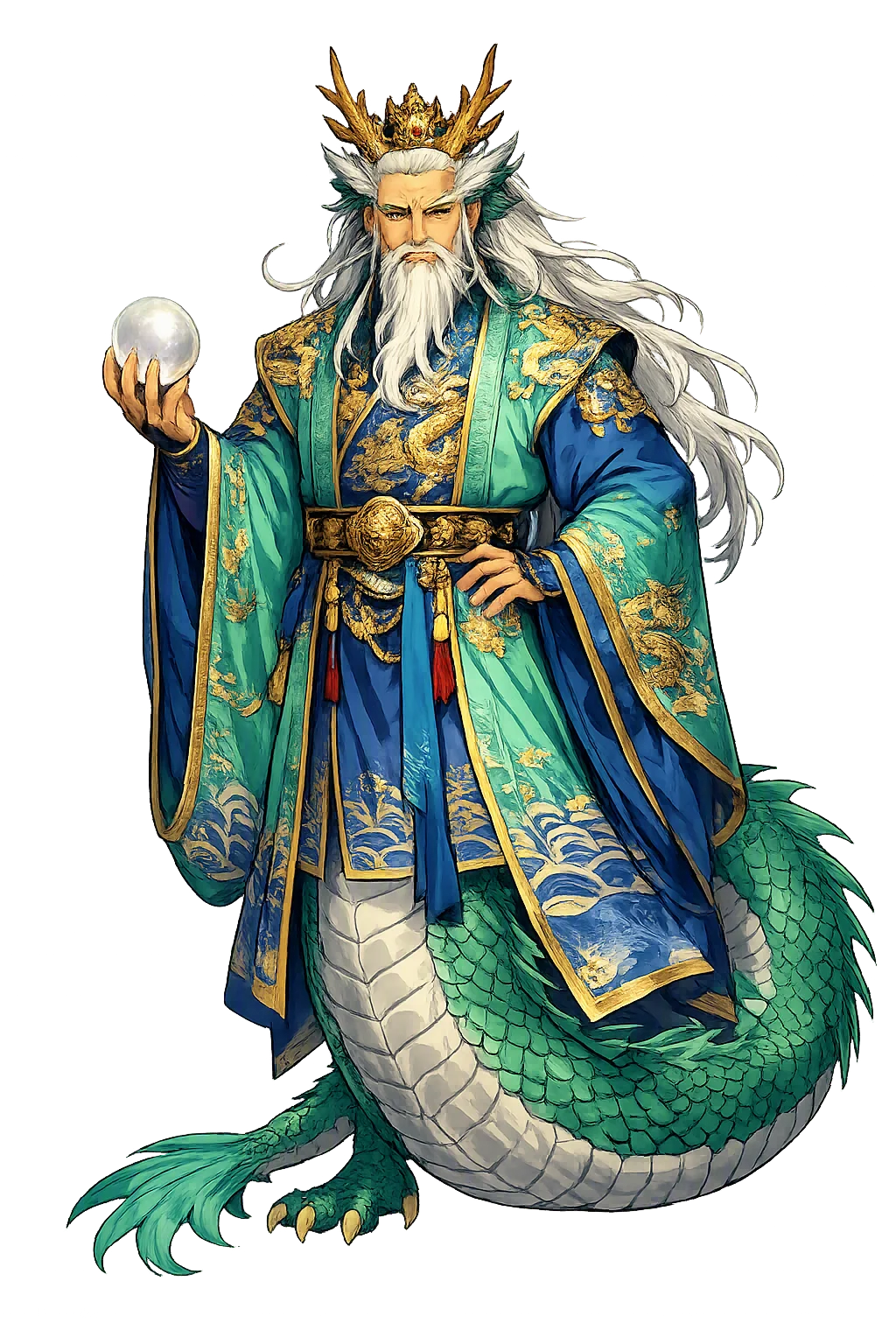
Yongwang walks into a defense, military & security firm
Somewhere right now, in a defense, military & security office, someone is doing exactly what the myths describe — and has never heard of Yongwang. This file is the introduction.
Before the Office, the Story
The Python and the Wish-Jewel. The Samguk Yusa, “Memorabilia of the Three Kingdoms” (13th century), tells of a poor but kind-hearted man who gave shelter to a strange traveller caught by night and rain. The stranger revealed himself as an imugi — a python that had waited a thousand years for the yeouiju, the wish-granting jewel that alone can raise a serpent to dragonhood. Entrusting the jewel to his host, the imugi attempted the ascent to heaven; when it slipped, the man caught it and set it upon the serpent’s head, and the imugi became a true dragon and rose into the sky.
The King Who Became a Dragon. The Samguk Sagi and Samguk Yusa record that King Munmu of Silla (r. 661–681), dying, commanded that his body be cremated and the ashes cast into the East Sea. “I will become a dragon,” he said, “and protect this kingdom from the pirates of the east.
At a Glance
- Temple: Yongwang
- Pantheon: Korean
- Domain of influence: Dragon King, Sea
- Pattern seats: 5
- Sectors touched: Commerce & Governance · Culture & Entertainment · Society & Spirit · Energy & Natural World
- Strongest seat: Defense, Military & Security
- Series: The Resonance Files, No. 543 of 548
The Reveal, Seat by Seat
Defense, Military & Security
Now read the why-line with the office in mind: Primary seat: Yongwang embodies dragon king, sea — the core of defense. The people doing this work did not borrow the archetype. They re-derived it — the way Yongwang was always going to be re-derived wherever dragon king, sea matters.
Gaming, Fantasy & Entertainment IP
Resonant seat: Yongwang shares symbolic territory with gaming entertainment. Nobody in that trade worships at this temple. They just keep its hours.
History, Archives & Records
Resonant seat: Yongwang shares symbolic territory with history archives. The match is not poetic license. Strip the trade to its function and the function is the myth.
Maritime, Shipping & Ocean Industries
Resonant seat: Yongwang shares symbolic territory with maritime. Nobody in that trade worships at this temple. They just keep its hours.
Sports, Fitness & Competition
Now read the why-line with the office in mind: Resonant seat: Yongwang shares symbolic territory with sports athletics. The people doing this work did not borrow the archetype. They re-derived it — the way Yongwang was always going to be re-derived wherever dragon king, sea matters.
Not the First Rebrand
Yongwang is part of a broader East Asian dragon-king tradition, with close parallels in Chinese, Japanese, and Vietnamese religion; the Sino-Korean name itself, 龍王, is borrowed directly. In Korea the figure was absorbed into both Buddhism and shamanism: he appears as a deva-like guardian and rain-maker in Buddhist temples, and as a sovereign spirit who must be formally petitioned in gut rituals. The office is only the latest translation.
The Method, Stated Plainly
Skeptical? Good — the system is built for you. Every seat in this file carries its why-line and its weight, the full derivation is public at the methodology page, and the challenge process is part of the design. Falsifiable is not a posture here; it is the mechanism.
For the Ones Who Work There
For a sponsor in defense, military & security, the fit here is not adjacency — it is inheritance. Your trade already tells this story every working day; the temple simply holds the original. The patron tier and the advertising terms carry the mechanics; the myths above carry the reason.
The File Continues
This is one of 548 Resonance Files — the third dispatch from every flagship temple, where the myths meet the markets. The temple's founding dispatch tells the name's story; its Restoration File tells the spelling's; the blog index holds the whole archive.
Continue the series — previous: Ymir (read it) · next: Yùhuáng (read it).
The Resonance Files are argued from the same canonical record as the pattern atlas itself: the lexicon, the lore catalog, and the cited sources. Every seat can be challenged at the methodology page — and the challenge is the point.