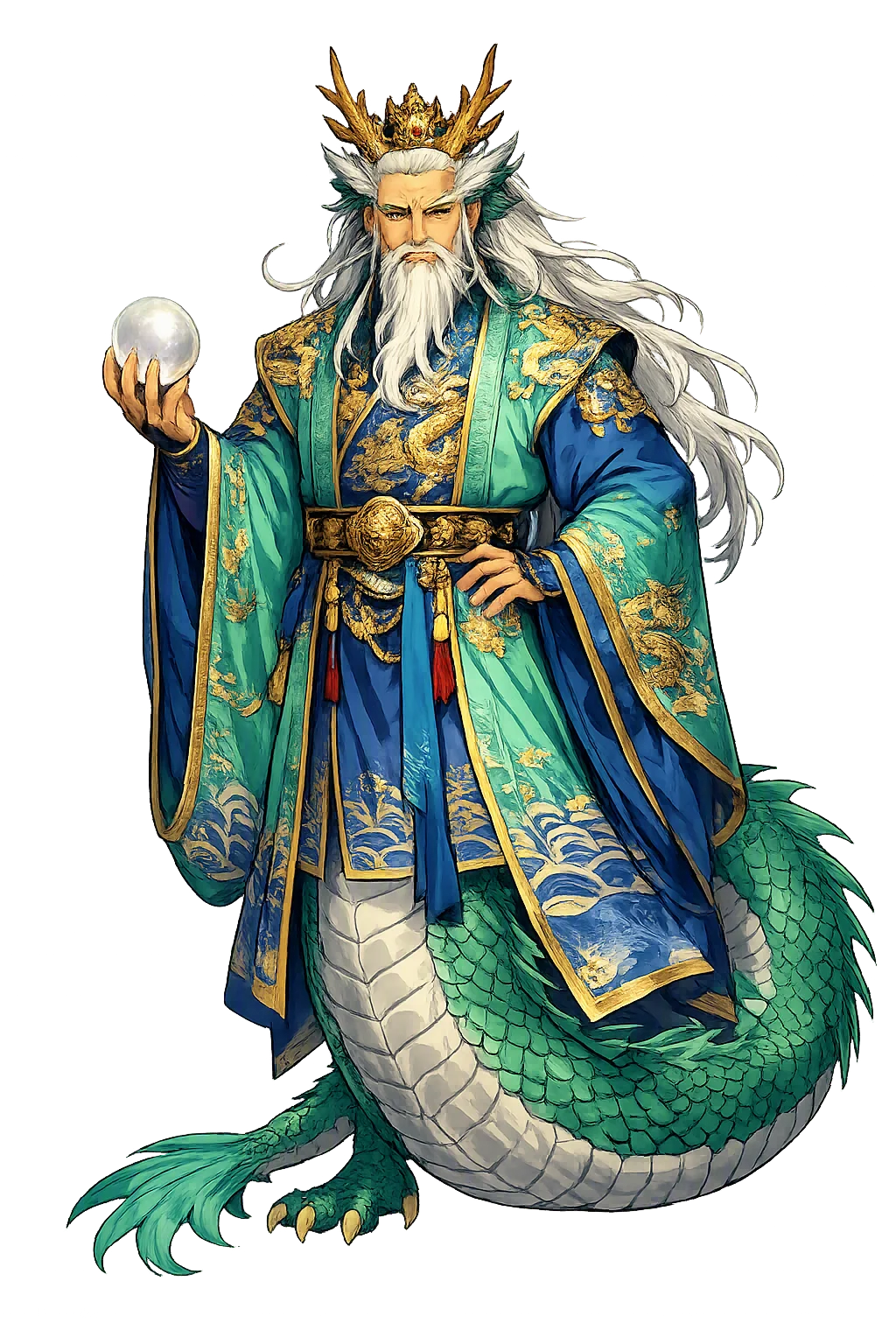
Stories of Yongwang
Yongwang is the Dragon King of the Korean seas — sovereign of storms, rain, and the shoals of fish on which coastal life depends. Buddhist scripture, shamanic gut ritual, and village folktale each give him a different throne: a guardian of the dharma, a king placated with offerings set afloat, and a grateful serpent who repays a kindness. His mythology is the story of how Korea learned to live beside a beautiful, dangerous sea.
The Samguk Yusa, “Memorabilia of the Three Kingdoms” (13th century), tells of a poor but kind-hearted man who gave shelter to a strange traveller caught by night and rain. The stranger revealed himself as an imugi — a python that had waited a thousand years for the yeouiju, the wish-granting jewel that alone can raise a serpent to dragonhood. Entrusting the jewel to his host, the imugi attempted the ascent to heaven; when it slipped, the man caught it and set it upon the serpent’s head, and the imugi became a true dragon and rose into the sky. In gratitude the dragon left a bright band of his own body coiled around the man’s house as a blessing, and the Samguk Yusa says this is why Koreans paint banded, rainbow colours along the eaves of their houses to this day. The tale teaches that the sea’s greatest power answers to ordinary human kindness — and that even a dragon’s fortune once depended on a stranger’s open door.
The Samguk Sagi and Samguk Yusa record that King Munmu of Silla (r. 661–681), dying, commanded that his body be cremated and the ashes cast into the East Sea. “I will become a dragon,” he said, “and protect this kingdom from the pirates of the east.” His queen and son fulfilled the vow; the ashes were committed to the sea off the coast near Gampo, and his son King Sinmun raised above the shore the temple Gameunsa — “the temple that appeases the sea” — whose pagodas still stand at Gyeongju. The episode makes explicit what coastal religion had long implied: that the Dragon King and the dead king could share one body, and that the sea’s protection was a royal responsibility, paid for in flesh. Korean Buddhists still honour Munmu as the dragon of the East Sea; the tale binds kingship, Buddhism, and the sea into a single sacred geography.
In the fishing villages of Korea’s south coast — Chaeseon in Tongyeong, Suyeong in Busan — shamans performed the Yongwang-gut, the rite of the Dragon King, to open the fishing season and beg calm seas. The folklorist Im Seok-jae recorded these rites in the twentieth century, when they were already old: the shaman invokes the dragon kings of the four seas in turn, receives their possessing presence, and sends a paper dragon-boat laden with rice, fruit, cloth, and coins out onto the water, the offering itself sailing to the palace beneath the waves. If the season proves good, the debt is remembered; if storms come, the rite is repeated with greater care. Here mythology is not a story but a contract renewed each year — a working relationship between a fishing people and the sovereign of the deep, maintained with drum, cymbal, and a boat far too small for its cargo of gratitude.
The temple of Haedong Yonggung at Busan, founded in 1376 by the Goryeo monk Naong Hyegeun, stands where cliffs meet the open sea — a rare orientation for a Korean monastery, whose temples customarily turn their backs on the water. Its foundation legend, preserved in the temple’s own tradition, tells that Naong dreamed the Dragon King of the East Sea rose from the waves and showed him a stretch of coast where, if a temple were built, prayers would surely be answered; waking, the dream-site proved to be a rugged shore east of the walled city. He built there, and the fishermen came. The tale reflects the late Goryeo world in which Buddhist and shamanic readings of the sea overlapped completely: the same Dragon King who received paper boats from shamans appeared in the dream of a great Seon master. Visitors still descend the temple’s 108 stairs to the seaside shrine of the dragon king — one of the few places where the old sea cult can be visited, not merely read about.
sovereign of the seas, storms, and waters
Yongwang — 龍王, “dragon king” — is the sovereign of the Korean seas: master of storms, rain, and the shoals of fish on which coastal villages live. Reached through Buddhist liturgy, shamanic gut ritual, and village folktale alike, he rewards respect with calm water and punishes neglect with empty nets and sudden gale.
The royal dragon enthroned in the underwater palace Yeonggung, sovereign of the four seas of the compass.
He governs tides, currents, and the creatures of the deep — the shoals are his armies, the turtles his couriers.
From his palace he releases the rains that fill the paddies and the typhoons that empty the harbours.
The south-coast villages honour him with the Yongwang-gut, the annual rite that secures safe voyages and abundant catch.
From the original script to the living URL
용왕 (龍王)
The name in its original Korean form. Yongwang (용왕 (龍王)) is attested in the source tradition — “Dragon king”. Its original diacritics and script distinctions carry the full phonetic and orthographic weight of the source tradition.
yongwang
The plain yongwang form is identical to the Unicode restoration. Because this name is already written in Latin letters, no diacritics, stress, or script information were lost — only capitalization differs.
Yongwang
The Unicode restoration does not need to recover lost marks for Yongwang. Its value is canonical spelling and consistent cataloguing, not the reconstruction of erased orthography. The domain is readable as-is to both DNS and humanity.
Yongwang.com
This restoration is written entirely in ASCII letters — no Punycode encoding stands between Yongwang and the DNS. The domain reads identically to machines and to human eyes.
Owned, ideal, and ASCII forms of Yongwang
Yongwang
Restores 용왕 (龍王). The full Unicode restoration. yongwang.com is not in the PuniCodex collection — it is watched for release; if it drops, this temple upgrades to an owned flagship.
How Yongwang was spoken
How Yongwang travels from ancient script to the modern URL
The lore you have read is the living myth. Extended Lore opens the scholarly vault beneath it: the cult and its material remains, a history of the image, the name after antiquity, a meditation on what the name still means, and the full scholarly apparatus — etymology, orthography, sources.
Enter Extended Lore