
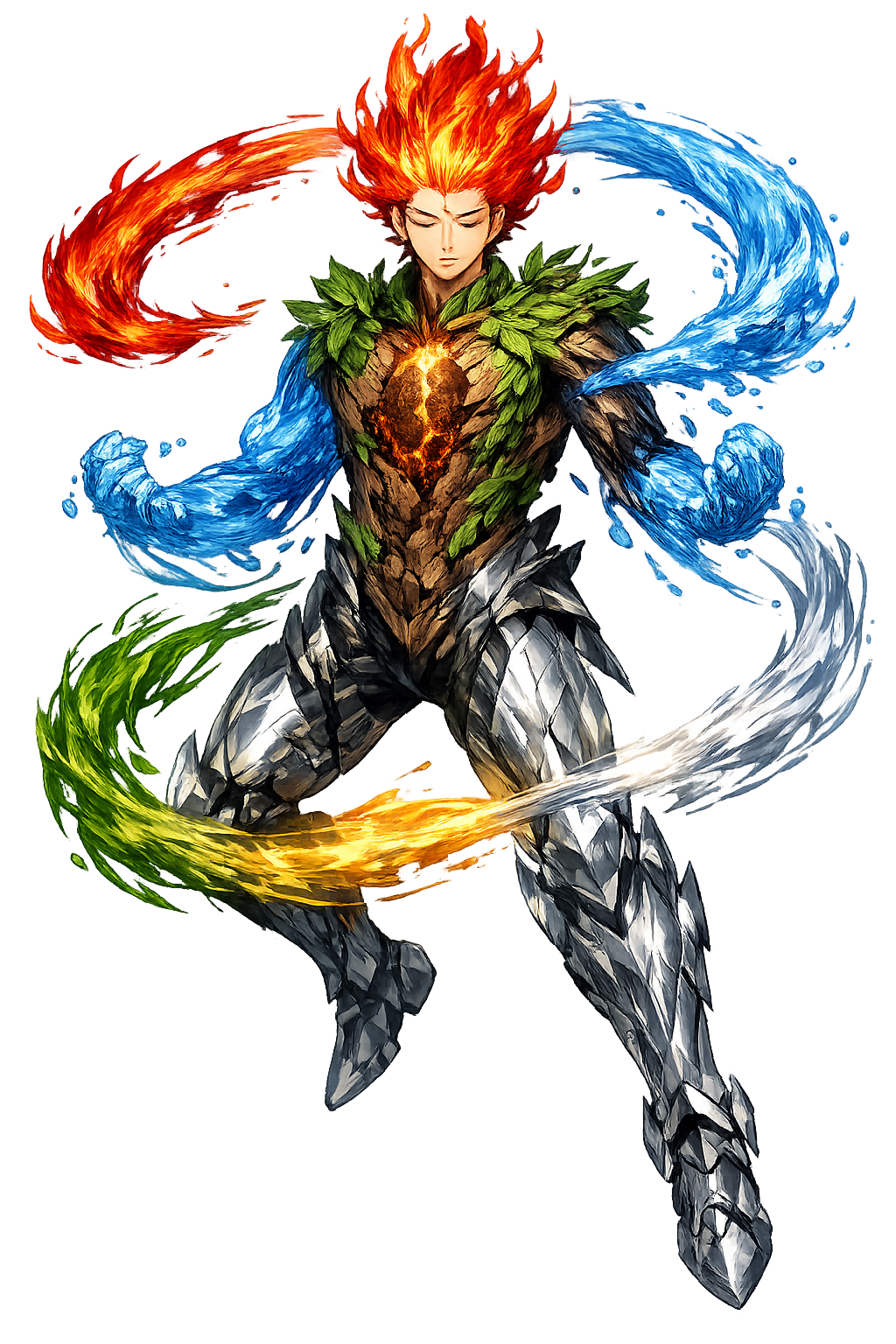
Wǔxíng: the stories first, then the spelling
You cannot weigh an accent without knowing what it carries. Here is what Wǔxíng has been carrying.
The Stories That Carry the Name
The Great Plan. The Hongfan ('Great Plan') chapter of the Shangshu presents the five materials as the first of the Nine Categories revealed to Yu the Great — the cosmic charter through which Heaven's order was transmitted to the founder of the Xia. Water, fire, wood, metal, and earth are listed with their natures: water soaks and descends, fire blazes and ascends, wood bends and straightens, metal yields and can be changed, earth receives sowing and yields harvests (Shangshu, Hongfan). This is the earliest systematic statement of Wǔxíng cosmology, and its setting matters as much as its content: the phases are handed down in the same breath as the laws of government, because in early Chinese thought there was no separating how nature behaves from how rule must behave.
The Yin-Yang and Five Phases School. The philosopher Zou Yan (c. 305–240 BCE) of Qi turned the five phases into an engine of history. Sima Qian, who appends his biography to those of Mencius and Xunzi in the Shiji (ch.
Five Phases as Cosmic Seasons. The Huainanzi, compiled at the court of Liu An around 139 BCE, integrates Wǔxíng with astronomy, music, and politics into a single encyclopedic vision. Its early chapters map the phases onto the heavens and the calendar: wood commands the east and the spring equinox, fire the south and the summer solstice, metal the west and the autumn, water the north and the winter — while earth holds the center and the season between. Each direction carries its emblems (the Green Dragon, the Red Bird, the White Tiger, the Dark Warrior), its pitch-pipe, its winds, its prohibitions, and the work of the month (Huainanzi, ch.
And Here Is What the Spelling Preserves
Against those stories, the attestation: 五行, in the attestation Shangshu, Hongfan (The Great Plan) and Huangdi Neijing, Suwen give us. The name means "Five phases".
The restoration keeps one feature the ASCII form wuxing cannot show:
- i → í — Stress on i: where the voice peaks.
A storyteller pronouncing the name would restore every one of them by instinct. The file only writes down what the voice already knows.
At a Glance
- Restored name: Wǔxíng
- ASCII form: wuxing
- Meaning: "Five phases"
- Domain of influence: Five Elements, Change
- Pantheon: Chinese
- Classification: Tier 1
- Original script: 五行
- Series: The Restoration Files, No. 528 of 546
The Name Travels
Wǔxíng was sometimes compared by Western observers to the Greek four elements, but the comparison is misleading. The Greek elements are building blocks of substance; the Chinese phases are patterns of change.
The Address It Earned
The temple of Wǔxíng stands at /wuxing/ — lore, scholars, patterns — because a name carrying this much story deserves more than a parking page. What survives here cannot be shown in ASCII: a feature of the original that the fallback alphabet flattens. That is the Tier-1 test, and this name passes it without argument.
The Sources Are Open
The myths above are retold from the temple's record; the primary voices are in the Sacred Texts: Tao Te Ching. Nothing in this file outranks them.
The File Continues
Read the founding dispatch for the name's full story, the Resonance File for the archetype at work — or the whole archive in one sitting.
Continue the series — previous file: Wújí (read it here) · next file: Wyrd (read it here).
The Restoration Files are written from the same canonical record as the temples themselves: the lexicon, the lore catalog, the pattern atlas, and the cited scholarly sources. If a file ever disagrees with its temple, the temple is right — tell us, and the file will be corrected.