
Urcaguary, translated into industries: what the archetype actually does
The myths did not retire. They moved offices. This is the file on where Urcaguary works now.
Urcaguary has no surviving epic. The sources are late, brief and partly modern, and honesty requires saying so plainly. What the tradition preserves is a portrait rather than a cycle: a serpent-bodied watcher below the mountains, a theology of treasure, and a mining etiquette that is still practiced in the Andes.
The pattern atlas — which maps every flagship temple to the industries its archetype demonstrably resonates with, each match argued and open to challenge — seats this temple in 4 industries. This file reads those seats the way they were earned: through the myths.
At a Glance
- Temple: Urcaguary
- Pantheon: Incan
- Domain of influence: Underworld Jewels
- Pattern seats: 4
- Sectors touched: Society & Spirit · Culture & Entertainment · Technology & Innovation
- Strongest seat: Funerary & Memorial Services
- Series: The Resonance Files, No. 508 of 548
The Myth at Work
A God Seen Through Colonial Eyes. Everything securely known about Urcaguary descends from the chroniclers writing after the conquest — above all Martín de Murúa, whose Historia general del Piru (1616) catalogues the gods of the Andes, and Bernabé Cobo, whose Historia del Nuevo Mundo (1653) preserves the most orderly account of the Inca huacas. In their pages Urcaguary appears as the deity of metals, jewels and the other precious things hidden underground — a figure who presided over ore-rich mountains and mining shrines, but whose cult left no standing temple and whose myths were never written down in Quechua. — remember the shape of that act. You will see it again, wearing a logo.
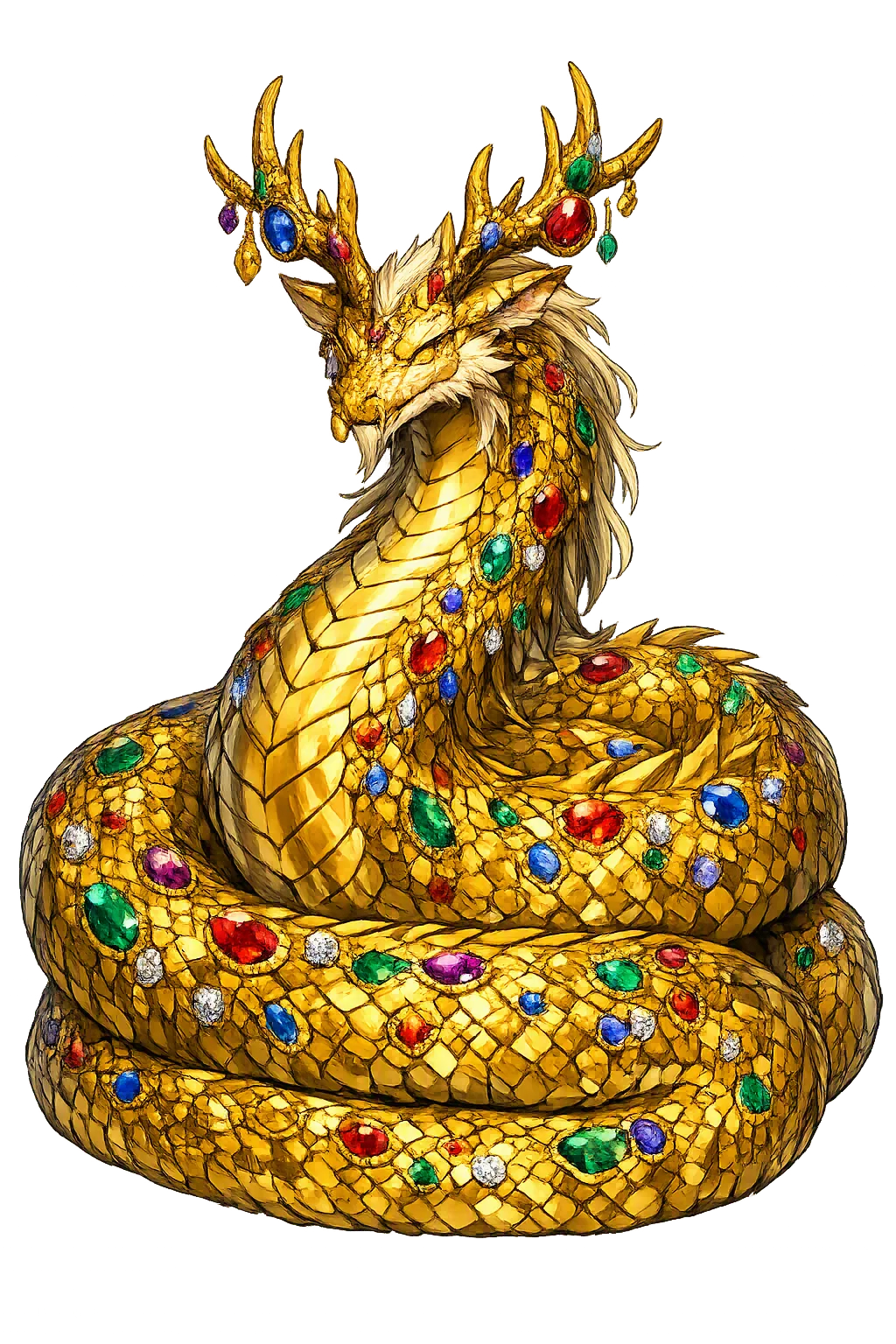
The Serpent in the Veins of Gold. Later tradition gives the figure a body. Urcaguary is pictured as a great serpent with the head of a taruka, the Andean deer, gold chains and precious stones linked along the tail, dwelling beneath the mountains in the uku pacha, the world within the earth. — that is not just a story. It is a business model, four thousand years early.
The Seats
Each of these is argued in the atlas with a weight and a why-line. What the atlas cannot fit in one line is the whole myth — so here is each seat with its story restored.
Funerary & Memorial Services
Funeral care, memorials, and legacy services. (Sector: Society & Spirit)
Primary seat: Urcaguary embodies underworld jewels — the core of funerary memorial. — the atlas stops there, out of discipline. The myth keeps going: the function Urcaguary performs in the stories is precisely the function this industry sells.
Gaming, Fantasy & Entertainment IP
Video games, streaming franchises, and fantasy worlds. (Sector: Culture & Entertainment)
The why-line says it in one breath: Resonant seat: Urcaguary shares symbolic territory with gaming entertainment. That is not a resemblance; it is the same act, performed in a newer building.
Manufacturing, Craft & Automation
Fabrication, industrial craft, and robotics. (Sector: Technology & Innovation)
Resonant seat: Urcaguary shares symbolic territory with manufacturing craft. — the atlas stops there, out of discipline. The myth keeps going: the function Urcaguary performs in the stories is precisely the function this industry sells.
Astrology, Tarot & Esoteric Services
Astrology apps, tarot, and spiritual guidance. (Sector: Society & Spirit)
Resonant seat: Urcaguary shares symbolic territory with occult esoteric. Swap the costume and the sentence is indistinguishable from the myth. That is what a resonance seat means.
The Long Employment
The etiquette Urcaguary presides over is alive: Andean miners still offer coca, alcohol and smoke to the mountain and to the Tío of the workings before blasting, a rite documented ethnographically from Potosí across Bolivia and Peru for over a century. In folklore collections the name circulates as the guardian of hidden treasure — the tesoros ocultos whose gold turns to leaves in the hands of the unworthy, a pan-Andean motif his serpent keeps. The age changed. The work did not.
The Method, Stated Plainly
The atlas is not a horoscope. Seats are earned from the sources — argued, weighted, published — and every one of them can be challenged at the methodology page. A match that cannot survive an argument does not survive review. That is the whole trick: the patterns are claims, and claims can be tested.
For the Ones Who Work There
If you work in funerary & memorial services, gaming, fantasy & entertainment ip, or any trade this temple holds a seat in, this is the honest version of what a placement means: your industry beside the story it has been re-telling all along — on the temple floor itself, before an audience that came specifically to read it. The patron tier and the advertising terms describe the mechanics; the resonance above describes the fit.
The File Continues
One of 548 Resonance Files — the series where the pantheon goes to work. Read the founding dispatch for the name, the Restoration File for the spelling, or the whole archive end to end.
Continue the series — previous: Uppsala (read it) · next: Vāc (read it).
The Resonance Files are argued from the same canonical record as the pattern atlas itself: the lexicon, the lore catalog, and the cited sources. Every seat can be challenged at the methodology page — and the challenge is the point.