Stories of Urcaguary
Urcaguary has no surviving epic. The sources are late, brief and partly modern, and honesty requires saying so plainly. What the tradition preserves is a portrait rather than a cycle: a serpent-bodied watcher below the mountains, a theology of treasure, and a mining etiquette that is still practiced in the Andes.
Everything securely known about Urcaguary descends from the chroniclers writing after the conquest — above all Martín de Murúa, whose Historia general del Piru (1616) catalogues the gods of the Andes, and Bernabé Cobo, whose Historia del Nuevo Mundo (1653) preserves the most orderly account of the Inca huacas. In their pages Urcaguary appears as the deity of metals, jewels and the other precious things hidden underground — a figure who presided over ore-rich mountains and mining shrines, but whose cult left no standing temple and whose myths were never written down in Quechua. The colonial writers worked decades after the religion they described had been outlawed, from informants under missionary pressure, so their catalogues are triage documents as much as testimonies.
Read that way, Urcaguary is half-known by necessity: a god glimpsed through the gap between destroyed shrines and Spanish notebooks. The temple built here is therefore a temple over an archive, not over a ruin.
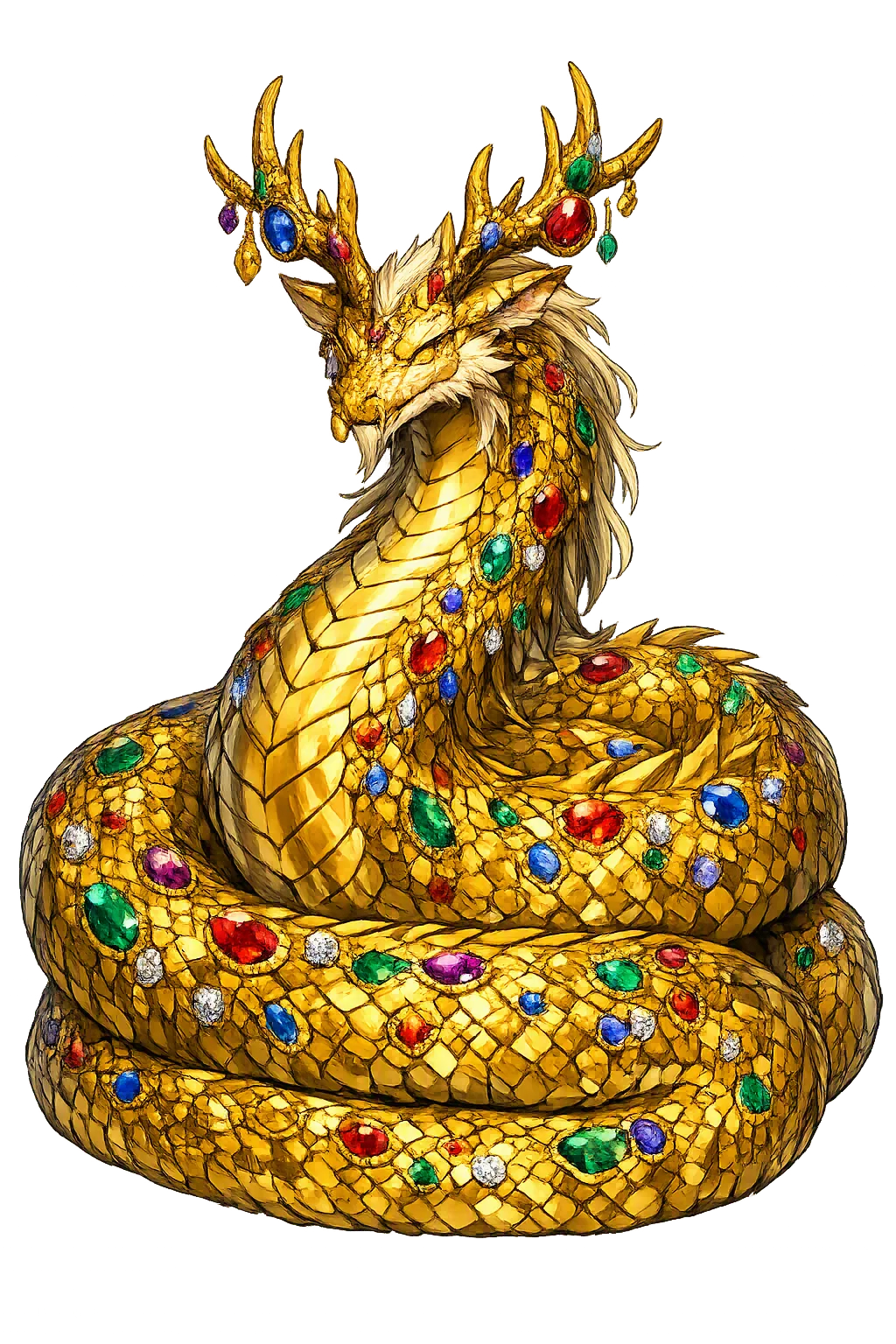
Later tradition gives the figure a body. Urcaguary is pictured as a great serpent with the head of a taruka, the Andean deer, gold chains and precious stones linked along the tail, dwelling beneath the mountains in the uku pacha, the world within the earth. The deer's head is explained as a mark of the guardian's way of thinking — alert, swift, impossible to catch — and in the same layer of folklore the guardian serpent of the depths, Hurkaway, is identified with Urcaguary: the snake that coils through the ore veins is the treasure's own watchman made visible.
The image is exact theology in zoological form. A vault guards wealth with walls; a serpent guards it with intention. The Andes buried their treasure in the most guarded shape the animal world offers.
The etiquette the colonial writers describe at mining shrines still survives in the Andes, where ethnographers from the twentieth century to the present record miners pouring chicha, laying coca leaves and burning cigarettes for the powers of the mine before a single charge is set — the same ritual courtesy, the ch'alla, that crews in Potosí and the central Andes pay to the lord of the mountain and to the Tío, the old one of the deep workings. Urcaguary stands behind this courtesy as its theological ground: the underground metals belong first to the guardian, and gifts earn a share. Mining, in this ethics, is not extraction but tribute.
The rite turns an act of violence into a negotiation, and that is the whole lesson of the god: the earth parts for those who ask and swallows those who only take.
The tradition's moral edge is aimed at thieves: Urcaguary protects the hoard from evil people who dare to steal it. After the conquest, when the ransom of Atahualpa filled a room with gold and the furnaces of Cuzco and Cajamarca melted down the sun god's garden and the huancas of the shrines, Andean storytellers had every reason to sharpen the point — the metal pried from the temples was only surface; the deep treasure has a serpent on watch, and it does not travel. Whether the tale circulated in exactly this form in the sixteenth century cannot now be shown, but the sentiment is old and Andean: gold is not owned, it is kept.
It is the theology of every robbed sanctuary, and it is also simply true: the empire's gold crossed the ocean; the guardian's never left the mountain.
Underworld Jewels
Urcaguary is the Inca guardian of what lies beneath the mountains: gold, silver, emeralds and the other precious things sealed in the earth. The figure is known only through the colonial chronicle tradition and later folklore, and the sources are late, brief and partly modern — but they agree on the core: the underground hoard has a watcher, and it is not a vault, it is a god.
Beneath the mountains Urcaguary keeps the metals and gems of the inner earth; the traditional description hangs gold chains and precious stones from the serpent's tail.
The figure takes the body of a serpent and the head of a taruka, the Andean deer — wealth that watches and thinks like a mountain animal.
The name reads from Quechua urqu, ‘within the earth’, and quri, ‘gold’: the title is the domain, and the domain is the treasury.
The hoard belongs to the guardian, not the miner: in the moral economy of the Andean mine, gold is taken only as tribute, never as theft.
From the original script to the living URL
Urcaguary
The name survives in scholarly transliteration. Urcaguary is the standard Incan romanisation, documented in academic sources — “He of the underground”. Because the spelling uses only Latin letters, the form is the same in both ASCII and Unicode.
No indigenous writing system is securely attested for individual incan names. The form shown is a modern scholarly transliteration.
urcaguary
The plain urcaguary form is identical to the Unicode restoration. Because this name is already written in Latin letters, no diacritics, stress, or script information were lost — only capitalization differs.
Urcaguary
The Unicode restoration does not need to recover lost marks for Urcaguary. Its value is canonical spelling and consistent cataloguing, not the reconstruction of erased orthography. The domain is readable as-is to both DNS and humanity.
Urcaguary.com
This restoration is written entirely in ASCII letters — no Punycode encoding stands between Urcaguary and the DNS. The domain reads identically to machines and to human eyes.
Owned, ideal, and ASCII forms of Urcaguary
Urcaguary
The full Unicode restoration. urcaguary.com is not in the PuniCodex collection — it is watched for release; if it drops, this temple upgrades to an owned flagship.
How Urcaguary was spoken
How Urcaguary is preserved in writing
No indigenous writing system is securely attested for individual incan names. The form shown is a modern scholarly transliteration.
Contribute scholarly provenance →The lore you have read is the living myth. Extended Lore opens the scholarly vault beneath it: the cult and its material remains, a history of the image, the name after antiquity, a meditation on what the name still means, and the full scholarly apparatus — etymology, orthography, sources.
Enter Extended Lore