
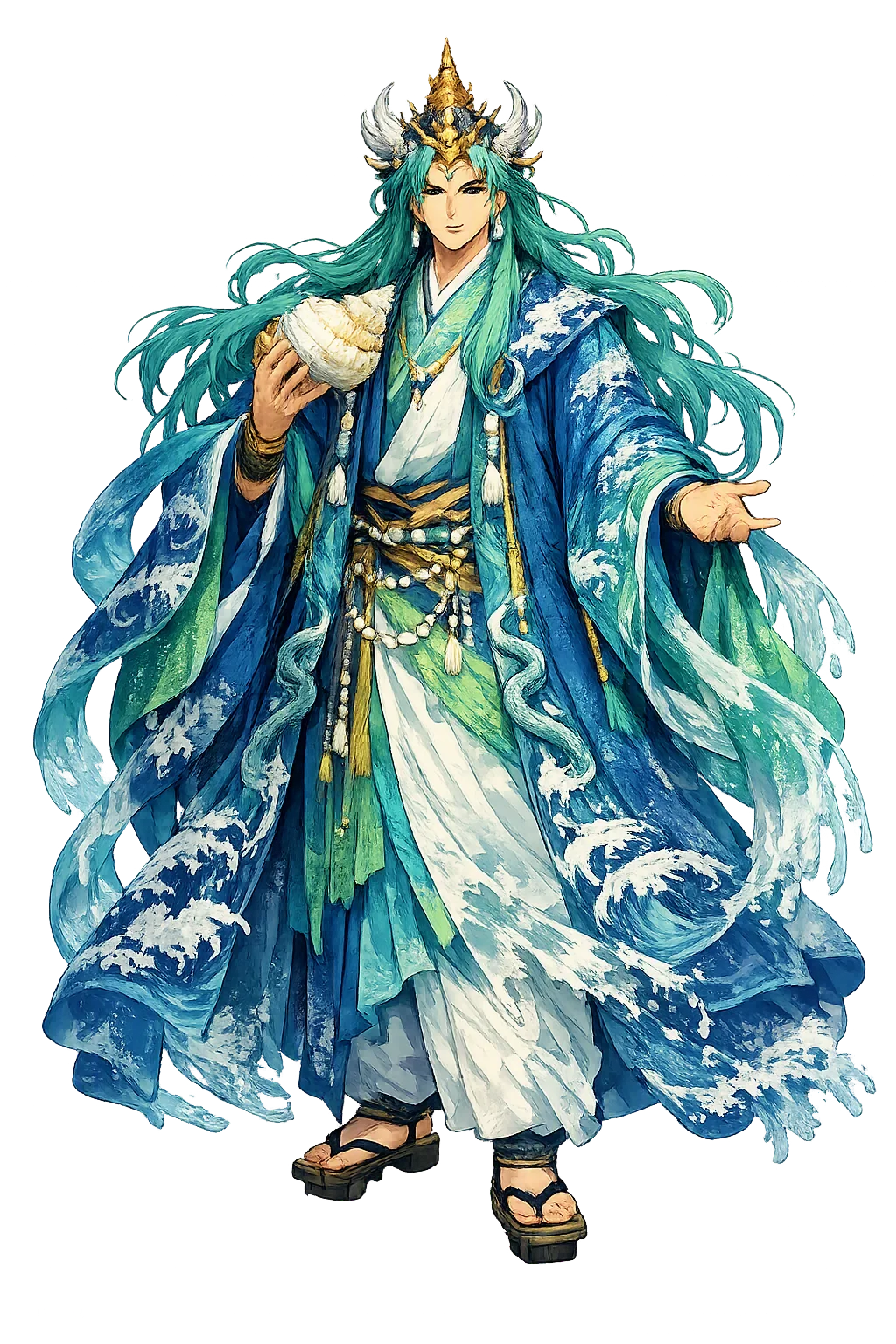
Why Ugayafukiaezu is spelled that way — and what it costs to get it right
There is a version of this name the early internet had to settle for: ugayafukiaezu. This is the file on how Ugayafukiaezu replaced it.
Ugayafukiaezu's mythology is the final chapter of the Hoori–Toyotama cycle and the prologue to the reign of Jimmu: one night on a seashore, one unfinished roof, one farewell poem, and a lineage that steps out of the hut into history.
At a Glance
- Restored name: Ugayafukiaezu
- ASCII form: ugayafukiaezu
- Meaning: "Cormorant grass-thatching unfinished"
- Domain of influence: Ancestor of Jimmu
- Pantheon: Japanese
- Classification: Tier 2
- Original script: 鵜草葺不合命
- Series: The Restoration Files, No. 505 of 548
The Name Before the Marks
The name is attested as 鵜草葺不合命, on the evidence Kojiki, age-of-gods chapters (Hoori, Toyotama, Ugayafukiaezu, and Jimmu cycles), trans. Donald L. Philippi (University of Tokyo Press, 1968) and Nihon Shoki (Nihongi), books 1–3, trans. W. G. Aston (1896) set down. On the evidence, it means "Cormorant grass-thatching unfinished".
Spoken, the name runs `/ɯ.ɡa.ja.fɯ.ki.a.e.zɯ/` — 'OO-gah-yah-foo-kee-ah-eh-zoo' — many light syllables; the 'f' is soft, made with both lips.
The Temple That Stands Now
The restored name is not a plaque; it is an address. The temple of Ugayafukiaezu lives at /ugayafukiaezu/, with its mythology in the lore halls, its peer-reviewed record in the Scholarly Edition, and its place in the pattern atlas on the patterns floor.
One decisive feature survives — a single, honest mark — which places the restoration in Tier-2: exact, and exactly labeled.
Where the Name Stood First
Ugayafukiaezu has no independent material cult; the evidence is textual and funerary. The Kojiki survives through the Shinpukuji manuscript line (supplemented by the 1371–72 date-bearing copies), and the Nihon Shoki through Heian-period manuscript traditions. The imperial mausoleum his line supposedly founded is real as a site: at Kashihara in Nara prefecture the Imperial Household Agency tends Unebi-yama no ushitora no sumi no misasagi, the kofun-style tomb attributed to Jimmu, the son whose birth the hut story explains — a large early-period enclosure, undisturbed by archaeology and unprovenanced to any historical person. Birth huts (ubuya) themselves, the custom behind the myth, persisted in parts of Japan into the twentieth century and were documented by ethnographers — the closest the earth comes to the cormorant-thatched roof. The temple on the web is the newest of these addresses — the first one that fits in a pocket.
The Archetype at Work
The pattern atlas seats this temple in 3 industries, each match argued and weighted: Ancestry & Heritage Services (the cormorant-grass prince and father of Jimmu; Japanese imperial ancestry begins here.); Leadership, Governance & Public Administration (ancestor of the first emperor; imperial leadership begins with him.); Maritime, Shipping & Ocean Industries (born of the sea-foam and cormorant-thatched palace; the maritime ancestor of Jimmu.). The Resonance File reads those seats through the myths themselves.
In the Sacred Texts
The Japanese tradition is not a vibe; it is a library. The Sacred Texts collection holds Kojiki and Nihon Shoki — the primary sources the temple's scholarship is built on. The temple is the argument; the texts are the evidence.
The File Continues
The temple's founding dispatch tells the name's story; its Resonance File reads the myths into the industries; the blog index holds the whole archive.
Continue the series — previous file: Týr (read it here) · next file: Ullr (read it here).
The Restoration Files are written from the same canonical record as the temples themselves: the lexicon, the lore catalog, the pattern atlas, and the cited scholarly sources. If a file ever disagrees with its temple, the temple is right — tell us, and the file will be corrected.