The Living Myth
Ancestor of Jimmu · Cormorant grass-thatching unfinished
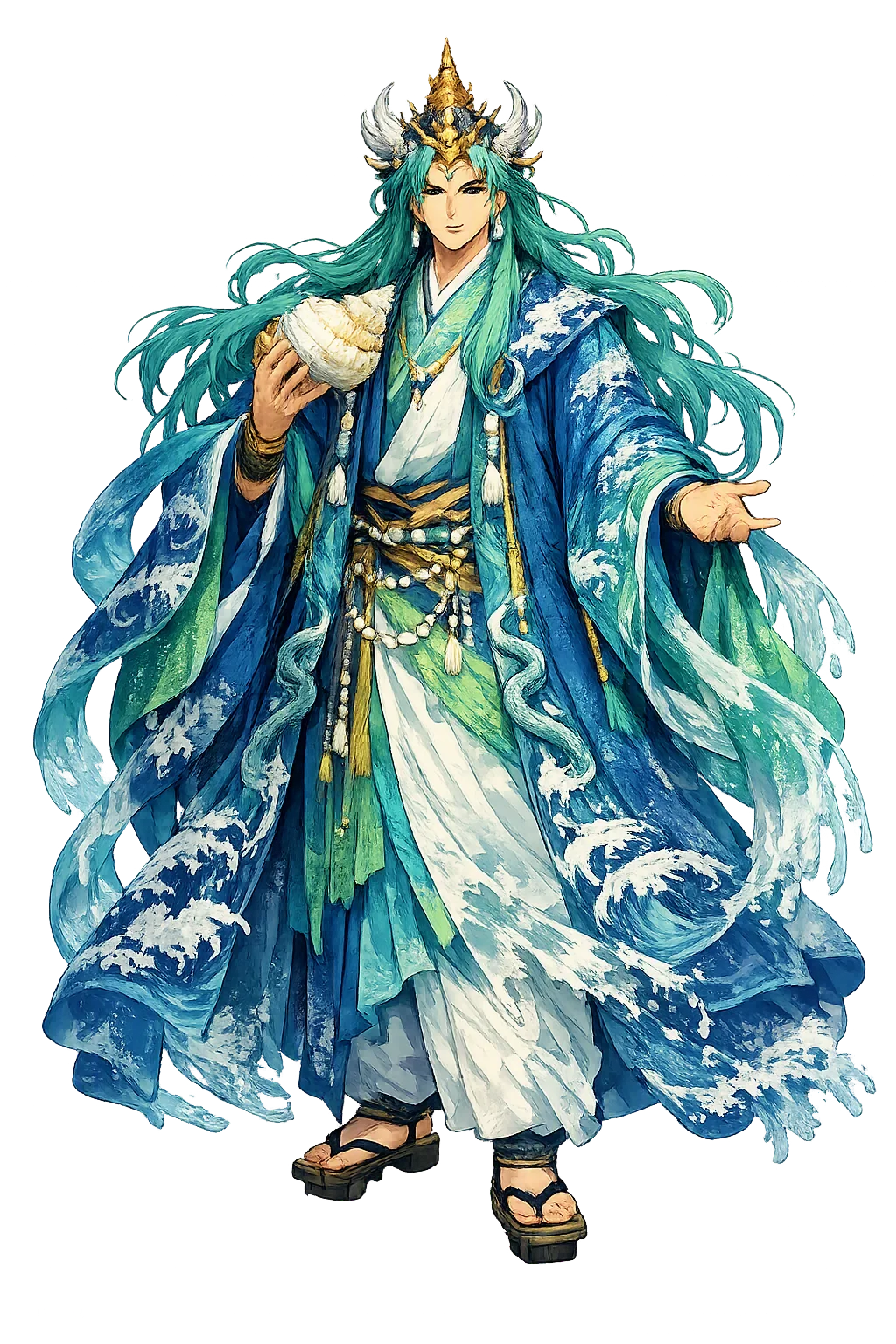
Stories of Ugayafukiaezu
Ugayafukiaezu's mythology is the final chapter of the Hoori–Toyotama cycle and the prologue to the reign of Jimmu: one night on a seashore, one unfinished roof, one farewell poem, and a lineage that steps out of the hut into history.
The Kojiki (age of gods) tells how the sea princess Toyotama-bime, daughter of Watatsumi the sea god, came up from the deep to bear the child of the land-hunter Hoori. On the seashore she built a hut and thatched its roof with cormorant feathers, and as her hour came she warned her husband: do not look inside. Hoori waited, but when the cry came he could not hold back; he peered through the wall and saw his wife transformed into a great sea-creature — the Kojiki says an eight-fathom shark — coiled in labor. Toyotama knew herself shamed. She left the newborn where he lay, in the hut whose cormorant thatch had never been finished, and the compilers give the child his name from the shelter itself: Ugayafukiaezu, 'Cormorant-Thatching-Unfinished'. The scene survives because a roof was never completed: a goddess of the sea delivering on land, and a lineage beginning in the gap between the elements.
Before she returned to the sea, Toyotama spoke the poem the Kojiki preserves as one of its most celebrated archaic songs: had you not shamed me, I would have come and gone by the sea-road, and for ever eased the way of the ships; but now that you have looked, the crossing will be hard — the precise wording varies in translation, but Philippi's rendering keeps its reproach intact. She left the child in the care of her younger sister Tamayori — 'Good Jewel' — who came up out of the water to suckle him. In a text crowded with genealogies, the poem is the rare moment the myth turns elegy: a mother who could have made the sea a road for her son instead leaves him a song — and the imperial line inherits, with its treasures, a story about the price of looking.
Tamayori raised the boy of the unfinished hut, and when he was grown the Kojiki says she became his wife; the compilers record the union without comment, the sea line marrying back into itself. Four sons were born: Itsuse, Inahi, Mikeiri, and the youngest, Kamuyamato-Iwarebiko. The Nihon Shoki's parallel account of the succession tells how the three elder brothers marched east against the defiant chiefs of the land and failed — Itsuse fell at Kusaka, his army repulsed — while the youngest, guided by the three-legged crow Yatagarasu sent down from heaven, found the road through the mountains, defeated Nagasunehiko, and planted the Yamato line. The child of the roofless hut becomes the hinge on which the narrative turns from gods to kings: from this point the chronicles stop telling of the divine age and begin, almost, to tell of a realm.
The Kojiki and Nihon Shoki agree on the cargo of the line Ugayafukiaezu completes: the imperial regalia — the mirror, the sword Kusanagi, and the jewel — descended from Amaterasu with Ninigi, passed down through Hoori's house, and went east with Jimmu on the expedition, the divine mirror and sword carried against the rebels of the land. Later tradition placed the unfinished hut's son at the exact point where the age of the gods closes: everything celestial has now crossed into a single human lineage. The Nihon Shoki's more sober parallel strips away wonders and keeps the genealogy, which is testimony of its own kind — whether read as myth or as charter, the story exists to make one claim: that the family of the unfinished roof was entrusted with heaven's treasures, and did not drop them.
Father of Jimmu and Link Between Sea and Land
Ugayafukiaezu is one of the most strangely named figures in Japanese myth. His name describes the unfinished thatched hut, covered with cormorant feathers, in which he was born. As the son of Hoori and the sea princess Toyotama, and the father of Emperor Jimmu, he is the final link between the ocean depths and the imperial line.
His fourth son, Kamuyamato-Iwarebiko, won the succession and founded the Yamato line as Emperor Jimmu (Kojiki I).
Son of Hoori the land-hunter and Toyotama-bime, daughter of the sea god Watatsumi — the marriage that joined coast and deep.
His name glosses the cormorant-feather thatch of the Kojiki's birth hut — and the roof never finished (鵜草葺不合).
The last link of the divine genealogy: through him the regalia line descends to the historic emperors (Nihon Shoki, books 1–3).
From the original script to the living URL
鵜草葺不合命
The name in its original Japanese form. Ugayafukiaezu (鵜草葺不合命) is attested in the source tradition — “Cormorant grass-thatching unfinished”. Its original diacritics and script distinctions carry the full phonetic and orthographic weight of the source tradition.
ugayafukiaezu
The plain ugayafukiaezu form is identical to the Unicode restoration. Because this name is already written in Latin letters, no diacritics, stress, or script information were lost — only capitalization differs.
Ugayafukiaezu
The Unicode restoration does not need to recover lost marks for Ugayafukiaezu. Its value is canonical spelling and consistent cataloguing, not the reconstruction of erased orthography. The domain is readable as-is to both DNS and humanity.
Ugayafukiaezu.com
This restoration is written entirely in ASCII letters — no Punycode encoding stands between Ugayafukiaezu and the DNS. The domain reads identically to machines and to human eyes.
Owned, ideal, and ASCII forms of Ugayafukiaezu
Ugayafukiaezu
Restores 鵜草葺不合命. The full Unicode restoration. ugayafukiaezu.com is not in the PuniCodex collection — it is watched for release; if it drops, this temple upgrades to an owned flagship.
How Ugayafukiaezu was spoken
How Ugayafukiaezu is preserved in writing
A bespoke provenance study for Ugayafukiaezu is being prepared by the PUNICODEX scholarly team.
Contribute scholarly provenance →The lore you have read is the living myth. Extended Lore opens the scholarly vault beneath it: the cult and its material remains, a history of the image, the name after antiquity, a meditation on what the name still means, and the full scholarly apparatus — etymology, orthography, sources.
Enter Extended Lore