
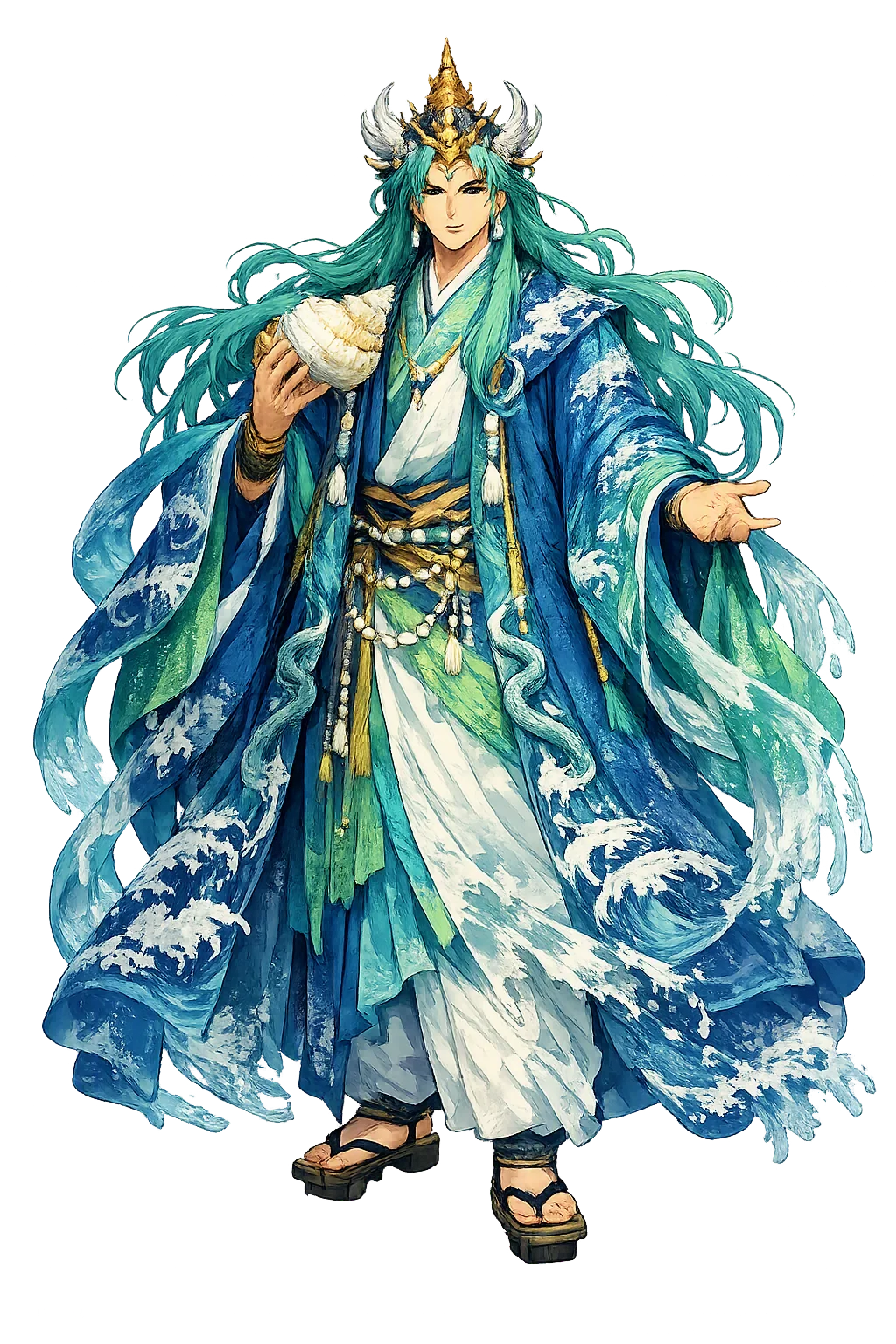
Ugayafukiaezu at work: ancestry & heritage services, leadership, governance & public administration, and the myths that got there first
The myths did not retire. They moved offices. This is the file on where Ugayafukiaezu works now.
Ugayafukiaezu's mythology is the final chapter of the Hoori–Toyotama cycle and the prologue to the reign of Jimmu: one night on a seashore, one unfinished roof, one farewell poem, and a lineage that steps out of the hut into history.
The pattern atlas — which maps every flagship temple to the industries its archetype demonstrably resonates with, each match argued and open to challenge — seats this temple in 3 industries. This file reads those seats the way they were earned: through the myths.
At a Glance
- Temple: Ugayafukiaezu
- Pantheon: Japanese
- Domain of influence: Ancestor of Jimmu
- Pattern seats: 3
- Sectors touched: Commerce & Governance · Energy & Natural World
- Strongest seat: Ancestry & Heritage Services
- Series: The Resonance Files, No. 505 of 548
The Myth at Work
The Cormorant-Feather Hut. The Kojiki (age of gods) tells how the sea princess Toyotama-bime, daughter of Watatsumi the sea god, came up from the deep to bear the child of the land-hunter Hoori. On the seashore she built a hut and thatched its roof with cormorant feathers, and as her hour came she warned her husband: do not look inside. — hold that image; the industries below are where it goes to work.
The Farewell Song. Before she returned to the sea, Toyotama spoke the poem the Kojiki preserves as one of its most celebrated archaic songs: had you not shamed me, I would have come and gone by the sea-road, and for ever eased the way of the ships; but now that you have looked, the crossing will be hard — the precise wording varies in translation, but Philippi's rendering keeps its reproach intact. She left the child in the care of her younger sister Tamayori — 'Good Jewel' — who came up out of the water to suckle him. — that is not just a story. It is a business model, four thousand years early.
The Seats
Each of these is argued in the atlas with a weight and a why-line. What the atlas cannot fit in one line is the whole myth — so here is each seat with its story restored.
Ancestry & Heritage Services
Genealogy, heritage research, and DNA ancestry. (Sector: Commerce & Governance)
The why-line says it in one breath: The cormorant-grass prince and father of Jimmu; Japanese imperial ancestry begins here. That is not a resemblance; it is the same act, performed in a newer building.
Leadership, Governance & Public Administration
Government, executive leadership, and statecraft. (Sector: Commerce & Governance)
Ancestor of the first emperor; imperial leadership begins with him. Swap the costume and the sentence is indistinguishable from the myth. That is what a resonance seat means.
Maritime, Shipping & Ocean Industries
Shipping, ports, fishing, and ocean exploration. (Sector: Energy & Natural World)
The why-line says it in one breath: Born of the sea-foam and cormorant-thatched palace; the maritime ancestor of Jimmu. That is not a resemblance; it is the same act, performed in a newer building.
The Long Employment
His legacy runs through the one institution he made possible. As Jimmu's father, Ugayafukiaezu stands in the imperial genealogy, and Japan's National Foundation Day (11 February) marks the legendary accession of the son born in the unfinished hut. The age changed. The work did not.
The Method, Stated Plainly
Skeptical? Good — the system is built for you. Every seat in this file carries its why-line and its weight, the full derivation is public at the methodology page, and the challenge process is part of the design. Falsifiable is not a posture here; it is the mechanism.
For the Ones Who Work There
If you work in ancestry & heritage services, leadership, governance & public administration, or any trade this temple holds a seat in, this is the honest version of what a placement means: your industry beside the story it has been re-telling all along — on the temple floor itself, before an audience that came specifically to read it. The patron tier and the advertising terms describe the mechanics; the resonance above describes the fit.
The File Continues
One of 548 Resonance Files — the series where the pantheon goes to work. Read the founding dispatch for the name, the Restoration File for the spelling, or the whole archive end to end.
Continue the series — previous: Týr (read it) · next: Ullr (read it).
The Resonance Files are argued from the same canonical record as the pattern atlas itself: the lexicon, the lore catalog, and the cited sources. Every seat can be challenged at the methodology page — and the challenge is the point.