
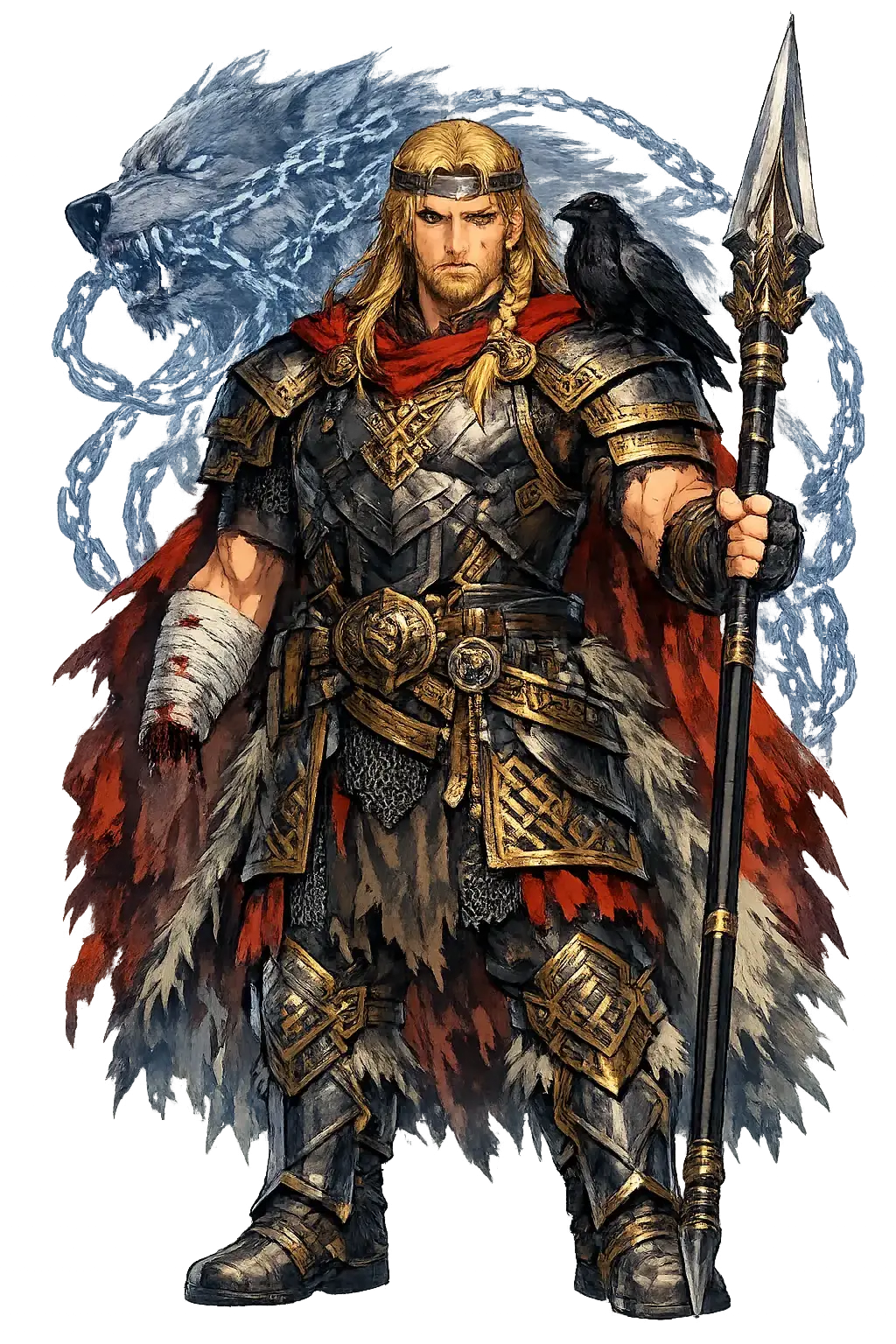
Why Týr is spelled that way — and what it costs to get it right
There is a version of this name the early internet had to settle for: tyr. This is the file on how Týr replaced it.
Týr's mythology is narrower than that of Óðinn or Þórr, but it turns on a single, unforgettable scene: a god who pays for the common good with his own body. His stories are stories of pledges kept, monsters bound, and the law that outlasts the hand that swore it.
At a Glance
- Restored name: Týr
- ASCII form: tyr
- Meaning: "God (cognate with Greek Zeus, Latin Jove)"
- Domain of influence: War, Law, Oaths
- Pantheon: Norse
- Classification: Tier 1
- Original script: ᛏᚢᚱ
- Series: The Restoration Files, No. 502 of 546
The Name Before the Marks
Strip Týr to tyr and one piece of evidence vanishes:
- y → ý — Acute on y: the stress position the ASCII form cannot show.
None of these marks is decoration. Each one is a fact about how the name was spoken, and each one is checkable against the scholarly record the temple cites.
Spoken, the name runs `/tyːr/` — 'TEWR' — start with a crisp 't', say the rounded 'ew' of 'few' while pursing the lips, hold it long, and finish with a light trilled r.
The Temple That Stands Now
The restored name is not a plaque; it is an address. The temple of Týr lives at /tyr/, with its mythology in the lore halls, its peer-reviewed record in the Scholarly Edition, and its place in the pattern atlas on the patterns floor.
What survives here cannot be shown in ASCII: a feature of the original that the fallback alphabet flattens. That is the Tier-1 test, and this name passes it without argument.
Where the Name Stood First
The name Týr is attested in runic inscriptions, including the early Viking-Age Ribe skull fragment. The Romano-Germanic altar at Housesteads (Vercovicium) on Hadrian's Wall names Mars Thincsus, the interpretatio romana of Týr as god of the thing. Place-names such as Týrsbergi in Sweden and the widespread Scandinavian Tis-/Tir- names suggest a cultic footprint broader than the literary record implies. The temple on the web is the newest of these addresses — the first one that fits in a pocket.
The Archetype at Work
The pattern atlas seats this temple in 4 industries, each match argued and weighted: Legal, Justice & Compliance (law and oaths; the god who paid the price of keeping one.); Defense, Military & Security (war bound by law; the just-war tradition.); Insurance & Protection Services (the hand in Fenrir's mouth — the pledge that made the binding hold; surety personified.). The Resonance File reads those seats through the myths themselves.
In the Sacred Texts
The Norse tradition is not a vibe; it is a library. The Sacred Texts collection holds Poetic Edda and Prose Edda — the primary sources the temple's scholarship is built on. The temple is the argument; the texts are the evidence.
The File Continues
The temple's founding dispatch tells the name's story; its Resonance File reads the myths into the industries; the blog index holds the whole archive.
Continue the series — previous file: Typhōn (read it here) · next file: Ugayafukiaezu (read it here).
The Restoration Files are written from the same canonical record as the temples themselves: the lexicon, the lore catalog, the pattern atlas, and the cited scholarly sources. If a file ever disagrees with its temple, the temple is right — tell us, and the file will be corrected.