
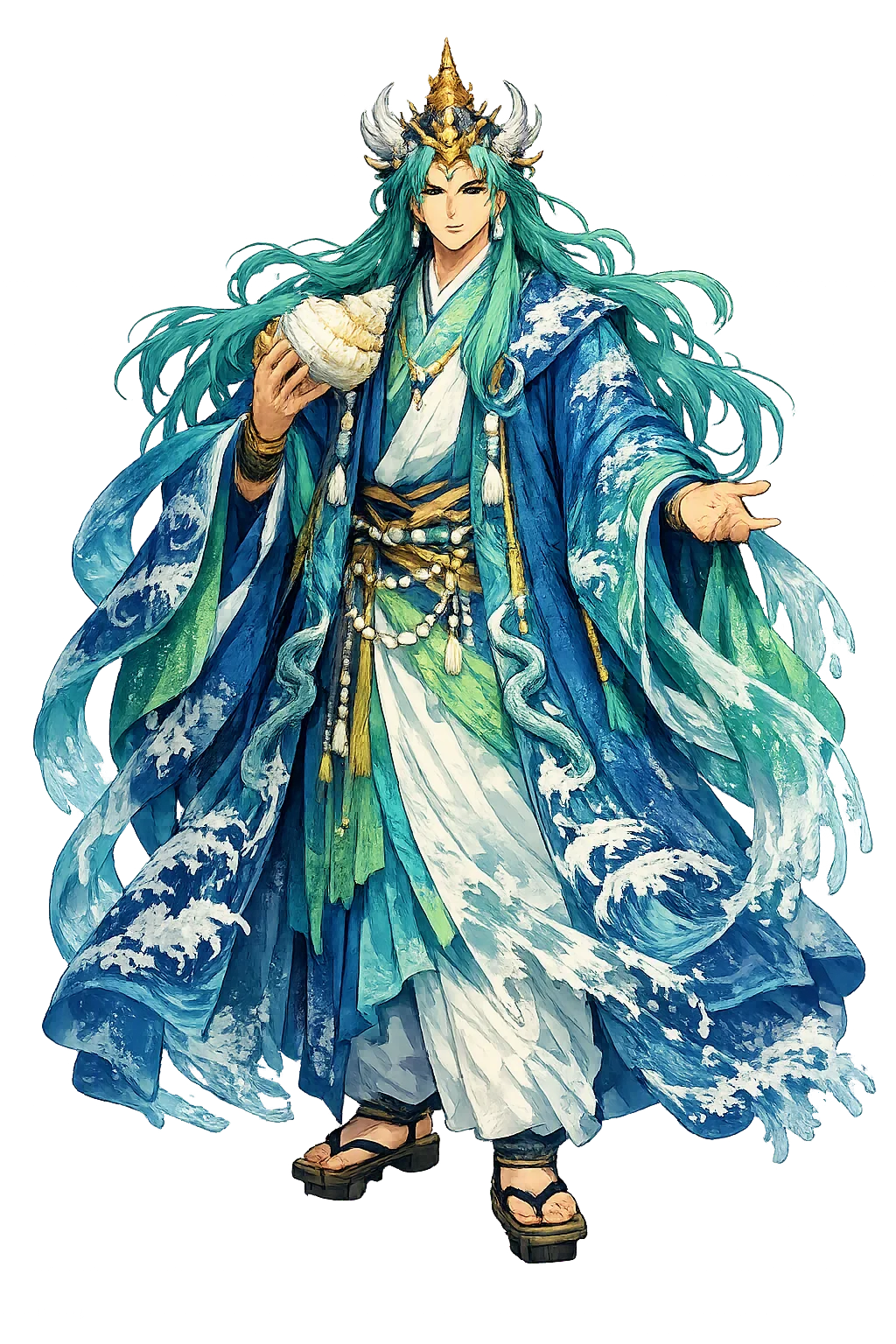
How Ugayafukiaezu found its canonical form
The ASCII form ugayafukiaezu is not missing anything that this name requires. Ugayafukiaezu is the canonical spelling supported by the Japanese characters evidence and the tradition's scholarly conventions. This post explains what that form preserves, how it is pronounced, which narratives surround it, and why consistency matters. There are no recovered accents to celebrate; there is something more useful — a spelling whose history can actually be checked.
At a Glance
- Canonical name: Ugayafukiaezu
- ASCII form: ugayafukiaezu
- Meaning: "Cormorant grass-thatching unfinished"
- Domain of influence: Ancestor of Jimmu
- Pantheon: Japanese
- Restoration: ASCII-equivalent form
- Original script: 鵜草葺不合命 (Japanese characters)
Overview
Ugayafukiaezu (ugayafukiaezu) — Ancestor of Jimmu · Cormorant grass-thatching unfinished — belongs to the Japanese tradition, where it is catalogued under the domain "Ancestor of Jimmu". The name means "Cormorant grass-thatching unfinished".
Ugayafukiaezu is one of the most strangely named figures in Japanese myth. His name describes the unfinished thatched hut, covered with cormorant feathers, in which he was born. As the son of Hoori and the sea princess Toyotama, and the father of Emperor Jimmu, he is the final link between the ocean depths and the imperial line.
PuniCodex records the canonical scholarly spelling Ugayafukiaezu and serves its temple at its temple. The displayed form is ASCII-equivalent — a description computed from the displayed form itself. The plain ASCII form ugayafukiaezu contains the same letters: no recovered diacritics or special encoding is claimed. The work here is consistent citation, capitalization, provenance, and cultural context.
The Name
The name is attested in Japanese characters as 鵜草葺不合命. Etymologically it means "Cormorant grass-thatching unfinished".
The canonical spelling Ugayafukiaezu matches the conventional scholarly romanization. The plain ASCII form ugayafukiaezu contains the same letters, so no lost diacritics or encoding transition is claimed. The editorial work is to fix one reviewed reference spelling, preserve capitalization and provenance, and keep the original evidence visible. The displayed form is ASCII-equivalent — a description computed from the displayed form itself.
The letter-by-letter transformation runs:
- u → U — Same, capitalized
- g → g — Same
- a → a — Same
- y → y — Same
- a → a — Same
- f → f — Same
- u → u — Same
- k → k — Same
- i → i — Same
- a → a — Same
- e → e — Same
- z → z — Same
- u → u — Same
The Original Script
The name is written in Japanese characters as 鵜草葺不合命. That attested script remains the primary evidence for the conventional romanization Ugayafukiaezu. The canonical Latin spelling does not pretend to recover marks it never contained: it fixes one reviewed reference form while leaving the original script visible for comparison.
The age-of-gods names are written in kanji that gloss rather than transcribe. The full ceremonial form is 鵜草葺不合命 (Ugayafukiaezu-no-mikoto), with the honorific 命 (mikoto): 鵜 “cormorant,” 草 “grass, reed,” 葺 “to thatch,” 不合 “not joined, unfinished.” The characters record the Kojiki's own explanation of the name, not a phonetic spelling; medieval manuscripts abbreviate the compound variously, and its reading has been debated since the earliest commentaries.
Pronunciation
The reconstructed pronunciation of the name is /ɯ.ɡa.ja.fɯ.ki.a.e.zɯ/ — Modern Standard Japanese (Hepburn).
Phoneme by phoneme:
- U- — Close back unrounded [ɯ]
- -ga- — Voiced velar stop [ɡ] plus open central [a]; from 鵜 'cormorant'
- -ya- — Palatal approximant [j] plus open central [a]; from 草 'grass'
- -fuki- — Voiceless bilabial fricative [ɸ], close back [ɯ], voiceless velar [k], close front [i]; from 葺 'thatch'
- -aezu — Open central [a], close-mid [e], voiced alveolar fricative [z], close back [ɯ]; from 不合 'unfinished/not joined'
For the modern speaker, the closest approximation is: 'OO-gah-yah-foo-kee-ah-eh-zoo' — many light syllables; the 'f' is soft, made with both lips.
Kindred and historical forms of the name:
- Japanese — 鵜草葺不合命 (Ugayafukiaezu-no-mikoto), 'Cormorant Thatching Unfinished' — Kojiki, age-of-gods genealogy
- Parents — Hoori (Hikohohodemi) and Toyotama-bime — Kojiki I; Nihon Shoki, book 1
- Son — Emperor Jimmu (Kamuyamato-Iwarebiko) — Kojiki I; Nihon Shoki, book 3
Ugayafukiaezu keeps its restoration plain: plain Hepburn. His strange name refers to a birth hut thatched with cormorant feathers and left unfinished. He is the immediate father of Emperor Jimmu.
Mythology
Ugayafukiaezu's mythology is the final chapter of the Hoori–Toyotama cycle and the prologue to the reign of Jimmu: one night on a seashore, one unfinished roof, one farewell poem, and a lineage that steps out of the hut into history.
The Cormorant-Feather Hut (Kojiki I)
The Kojiki (age of gods) tells how the sea princess Toyotama-bime, daughter of Watatsumi the sea god, came up from the deep to bear the child of the land-hunter Hoori. On the seashore she built a hut and thatched its roof with cormorant feathers, and as her hour came she warned her husband: do not look inside. Hoori waited, but when the cry came he could not hold back; he peered through the wall and saw his wife transformed into a great sea-creature — the Kojiki says an eight-fathom shark — coiled in labor. Toyotama knew herself shamed. She left the newborn where he lay, in the hut whose cormorant thatch had never been finished, and the compilers give the child his name from the shelter itself: Ugayafukiaezu, 'Cormorant-Thatching-Unfinished'. The scene survives because a roof was never completed: a goddess of the sea delivering on land, and a lineage beginning in the gap between the elements.
The Farewell Song (Kojiki I)
Before she returned to the sea, Toyotama spoke the poem the Kojiki preserves as one of its most celebrated archaic songs: had you not shamed me, I would have come and gone by the sea-road, and for ever eased the way of the ships; but now that you have looked, the crossing will be hard — the precise wording varies in translation, but Philippi's rendering keeps its reproach intact. She left the child in the care of her younger sister Tamayori — 'Good Jewel' — who came up out of the water to suckle him. In a text crowded with genealogies, the poem is the rare moment the myth turns elegy: a mother who could have made the sea a road for her son instead leaves him a song — and the imperial line inherits, with its treasures, a story about the price of looking.
The Aunt Who Stayed (Kojiki I)
Tamayori raised the boy of the unfinished hut, and when he was grown the Kojiki says she became his wife; the compilers record the union without comment, the sea line marrying back into itself. Four sons were born: Itsuse, Inahi, Mikeiri, and the youngest, Kamuyamato-Iwarebiko. The Nihon Shoki's parallel account of the succession tells how the three elder brothers marched east against the defiant chiefs of the land and failed — Itsuse fell at Kusaka, his army repulsed — while the youngest, guided by the three-legged crow Yatagarasu sent down from heaven, found the road through the mountains, defeated Nagasunehiko, and planted the Yamato line. The child of the roofless hut becomes the hinge on which the narrative turns from gods to kings: from this point the chronicles stop telling of the divine age and begin, almost, to tell of a realm.
The Treasures Cross the Water (Nihon Shoki)
The Kojiki and Nihon Shoki agree on the cargo of the line Ugayafukiaezu completes: the imperial regalia — the mirror, the sword Kusanagi, and the jewel — descended from Amaterasu with Ninigi, passed down through Hoori's house, and went east with Jimmu on the expedition, the divine mirror and sword carried against the rebels of the land. Later tradition placed the unfinished hut's son at the exact point where the age of the gods closes: everything celestial has now crossed into a single human lineage. The Nihon Shoki's more sober parallel strips away wonders and keeps the genealogy, which is testimony of its own kind — whether read as myth or as charter, the story exists to make one claim: that the family of the unfinished roof was entrusted with heaven's treasures, and did not drop them.
Symbols & Iconography
The iconography associated with Ugayafukiaezu concentrates in a small set of recurring attributes, each a compressed statement about the name:
- Cormorant feathers — The black plumage of the diving bird that the Kojiki makes the roof of his birth hut (ugaya)
- Thatching — fukiaezu — 'not yet completed': the unfinished roof read directly as his name
- Sea and land — His double heritage: the tide-jewel deep of Watatsumi's house and the hills of his father Hoori
- Bow and fishhook — The paternal gear of Hoori's line — the hunter's bow against the sea's hooked line
Archaeology & Evidence
Ugayafukiaezu has no independent material cult; the evidence is textual and funerary. The Kojiki survives through the Shinpukuji manuscript line (supplemented by the 1371–72 date-bearing copies), and the Nihon Shoki through Heian-period manuscript traditions. The imperial mausoleum his line supposedly founded is real as a site: at Kashihara in Nara prefecture the Imperial Household Agency tends Unebi-yama no ushitora no sumi no misasagi, the kofun-style tomb attributed to Jimmu, the son whose birth the hut story explains — a large early-period enclosure, undisturbed by archaeology and unprovenanced to any historical person. Birth huts (ubuya) themselves, the custom behind the myth, persisted in parts of Japan into the twentieth century and were documented by ethnographers — the closest the earth comes to the cormorant-thatched roof.
Realm & Domain
Ugayafukiaezu is one of the most strangely named figures in Japanese myth. His name describes the unfinished thatched hut, covered with cormorant feathers, in which he was born. As the son of Hoori and the sea princess Toyotama, and the father of Emperor Jimmu, he is the final link between the ocean depths and the imperial line.
Father of Jimmu
His fourth son, Kamuyamato-Iwarebiko, won the succession and founded the Yamato line as Emperor Jimmu (Kojiki I).
Sea-Land Bridge
Son of Hoori the land-hunter and Toyotama-bime, daughter of the sea god Watatsumi — the marriage that joined coast and deep.
Unfinished Birth Hut
His name glosses the cormorant-feather thatch of the Kojiki's birth hut — and the roof never finished (鵜草葺不合).
Imperial Ancestor
The last link of the divine genealogy: through him the regalia line descends to the historic emperors (Nihon Shoki, books 1–3).
Across Cultures
Ugayafukiaezu has no cult and no shrine — his whole existence is genealogical, and his meaning is that of the custom his name preserves. Japanese ethnographers documented birth huts, ubuya, in which mothers delivered and secluded themselves, persisting in parts of the country into the twentieth century; the Kojiki's cormorant-feather hut is read against this custom as its mythic charter. Medieval Buddhist exegetes folded the age-of-gods narratives into the honji suijaku framework, treating the kami's doings as local manifestations of cosmic Buddha-activity, while Edo-period nativists of the Kokugaku school — Motoori Norinaga above all — pored over the strange compounds of the divine genealogy as evidence of an authentically Japanese antiquity. Each tradition found in the unfinished roof what it needed: ritualists a birth custom, monks a parable of manifestation, nativists a pure native word.
Kindred figures in the PuniCodex cross-tradition index include Hoori (father and ancestor of Jimmu), Toyotama (mother and ancestor of Jimmu), Anāhitā (earth / mother / fertility), Auðhumla (earth / mother / fertility), Ọbalúayé (earth / mother / fertility), and Bꜣstt (earth / mother / fertility).
Cultural Legacy
His legacy runs through the one institution he made possible. As Jimmu's father, Ugayafukiaezu stands in the imperial genealogy, and Japan's National Foundation Day (11 February) marks the legendary accession of the son born in the unfinished hut. The birth-hut custom behind his name outlived the myth in practice: ethnographers recorded ubuya seclusion into the modern period, especially in the Izu Islands and the northeast. In scholarship his name is a permanent puzzle — every handbook of Japanese myth pauses over the cormorant feathers — and in popular culture the Jimmu cycle, Yatagarasu and all, returns in anime, manga, and school texts as the nation's prologue. The strange name does the work: a lineage that begins under an unfinished roof can never be accused of having begun too comfortably.
The Scholarly Record
The account of Ugayafukiaezu given in this edition rests on the witnesses and reference works listed below. Lexica and etymological dictionaries secure the form and meaning of the name; the literary and religious texts supply the narrative evidence.
- Kojiki, age-of-gods chapters (Hoori, Toyotama, Ugayafukiaezu, and Jimmu cycles), trans. Donald L. Philippi (University of Tokyo Press, 1968).
- Nihon Shoki (Nihongi), books 1–3, trans. W. G. Aston (1896).
- Philippi, Donald L., Kojiki (Princeton University Press, 1969).
A Meditation
He is named for what was never finished. Every other figure of the Kojiki's first books wins a name from a deed, a place, a father; Ugayafukiaezu wins his from defective carpentry — a roof of cormorant feathers, begun in haste and never completed. Scholars have tried to make the name less odd, reading the feathers as ritual paraphernalia, the incompleteness as birth taboo, the whole hut as a lodge built for a single night and deliberately left open to the sky. All may be true, and the text does not care. What matters is that the imperial line — the oldest continuously claimed succession on earth — passes through a child born in a shelter that was never made weatherproof. The unfinished roof is the tradition's quiet joke and its deepest claim at once: origins are not supposed to be comfortable, complete, or safe. Beginnings, like thatch, are provisional; what matters is who carries the story out of the hut.
The Canonical Spelling
Ugayafukiaezu is the canonical spelling used by this temple. The plain ASCII form ugayafukiaezu contains the same letters, so there are no lost diacritics to recover and no special encoding transition to explain. What the temple preserves is the reviewed reference form: capitalization, conventional romanization, original evidence, and a stable place to inspect them. The value here is not added decoration; it is fidelity to the attested record.
Character by Character
The canonical form Ugayafukiaezu and the plain ASCII form ugayafukiaezu share the same letters. The character list therefore documents continuity rather than recovery: every character is carried forward deliberately, with capitalization serving as the proper-noun convention. No additional mark is inserted merely to make the restoration appear more elaborate.
The Japanese Pantheon
Ugayafukiaezu is one of 45 entries the PuniCodex lexicon catalogues under the Japanese pantheon. The Pantheon page gathers the tradition's major figures in one place, and the Lexicon lets you filter all 983 restorations by tradition or script — the fastest way to see where this name sits among its kin.
Frequently Asked Questions
What does Ugayafukiaezu mean? The traditional gloss is "Cormorant grass-thatching unfinished."
Which tradition does Ugayafukiaezu belong to? Ugayafukiaezu is catalogued in the Japanese pantheon of the PuniCodex lexicon.
Does this name need recovered diacritics? No. Ugayafukiaezu is already an ASCII-form canonical spelling. The scholarly work is to preserve the attested convention and its evidence, not to add marks.
Can I use Ugayafukiaezu in a normal browser? Yes. The spelling works directly in an ordinary browser, and the type tool can confirm and copy the canonical form.
Where does the scholarly information come from? The entry is built from lexica, inscriptional evidence, and reviewed scholarly sources listed in the Scholarly Edition.
Typing Ugayafukiaezu
You do not need a special keyboard to use this name. Ugayafukiaezu already uses ordinary Latin letters. The PuniCodex Type Tool lets you confirm the canonical spelling and copy it cleanly, while the original-script notes in the temple show the evidence behind the romanization.
Why This Record Matters
The letters in Ugayafukiaezu were never lost, and no replacement marks are needed to make them whole. The burden is instead one of fidelity: every use should carry the same attested spelling and the history attached to it. The PuniCodex temple keeps that form in circulation — as a digital address, a dataset entry, and a scholarly argument — so consistency becomes the easy choice rather than an accident of citation.
Explore Further
This post is one doorway into the temple. The home page carries the full character breakdown and the ambient canvas; the lore page tells the myths in long form; the Scholarly Edition preserves the sources, pronunciation data, and revision history; and the patron wall supports the restoration directly. For the wider map, browse the Lexicon, explore the Pantheon, or return to the PuniCodex blog.
Related Names
Sources
The full scholarly apparatus — every citation, revision, and review — lives in the Scholarly Edition. Key references for this post:
- Kojiki, age-of-gods chapters (Hoori, Toyotama, Ugayafukiaezu, and Jimmu cycles), trans. Donald L. Philippi (University of Tokyo Press, 1968).
- Nihon Shoki (Nihongi), books 1–3, trans. W. G. Aston (1896).
- Philippi, Donald L., Kojiki (Princeton University Press, 1969).
- Lexicon authorities for this entry: Kojiki, Nihon Shoki.