
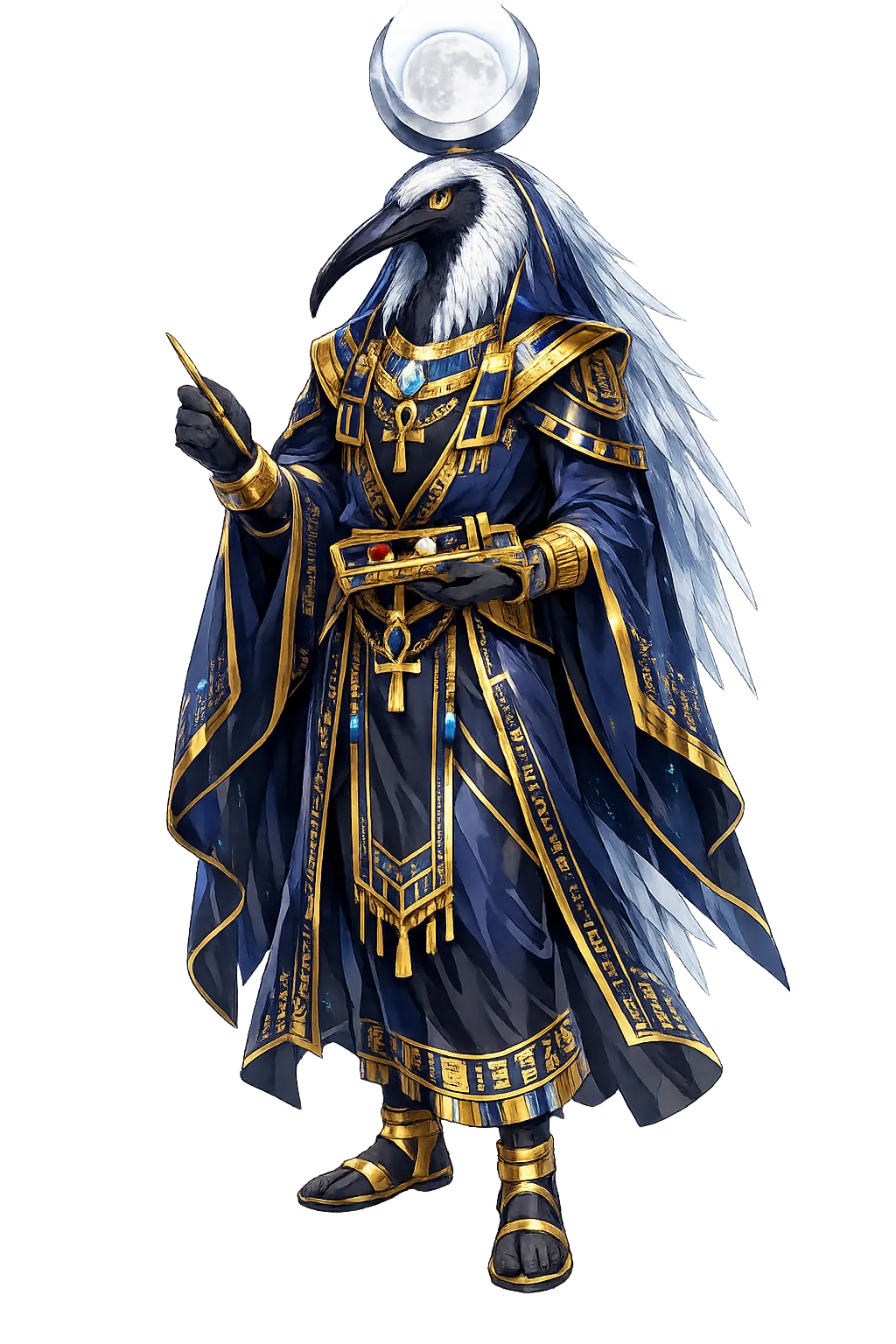
The appointments Ḏḥwtj made — and who is keeping them
One myth is a story. A cycle of myths is a specification. Read Ḏḥwtj's cycle in order and the industries fall out of it one by one.
At a Glance
- Temple: Ḏḥwtj
- Pantheon: Egyptian
- Domain of influence: Writing, Wisdom, Moon
- Pattern seats: 5
- Sectors touched: Society & Spirit · Culture & Entertainment · Technology & Innovation
- Strongest seat: Education, Research & Knowledge
- Series: The Resonance Files, No. 485 of 546
The Cycle, Read Forward
Education, Research & Knowledge — through The Word That Organized Creation
Egyptian creation had many authors — Atum of Heliopolis, Ptḥ of Memphis, the eight of Hermopolis — and Ḏḥwtj is the one indispensable technician in all of them. The Shabaka Stone's Memphite Theology makes him effectively the tongue of Ptḥ: the creator conceives in his heart, and it is Thoth's word that carries the conception into speech, 'which created all that exists.
The atlas states the seat in one line: Writing and wisdom; the first scholar’s god. The story above is the long version of the same sentence. Industries do not invent their archetypes; they inherit them and call them best practice.
History, Archives & Records — through The Mediator of the Gods
In the New Kingdom narrative The Contendings of Horus and Set (Papyrus Chester Beatty I), Ḏḥwtj is the divine institution that keeps the brawl from becoming apocalypse: he is scribe to the Ennead's tribunal, messenger between the courts above and below, and healer of both combatants — restoring Horus's torn eye and Set's injured testicles with the same professional calm. When the gods deadlock for years, it is Thoth who carries the correspondence with Osiris in the Duat, and Thoth who records the final verdict that seats Horus on the throne.
The atlas states the seat in one line: The divine scribe — writing itself was his gift; every record ever kept runs on his invention. The story above is the long version of the same sentence. Industries do not invent their archetypes; they inherit them and call them best practice.
Writing, Publishing & Media — through The Scribe of the Weighing
Spell 125 of the Book of the Dead gives Ḏḥwtj his most solemn office. In the Hall of the Two Truths he stands beside the scales where ꜣnpw weighs the heart against the feather of Maat, and it is Thoth who reads the balance and writes the record — the divine audit trail on which every verdict of Osiris rests.
The atlas states the seat in one line: Inventor of writing; every scribe’s and editor’s patron. The story above is the long version of the same sentence. That is the cycle working: story becomes duty, duty becomes trade.
Mapping & Geospatial — through Winning the Days from the Moon
Plutarch (On Isis and Osiris 12) preserves the calendar myth in which Ḏḥwtj outwits time itself. When Rē cursed the sky-goddess Nut that she should bear children 'on no day of the year,' Thoth — gambler and reckoner, the moon's own accountant — played draughts with the moon-god and won a seventy-second part of the moon's light, five full days outside the calendar.
The atlas states the seat in one line: Reckoner, measurer, and surveyor of the gods; patron of every discipline that counts and plots the earth. The story above is the long version of the same sentence. Industries do not invent their archetypes; they inherit them and call them best practice.
The Theme That Runs the Cycle
Thoth moves through Egyptian myth as the indispensable companion: he is present at creation, mediates divine quarrels, heals the wounded eye, and judges the dead. His stories are less about his own ambition than about the power of knowledge, writing, and measured speech to resolve conflict and preserve order.
The Method, Stated Plainly
The atlas is not a horoscope. Seats are earned from the sources — argued, weighted, published — and every one of them can be challenged at the methodology page. A match that cannot survive an argument does not survive review. That is the whole trick: the patterns are claims, and claims can be tested.
For the Ones Who Work There
If you work in education, research & knowledge, history, archives & records, or any trade this temple holds a seat in, this is the honest version of what a placement means: your industry beside the story it has been re-telling all along — on the temple floor itself, before an audience that came specifically to read it. The patron tier and the advertising terms describe the mechanics; the resonance above describes the fit.
The File Continues
One of 546 Resonance Files — the series where the pantheon goes to work. Read the founding dispatch for the name, the Restoration File for the spelling, or the whole archive end to end.
Continue the series — previous: Þórr (read it) · next: Þrúðr (read it).
The Resonance Files are argued from the same canonical record as the pattern atlas itself: the lexicon, the lore catalog, and the cited sources. Every seat can be challenged at the methodology page — and the challenge is the point.