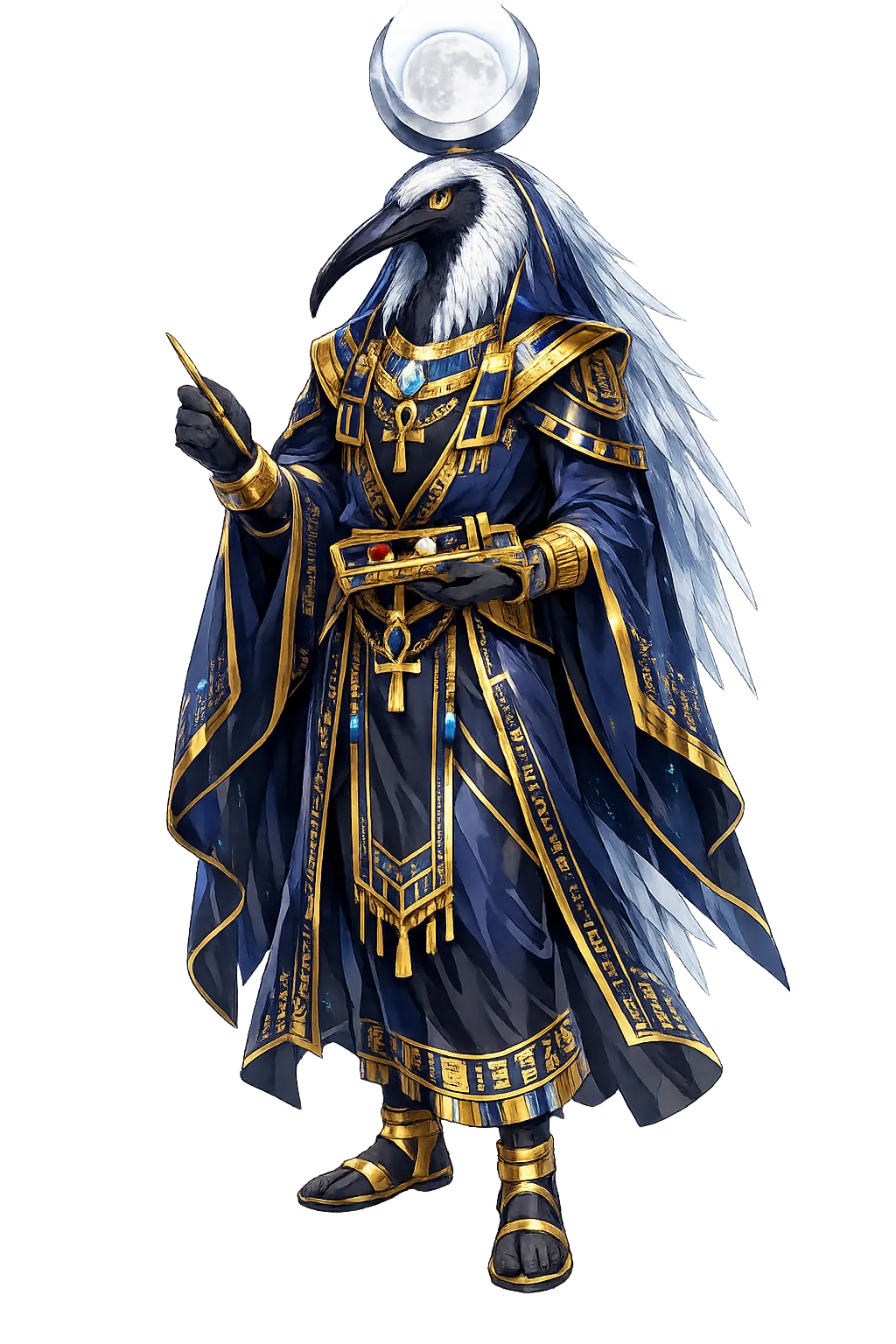
Stories of Ḏḥwtj
Thoth moves through Egyptian myth as the indispensable companion: he is present at creation, mediates divine quarrels, heals the wounded eye, and judges the dead. His stories are less about his own ambition than about the power of knowledge, writing, and measured speech to resolve conflict and preserve order.
Egyptian creation had many authors — Atum of Heliopolis, Ptḥ of Memphis, the eight of Hermopolis — and Ḏḥwtj is the one indispensable technician in all of them. The Shabaka Stone's Memphite Theology makes him effectively the tongue of Ptḥ: the creator conceives in his heart, and it is Thoth's word that carries the conception into speech, 'which created all that exists.' Elsewhere he is credited with inventing hieroglyphs, numbers, and the calendar — the tools by which humans keep Maat on earth — and the Hermopolitan cosmogony makes his own city, Khemenu, the mound that first rose from the flood. Creation, in this theology, is not only a making but a record: nothing made is secure until it is written. The myth means speech without a scribe is unfinished creation — the word that is not written down has not yet fully happened.
In the New Kingdom narrative The Contendings of Horus and Set (Papyrus Chester Beatty I), Ḏḥwtj is the divine institution that keeps the brawl from becoming apocalypse: he is scribe to the Ennead's tribunal, messenger between the courts above and below, and healer of both combatants — restoring Horus's torn eye and Set's injured testicles with the same professional calm. When the gods deadlock for years, it is Thoth who carries the correspondence with Osiris in the Duat, and Thoth who records the final verdict that seats Horus on the throne. His prestige is the point: the text is a comedy in which kings, warriors, and even the sun's council behave like litigants, and only the scribe behaves like a god. The myth defines a specific kind of sacredness: not the hand that throws the spear but the hand that writes the verdict — the power that ends wars by making decisions legible.
Spell 125 of the Book of the Dead gives Ḏḥwtj his most solemn office. In the Hall of the Two Truths he stands beside the scales where ꜣnpw weighs the heart against the feather of Maat, and it is Thoth who reads the balance and writes the record — the divine audit trail on which every verdict of Osiris rests. 'Thoth, exact of voice, the scribe of the gods' is his title there; the justified dead are those whose entry his pen admits. The deceased, knowing this, did not merely submit to the judgment — they tried to become it: funerary texts of the New Kingdom let the dead declare 'I am Thoth,' claiming the protection of the sacred words for their own case. The myth means the afterlife is a bureaucracy staffed by the wise: survive the weighing, and it is because the god of writing has written you down among the living forever.
Plutarch (On Isis and Osiris 12) preserves the calendar myth in which Ḏḥwtj outwits time itself. When Rē cursed the sky-goddess Nut that she should bear children 'on no day of the year,' Thoth — gambler and reckoner, the moon's own accountant — played draughts with the moon-god and won a seventy-second part of the moon's light, five full days outside the calendar. On them Nut bore her five children: Osiris, Horus the Elder, Set, Isis, Nephthys — the entire cast of Egypt's central drama, born on borrowed time. The five epagomenal days, 'the five days upon the year,' were celebrated across Egypt as the gods' birthdays, and Egypt's 365-day year balanced on this ancient gift. The myth makes the calendar itself a story: the year has no room for the future until the god of writing cheats the arithmetic.
The 'Myth of the Eye of the Sun,' known from copies such as Papyrus Leiden I 384 and temple versions at Kom Ombo and Dendera, sends Ḏḥwtj on his most delicate embassy. The Eye of Rē — the furious lioness who stormed away to Nubia in rage — must be coaxed home, for without her the land withers. Rē sends the cleverest speaker he has: Thoth, who finds the goddess ravening in the desert and does not fight her but talks — flatteries, fables, gentle jokes — until her anger softens, her lioness skin is shed, and she consents to return as the mild, life-giving Eye. Wherever the myth is told, the divine council agrees that no other god could have managed it: not force, not magic, but speech. The myth praises a specific genius: there are disasters that power cannot retrieve — only a perfect speech can bring the light back home.
Writing, Wisdom, Moon, and Judgment
Ḏḥwtj is the ibis-headed scribe of the gods, the measurer of time, the reckoner of accounts, and the moon whose light lets humans see at night. He invented writing, preserved the laws of Maat, and stands beside Osiris in the Hall of Judgment to record the verdict of the heart. Where Ptḥ creates by speaking, Thoth creates by writing: he is the god who makes knowledge durable.
Thoth is the moon that measures months, festivals, and the night hours of the Duat.
He records the weighing of the heart and knows the spells that protect the justified dead.
He intervenes in disputes among gods, restores the Eye of Horus, and masters medicine and magic.
His city Khemenu, 'Eight-Town,' was a center of learning and the cult of the Ogdoad.
From the original script to the living URL
𓅜𓏏
The name in its original Egyptian form. Ḏḥwtj (𓅜𓏏) is attested in the source tradition — “He who is like the ibis”. Its emphatic consonants carry the full phonetic and orthographic weight of the source tradition.
thoth
Reduced to plain thoth, the name loses everything that made it specific: emphatic consonants. What remains is an ASCII string that machines can parse but that no longer speaks with its original voice.
Ḏḥwtj
The Unicode restoration recovers what ASCII flattened. Ḏḥwtj restores emphatic consonants, returning the name to its original written dignity. The domain encodes to Punycode, but the browser displays the truth.
Ḏḥwtj.com → xn--wtj-2yy4e.com
The non-ASCII characters in Ḏḥwtj are encoded while the ASCII remains visible. To the DNS, it is Punycode. To humanity, it is Ḏḥwtj.
Owned, ideal, and ASCII forms of Ḏḥwtj
Ḏḥwtj
Restores 𓅜𓏏. The live temple domain — ḏḥwtj.com.
thoth
Flattens 𓅜𓏏. The plain ASCII fallback — what DNS and legacy systems see.
How Ḏḥwtj was spoken
How Ḏḥwtj travels from ancient script to the modern URL
Egyptian Ḏḥwtj; the original vocalisation is unknown. The name is conventionally derived from ḏḥw “ibis" or from a term for the moon.
The lore you have read is the living myth. Extended Lore opens the scholarly vault beneath it: the cult and its material remains, a history of the image, the name after antiquity, a meditation on what the name still means, and the full scholarly apparatus — etymology, orthography, sources.
Enter Extended Lore