
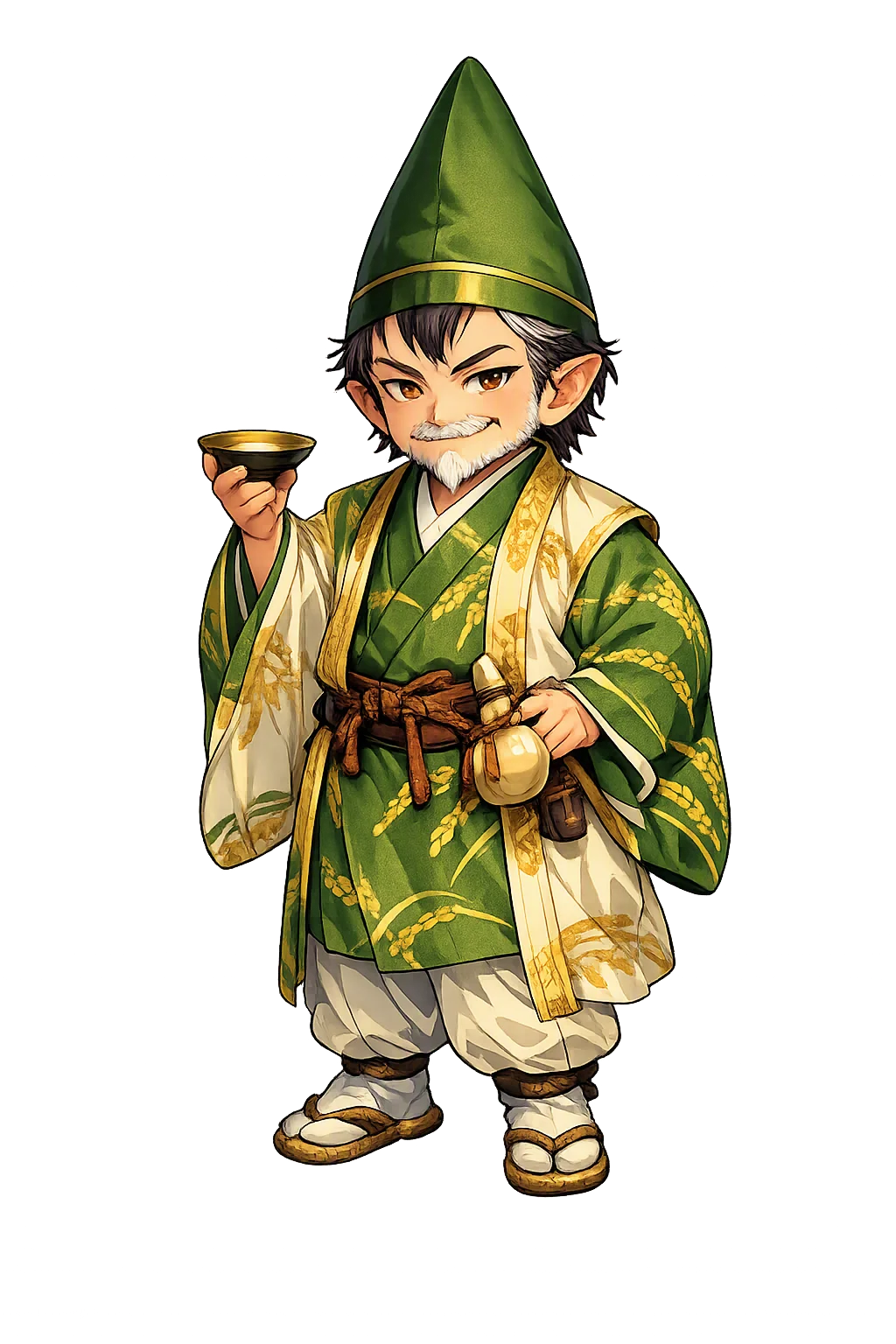
Why Sukunahikona is spelled that way — and what it costs to get it right
There is a version of this name the early internet had to settle for: sukunahikona. This is the file on how Sukunahikona replaced it.
Sukunahikona's dossier is small but perfectly formed: the Kojiki (712) and the Nihon Shoki (720) tell how a kami no bigger than a child crossed the sea in a bark boat, partnered the great Ōkuninushi, taught medicine and sake, and sailed away to the Everlasting Land. The lesson the sources keep pressing: size and power are not the same thing.
At a Glance
- Restored name: Sukunahikona
- ASCII form: sukunahikona
- Meaning: "Renowned little prince"
- Domain of influence: Healing, Sake, Smallpox
- Pantheon: Japanese
- Classification: Tier 2
- Original script: 少彦名神
- Series: The Restoration Files, No. 461 of 548
The Name Before the Marks
The name is attested as 少彦名神, in the attestation Kojiki, age-of-the-gods chapters (trans. Donald L. Philippi, Princeton University Press, 1968) and Nihon Shoki, age-of-the-gods chapters (trans. W. G. Aston, 1896) give us. On the evidence, it means "Renowned little prince".
Spoken, the name runs `/sɯ.kɯ.na.hi.ko.na/` — 'SOO-koo-nah-hee-koh-nah' — light, even syllables; the final vowels are soft.
The Temple That Stands Now
The restored name is not a plaque; it is an address. The temple of Sukunahikona lives at /sukunahikona/, with its mythology in the lore halls, its peer-reviewed record in the Scholarly Edition, and its place in the pattern atlas on the patterns floor.
One decisive feature survives — a single, honest mark — which places the restoration in Tier-2: exact, and exactly labeled.
Where the Name Stood First
No excavated sanctuary can be securely assigned to Sukunahikona; his presence is textual and cultic. The witnesses are the manuscripts: the Kojiki survives in the Shinpukuji manuscript of 1371–72 and later copies, the Nihon Shoki in twelfth-century and later codices — the oldest stratum of Japanese prose. On the ground, Sukunahikona Jinja in Ōsaka's Horie district preserves his living cult amid the warehouses of the old medicine market, a rare case of a shrine and the trade it protects growing up together. Offerings of model sake barrels at brewing shrines across Japan extend the evidence from paper to practice. The temple on the web is the newest of these addresses — the first one that fits in a pocket.
The Archetype at Work
The pattern atlas seats this temple in 3 industries, each match argued and weighted: Food & Hospitality (the small prince of sake; brewing is his gift.); Healthcare, Pharma & Medicine (the renowned little prince of healing and smallpox; folk medicine still invokes his name.); Biotech, Longevity & Life Sciences (healing and smallpox mastery; the small divine prince of longevity lore.). The Resonance File reads those seats through the myths themselves.
In the Sacred Texts
The Japanese tradition is not a vibe; it is a library. The Sacred Texts collection holds Kojiki and Nihon Shoki — the primary sources the temple's scholarship is built on. The temple is the argument; the texts are the evidence.
The File Continues
The temple's founding dispatch tells the name's story; its Resonance File reads the myths into the industries; the blog index holds the whole archive.
Continue the series — previous file: Stýx (read it here) · next file: Sūnwùkōng (read it here).
The Restoration Files are written from the same canonical record as the temples themselves: the lexicon, the lore catalog, the pattern atlas, and the cited scholarly sources. If a file ever disagrees with its temple, the temple is right — tell us, and the file will be corrected.