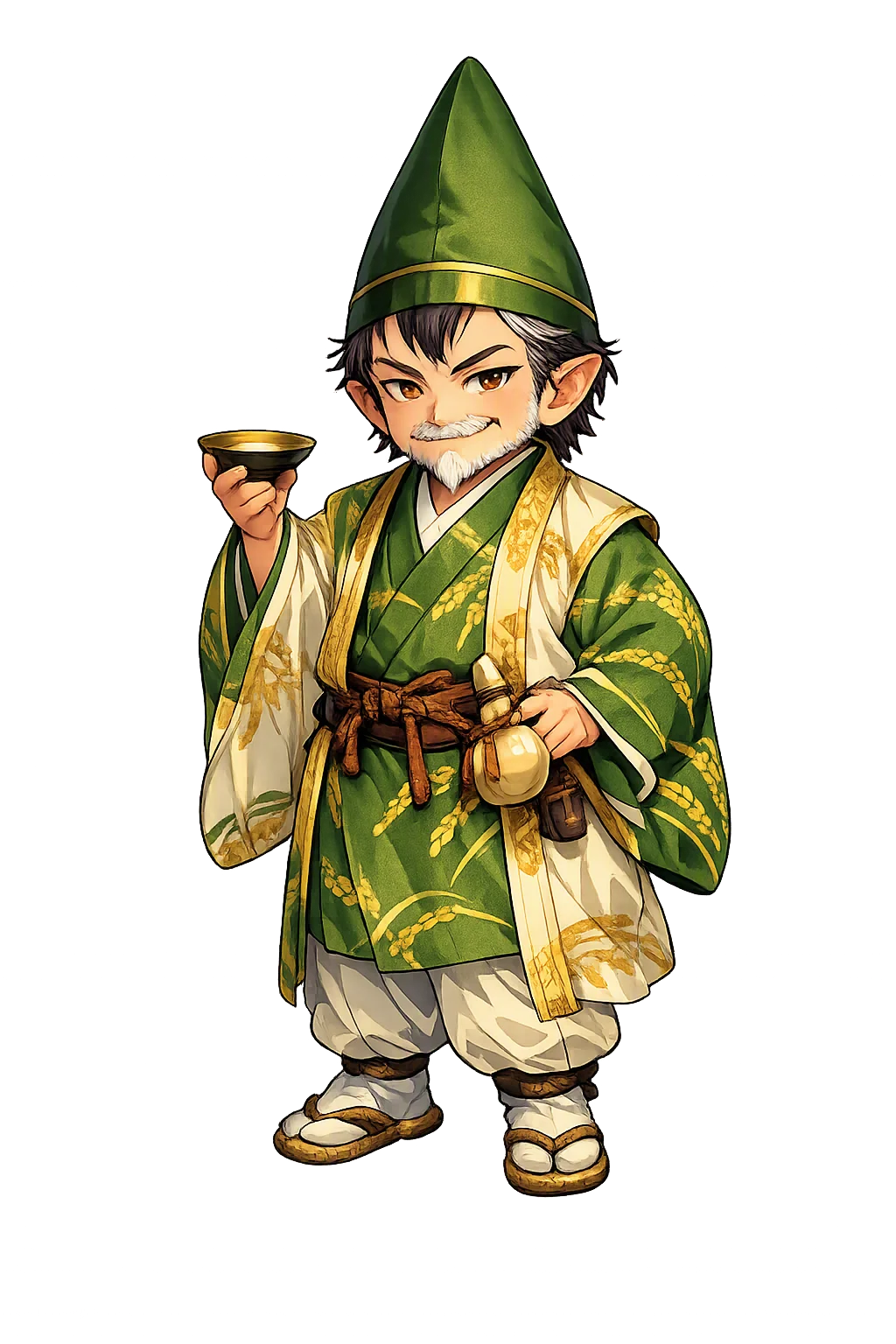
Stories of Sukunahikona
Sukunahikona's dossier is small but perfectly formed: the Kojiki (712) and the Nihon Shoki (720) tell how a kami no bigger than a child crossed the sea in a bark boat, partnered the great Ōkuninushi, taught medicine and sake, and sailed away to the Everlasting Land. The lesson the sources keep pressing: size and power are not the same thing.
The Kojiki ('Records of Ancient Matters', 712) tells how Ōnamuchi — the god later called Ōkuninushi, 'Great Renowned Lord' — stood on a beach in Izumo when a strange little boat came gliding over the sea. In it sat a kami small in body, and his boat was woven of muku bark. Ōnamuchi asked his name, and the small one answered: he was the son of Kamimusubi, one of the three creation deities, and his name was Sukunahikona, the Little Renowned Prince. Then came the exchange that defines the whole partnership: Ōnamuchi, who had struggled alone to make the wild land fit for people, asked, in effect, whether anyone would be his companion in that work — and Sukunahikona answered that this was why he had come. The meeting is the myth's thesis: the great lord had strength without knowledge, and the little prince had knowledge without strength; the land needed both. The Nihon Shoki ('Chronicles of Japan', 720) tells a parallel version with details of its own. (Kojiki, trans. Philippi, 1968; Nihon Shoki, trans. Aston, 1896.)
Together the two set about the work the Kojiki calls making and pacifying the land. Ōnamuchi brought the authority — he had survived Susanoo's trials by fire and serpent and the malice of his eighty brothers — and Sukunahikona brought knowledge: the two traveled the islands fixing boundaries, subduing hostile kami, and settling where rivers, rocks, and forests would belong to people. The Kojiki gives the partnership no single set-piece battle; its point is duration — the long, unglamorous labour of turning wilderness into a country. When the work was done, the land had shrines where none had been and fields where none had grown. Later ages read the pair as a charter for Japanese rule: sovereignty as collaboration between visible majesty and hidden craft, the great lord above and the little prince below — a division of labour the Kojiki quietly credits with everything that made Japan habitable.
Before he left, Sukunahikona gave the two arts for which he is still worshipped. The Kojiki credits him with teaching humanity the way of healing disease and the way of brewing sake — medicine and wine, the twin consolations of the mortal condition. Sake in particular became the bridge between worlds: the offering that eases speech between humans and kami. His medical patronage deepened in later centuries, when epidemic disease, above all smallpox (hōsō), made his name a household word; the tiny prince who came in a bark boat became one of the kami most often petitioned when illness struck, and his Ōsaka shrine in the old medicine quarter of Horie still draws those praying for health. The pairing is older than any shrine: a god who heals and a god who brews are one god, because both trades turn perishable things — grain, herbs, time — into comfort.
The Kojiki closes the partnership with a farewell. Sukunahikona climbed into his little bark boat and sailed away over the horizon to Tokoyo-no-kuni, the Everlasting Land across the sea, the country from which he had come. Ōnamuchi watched him go and grieved aloud: with his companion gone, how could he alone complete the work of the land? In his loneliness he built a palace for the absent prince and enshrined him there, so that departure became enshrinement — the myth's own explanation of how a god who left Japan can still be worshipped in Japan. Every reading must face the quiet poignancy of the scene: the helper deities of the age of the gods do not stay; they equip the land and withdraw, leaving mortals to carry on with what they were taught. That withdrawal is the hinge between myth and history.
Healer, Sake-Maker, and Shaper of the Land
Sukunahikona is a tiny kami with enormous power. Floating to Japan in a boat of bark, he met Ōkuninushi and helped him pacify and cultivate the land. He taught the arts of healing and sake-making, and he became a protector against smallpox and illness. His small size makes him a deity of the overlooked and the underestimated.
The Kojiki calls him a kami 'small in body'; in his bark boat he crossed the sea and became Ōnamuchi's indispensable companion.
He taught the curing of disease, and later centuries invoked him against smallpox and epidemic.
He taught the brewing of sake, the offering that mediates between humans and kami.
With Ōnamuchi he pacified the land, set boundaries, and made the world fit for people.
From the original script to the living URL
少彦名神
The name in its original Japanese form. Sukunahikona (少彦名神) is attested in the source tradition — “Renowned little prince”. Its original diacritics and script distinctions carry the full phonetic and orthographic weight of the source tradition.
sukunahikona
The plain sukunahikona form is identical to the Unicode restoration. Because this name is already written in Latin letters, no diacritics, stress, or script information were lost — only capitalization differs.
Sukunahikona
The Unicode restoration does not need to recover lost marks for Sukunahikona. Its value is canonical spelling and consistent cataloguing, not the reconstruction of erased orthography. The domain is readable as-is to both DNS and humanity.
Sukunahikona.com
This restoration is written entirely in ASCII letters — no Punycode encoding stands between Sukunahikona and the DNS. The domain reads identically to machines and to human eyes.
Owned, ideal, and ASCII forms of Sukunahikona
Sukunahikona
Restores 少彦名神. The full Unicode restoration. sukunahikona.com is not in the PuniCodex collection — it is watched for release; if it drops, this temple upgrades to an owned flagship.
How Sukunahikona was spoken
How Sukunahikona is preserved in writing
A bespoke provenance study for Sukunahikona is being prepared by the PUNICODEX scholarly team.
Contribute scholarly provenance →The lore you have read is the living myth. Extended Lore opens the scholarly vault beneath it: the cult and its material remains, a history of the image, the name after antiquity, a meditation on what the name still means, and the full scholarly apparatus — etymology, orthography, sources.
Enter Extended Lore