
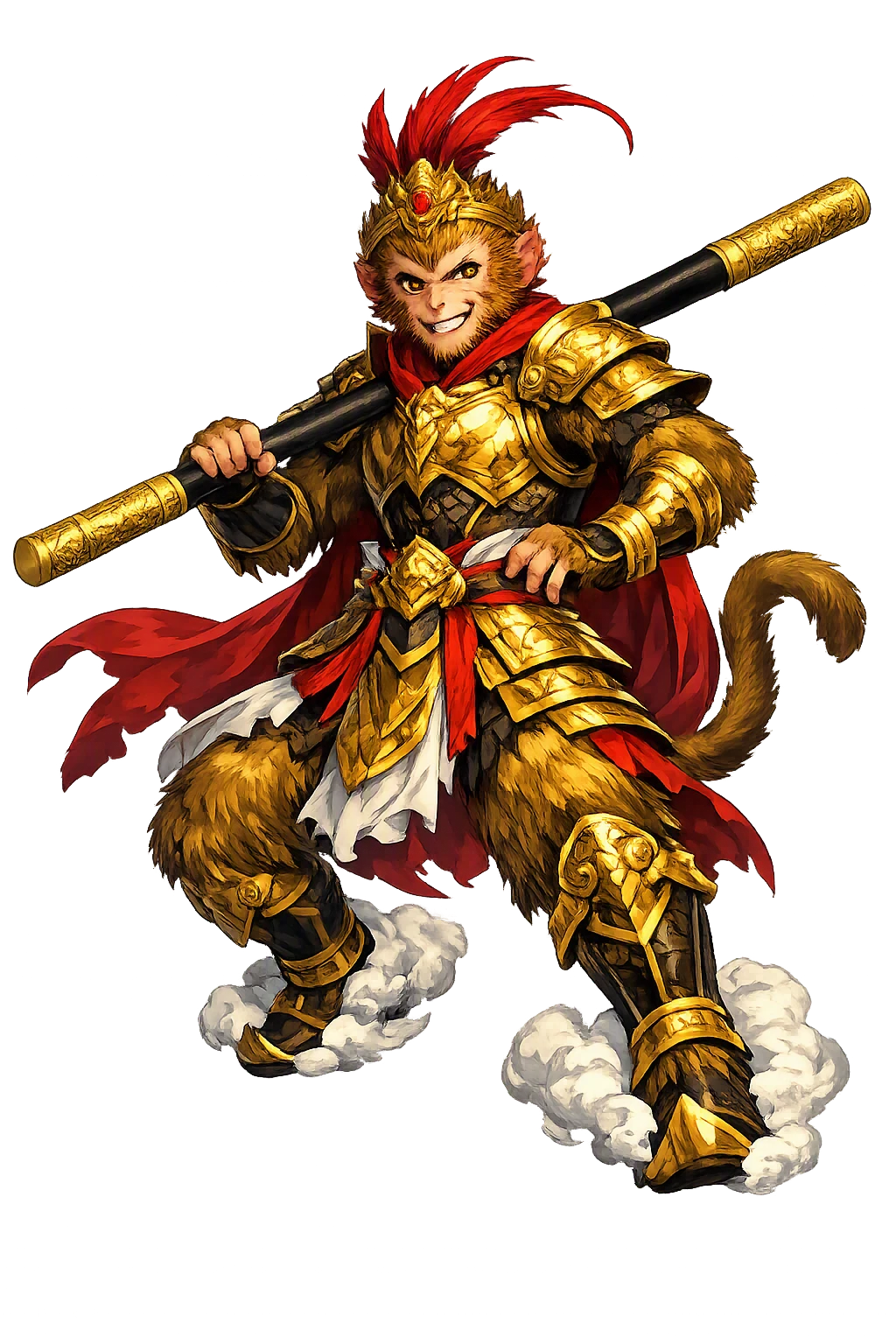
Why Sūnwùkōng is spelled that way — and what it costs to get it right
There is a version of this name the early internet had to settle for: sunwukong. This is the file on how Sūnwùkōng replaced it.
The Monkey King's story is China's great comic epic of self-mastery: born from a stone egg, tutored in the arts of immortality, at war with heaven itself — then bound to a monk and set on a road that turns the cosmic delinquent into a Buddha. Every age has read its own rebellion in him.
At a Glance
- Restored name: Sūnwùkōng
- ASCII form: sunwukong
- Meaning: "Monkey awakened to emptiness"
- Domain of influence: Monkey King, Chaos, Enlightenment
- Pantheon: Chinese
- Classification: Tier 1
- Original script: 孙悟空
- Series: The Restoration Files, No. 462 of 548
The Name Before the Marks
The name is attested as 孙悟空, in the attestation Wu Cheng'en (attrib.), Xīyóujì (Journey to the West), 1592 Shidetang edition and Dà Táng Sānzàng qǔjīng shīhuà (Poetic Tale of Tripitaka's Pilgrimage), Song give us. On the evidence, it means "Monkey awakened to emptiness".
Strip Sūnwùkōng to sunwukong and 3 pieces of evidence vanish:
- u → ū — Macron: long vowel: the vowel length the ASCII form cannot show.
- u → ù — Grave tone mark: the stress position the ASCII form cannot show.
- o → ō — Macron: long vowel: the vowel length the ASCII form cannot show.
These are the small, provable things a restoration is made of: not taste, not branding — attestation.
Spoken, the name runs `/su˥n u˥˩ kʊŋ˥/` — sOON-oo-KOHNG — first syllable high and level like a held note, middle syllable falling away sharply, last high and level again; the 'o' of kōng is like the 'oo' in 'book'.
The Temple That Stands Now
The restored name is not a plaque; it is an address. The temple of Sūnwùkōng lives at /sunwukong/, with its mythology in the lore halls, its peer-reviewed record in the Scholarly Edition, and its place in the pattern atlas on the patterns floor.
The restoration preserves more than the ASCII form can express — stress, length, or a letter the Latin keyboard lost — which places it, mechanically, in Tier-1.
Where the Name Stood First
Wùkōng's material record tracks the novel's. The earliest narrative stratum is the Song Poetic Tale of Tripitaka's Pilgrimage; the Ming zaju play was preserved in part through the Yongle Encyclopedia; and the 1592 Shidetang woodblock edition of Journey to the West is the earliest extant complete text. The cult beneath the literature is older than the novel: a Song-dated stone shrine at Baoshan, Shunchang County, Fujian, dedicated to Qítiān Dàshèng and his brother Tōngtiān Dàshèng, is among the earliest material evidence of the Great Sage's worship — decades, at least, before the novel fixed his story. Qítiān Dàshèng temples remain active across Fujian and Taiwan, where the Great Sage's spirit-medium rites are among the most dramatic survivals of Chinese popular religion. The temple on the web is the newest of these addresses — the first one that fits in a pocket.
The Archetype at Work
The pattern atlas seats this temple in 7 industries, each match argued and weighted: Gaming, Fantasy & Entertainment IP (the Monkey King stars in games across every platform, from MOBAs to action titles to mobile gacha.); Global Pantheon Brands (the Monkey King is one of the most widely recognized mythic figures across East and Southeast Asia.); Mythic Name Restoration (the Monkey King as a globally recognized figure whose pinyin tones matter in transcription.). The Resonance File reads those seats through the myths themselves.
In the Sacred Texts
The Chinese tradition is not a vibe; it is a library. The Sacred Texts collection holds Tao Te Ching — the primary sources the temple's scholarship is built on. The temple is the argument; the texts are the evidence.
The File Continues
The temple's founding dispatch tells the name's story; its Resonance File reads the myths into the industries; the blog index holds the whole archive.
Continue the series — previous file: Sukunahikona (read it here) · next file: Supay (read it here).
The Restoration Files are written from the same canonical record as the temples themselves: the lexicon, the lore catalog, the pattern atlas, and the cited scholarly sources. If a file ever disagrees with its temple, the temple is right — tell us, and the file will be corrected.